


- Free Article: Yes
- Contents Category: Opera
- Custom Article Title: Simone Young conducts Gurrelieder
- Review Article: Yes
- Article Title: Simone Young conducts Gurrelieder
- Article Subtitle: A splendid performance of Schoenberg’s 'opera'
- Online Only: No
- Custom Highlight Text:
What is Gurrelieder? Arnold Schoenberg’s massive cantata, or oratorio, or symphonic psychodrama, is technically a song cycle, presenting ‘Songs of Gurre’, a small Danish settlement best known for its crumbling medieval castle. A five-part sequence of naturalist poems, by the Danish ‘Modern Breakthrough’ writer and botanist Jens Peter Jacobsen, became the text of Schoenberg’s cycle, in a lacklustre German translation by Robert Franz Arnold, to which Schoenberg made few revisions.
- Article Hero Image (920px wide):
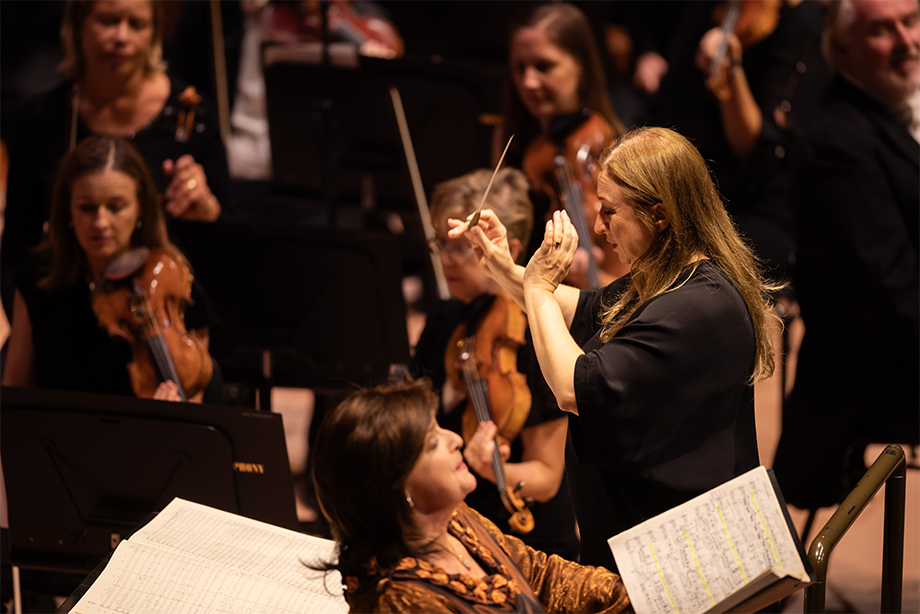
- Article Hero Image Caption: Simone Young conducts Gurrelieder (image courtesy of Sydney Symphony Orchestra, photograph by Dan Boud.)
- Alt Tag (Article Hero Image): Simone Young conducts Gurrelieder (image courtesy of Sydney Symphony Orchestra, photograph by Dan Boud.)
- Production Company: Sydney Symphony Orchestra
The concert’s conception, casting, and successful execution owe most to Sydney Symphony Orchestra’s conductor, Simone Young. Her musical carte de visite in recent times has gravitated towards Gustav Mahler, Richard Wagner, and Richard Strauss, three crucial influences upon the young Schoenberg. So rare still are this work’s performances that Young herself had not previously attended an actual live performance of it. Indeed, Sydney’s Gurrelieder project became a veritably federal one, with SSO’s playing strengths being buttressed by young stars from the Australian National Academy of Music, in Melbourne. The muster call for chorus members was answered by contingents, mainly of tenors and basses, from Melbourne and Hobart, not to overlook the massed resource of the Sydney Philharmonia Choirs.
Schoenberg, like Mahler, uses this huge assemblage of instruments and voices to explore many exquisite, sometimes unique, blends of timbre. It is only in Gurrelieder’s last few minutes that he pulls out all stops in his (and Jacobsen’s) glorification of the rising of ‘the colourful sun’: ‘she rises, smiling, from the waters of the night, and a splendour of radiant curls flies from her clear forehead’.
 Simone Young conducts Gurrelieder (image courtesy of Sydney Symphony Orchestra, photograph by Dan Boud.)
Gurrelieder, then, involves a medley of mainly solo songs, interspersed with orchestral interludes, introductions, and tailpieces. Unlike in a Lieder recital, these songs are placed in a rich, luscious, Wagnerian orchestral sea of continuous sound. It surges around and sometimes its higher waves challenge the outpourings of the most Helden of tenors, or most coloratura of sopranos. Young’s pick of the work’s half dozen soloists was superb: her two lovers Waldemar (Simon O’Neill) and Tove (Ricarda Merbeth) possess the height, the power, and the untrammelled grandeur that Schoenberg demands for his Danish King and his adored and adoring lover. Their ability to cut right through this massed orchestral texture was never in doubt. O’Neill’s more interpretative virtues were most evident in the work’s mid-point crux, Waldemar’s rebuke to the Lord God himself, ending with ‘Permit me, Lord, to be your Fool’. Equally impressive was the darker-hued mezzo-soprano voice of Deborah Humble, as the chatty Wood Dove. In the longest of Schoenberg’s songs, she reports on the deadly revenge of Waldemar’s Queen upon his husband’s illicit lover, and even announces her own impending fate through the outraged Queen’s action.
The three cameo roles, appearing in single song numbers in the work’s ghastly, ethereal third part, The Wild Hunt, were, by contrast, less high-flown. They required more modest, albeit still desperate, utterances from Sava Vemić as Peasant, Andrew Goodwin as Fool, and Warwick Fyfe as Speaker. However, Goodwin’s beautiful voice was, in its lower registers, simply overwhelmed on occasion by Schoenberg’s glutinous orchestration. Fyfe’s attempt at the speech-song style (Sprechgesang), specified by Schoenberg, certainly well conveyed its crazed purpose, but was too close to the ‘song’ end of the speech-to-song spectrum, thereby sometimes pushing the Speaker’s serious reportage of ‘the summerwind’s wild chase’ towards parody.
Amid the hubbub about Schoenberg’s adoption of an atonal approach to composition – a small step in his mind, undoubtedly, but ‘a giant leap for mankind’ as it turned out – within the time frame of his composition of Gurrelieder, it is often forgotten just how magnificent a craftsman Schoenberg was. His analytical yet imaginative command of form, style, harmony and counterpoint, instrumentation, and text-setting are all on display within the dazzling texture of this complex work. In fact, Schoenberg totally seduced his Viennese audience, which had hitherto rather loved to hate him.
It is in the orchestral writing and the sinewy parts for Gurrelieder’s three male choirs that Schoenberg’s compositional expertise is most apparent. The orchestra’s constant presence, as in Wagner’s later operas, is like an unpunctuated psychodrama, reflecting in its mélange of disparate motives and themes the inner musical narrative, to the meaning of which the ‘libretto’ makes its occasional, and often simplistic, reference. Schoenberg’s music has the flow, the swing, the shock, and the subtlety that surpass anything that words alone can attempt, however sung or chanted. Had Schoenberg continued in this vein he might have surpassed Wagner, or Mahler, in becoming the final exemplar of late-Romantic ultra-expressionism. But that would not be his direction: ‘I was not destined to continue in the manner of … Gurrelieder … The Supreme Commander had ordered me on a harder road.’ And so it was.
There were two heroes of this spectacular Sydney production of Gurrelieder: Schoenberg, and Simone Young, who made it all possible. Throughout nearly two hours, she held her massed forces tightly. Her smooth, incisive, at times athletic direction paid particular attention to the work’s nuances, to the balance of voices with instruments, and to projecting the work’s larger-scale architecture. Like an organist, her footwork was as purposeful as her upper-body and hand directions. While I am sure many in the audience were just gob-smacked by the sheer effrontery and over-the-top decibels of Schoenberg’s huge work, no one surely could be anything less than admiring of Young’s flawless musicianship, inspired interpretation, and sheer resilience.
As reported verbatim by Limelight (19 February 2024), Young envisioned three challenges in bringing her Gurrelieder to pass: ‘to keep 10 percent of yourself outside this orgiastic orchestral sound’, to ensure a cool-headed steerage of the enterprise; ‘to create a transparency of sound’ that always leads ‘the listener’s ear’ from one vocal-instrumental soundscape to the next; and, first of all, to ‘conduct the work as an opera because architecturally it is an opera’.
Is Gurrelieder, then, best approached as an opera? Indeed, has it ever been produced as an opera? And, yes, it was Pierre Audi, the French-Lebanese director, and conductor Marc Albrecht, who first put Gurrelieder on the stage, at the Dutch National Opera in Amsterdam on 16 September 2014, set amid a ‘poisonous’ industrial landscape, echoing the decadence of 1910s Vienna. It was a splendid achievement – I was honoured to be there – and revived in 2018. Given the ovations of this weekend’s bold Sydney initiative, might we one day not invite Young to the Joan Sutherland Theatre to demonstrate Gurrelieder, as the opera she believes it architecturally is? But first we might have to work out where to put the gargantuan orchestra, the four choirs, and, of course, the appreciative audience.
Simone Young’s Gurrelieder (Sydney Symphony Orchestra) was performed on 15 and 16 March 2024 in the Concert Hall, Sydney Opera House. Performance attended: 15 March.