


- Free Article: No
- Contents Category: Theatre
- Custom Article Title: Gaslight
- Review Article: Yes
- Article Title: Gaslight
- Article Subtitle: A turgid little melodrama
- Online Only: No
- Custom Highlight Text: Patrick Hamilton’s play Gaslight (1938) surely ranks as the least likely cultural touchstone of our age. A middling melodrama about a suspicious husband, a nervy wife, and some dramatically expedient lost jewels, it made a minor splash on Broadway before being adapted twice for the screen, the second starring Ingrid Bergman and Charles Boyer in 1944 (Bergman won her first Oscar in the role). Decades passed and the work was largely forgotten, until the play’s title resurfaced as a byword for a particular category of coercive control.
- Article Hero Image (920px wide):
.jpg)
- Article Hero Image Caption: Toby Schmitz as Jack and Geraldine Hakewill as Bella (photograph by Brett Boardman)
- Alt Tag (Article Hero Image): Toby Schmitz as Jack and Geraldine Hakewill as Bella (photograph by Brett Boardman)
- Production Company: Rodney Rigby for Newtheatricals in association with Queensland Theatre
Wright and Jamieson, and director Lee Lewis and her cast in turn, ignore this inconvenient fact in the hope it might go away, and the result is disastrous. Hamilton’s only other hit, Rope (1929) – adapted for the screen by Arthur Laurents and directed by Alfred Hitchcock in 1948 – employs an ingenious and satisfying dramatic irony, deriving its suspense from the audience’s knowledge that the body is in the chest all along. In Gaslight, the audience’s knowledge is a kind of undramatic irony, like a blanket over a fire.
Bella (Geraldine Hakewill) has been married to Jack (Toby Schmitz) for little over a year. Cracks in the relationship are already emerging in the form of small disappearances, apparent slips in memory. A portrait of the previous owner of their house, murdered for the precious stones she kept hidden, is taken off the wall and placed under the stairs, for no apparent reason. When Bella’s late mother’s pearls go missing, the staff – staunch housekeeper Elizabeth (Kate Fitzpatrick) and surly newcomer Nancy (Courtney Cavallaro) – are accused, but deny any wrongdoing. Since it can’t possibly be Jack, it follows that it must be Bella herself. Most disturbing of all are the noises coming from the sealed attic and the inexplicable dimming of the gaslights in the house, which only occur when Jack is out.
The first act consists of a series of oscillations between uneasy calm and ratcheting anxiety, as Bella tries to rationalise her seemingly irrational behaviour and Jack ‘frets’ about her mental acuity. It is only as the act closes, and Bella discovers the pearls hidden in her husband’s desk drawer, that something shifts and a battle between conflicting viewpoints looms. This is where Wright and Jamieson’s adaptation diverts from the original, which imagined a detective who cottons on to Jack’s perfidy and rescues Bella. In this telling, no one else is coming – she’ll have to rescue herself.
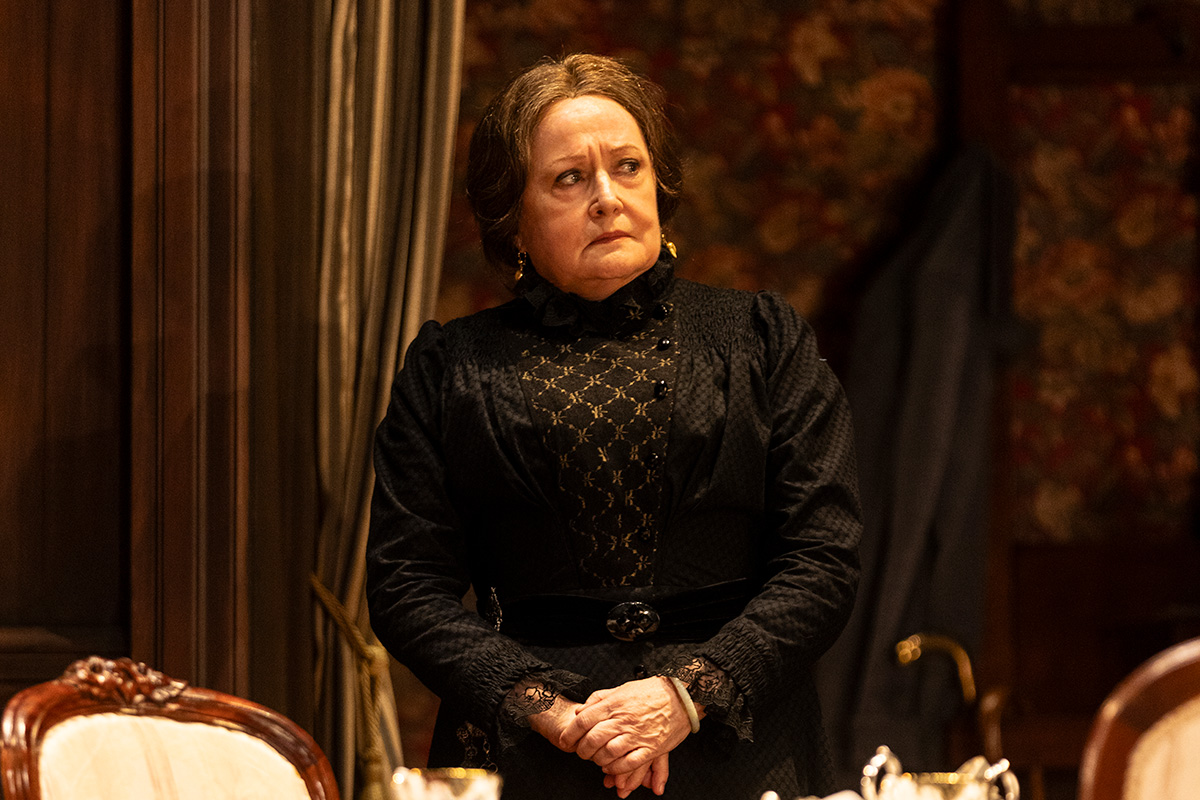 Kate Fitzpatrick as Elizabeth in Gaslight (photograph by Brett Boardman)
Lewis is an excellent director of actors, and she gets finely articulated performances from the cast – at least until the lunacies of the plot tilt the play into outright silliness. Hakewill is a commanding lead, distraught and distracted before the horrible realisation hits her, steely and shrewd afterward. Fitzpatrick is hilariously impervious as the housekeeper, withering about protocol but cool in a crisis. Cavallaro is sanguine and snarly as the improbably rude maid – a role in which Angela Lansbury made her film début. And Schmitz, who deserves a more nuanced and psychologically credible part, hams up the villainy of Jack, the jowls and the big eyes bringing to mind a bloodhound on the scent.
Most impressive is the design. Renée Mulder’s set is a meticulous and highly considered work of naturalism that seems to physically oppress Bella, even while it entrances the audience. Paul Jackson’s superb lighting is so convincing and responsive it feels like the fifth character in the play, and Paul Charlier’s sound is restrained on the one hand and explosive on the other. If the mise en scène isn’t quite as revolutionary as Ian McNeill’s for the National Theatre’s revival of J.B. Priestley’s An Inspector Calls (1992), it suggests how good a complete overhaul of the play might have been.
Adding some spunk and agency to the role of Bella certainly helps modernise Gaslight, but it’s not enough to drag this otherwise turgid little melodrama into the twenty-first century. Gaslighting is an insidious, layered, and elaborate form of psychological abuse, a way of further disenfranchising powerless people. It can be an extension of domestic violence, but it can also be perpetrated on a people, a culture. An adaptation of Hamilton’s play that took our understanding of this behaviour into deeper, more disturbing waters might have been electric. As it stands, with its hoary contrivances of plot and wooden characterisations, it feels like the final reflexes of a moribund work of art, something we have well and truly left behind.
Gaslight (Rodney Rigby for Newtheatricals in association with Queensland Theatre) continues at the Comedy Theatre in Melbourne until 24 March 2024 before continuing its national tour. Performance attended: 8 March.