


- Free Article: No
- Custom Article Title: The Threepenny Opera
- Review Article: Yes
- Article Title: The Threepenny Opera
- Article Subtitle: Barrie Kosky ‘makes it new’ with Brecht and Weill
- Online Only: No
- Custom Highlight Text:
The enduring popularity of The Threepenny Opera is often attributed to Kurt Weill’s music rather than Bertolt Brecht’s text. As director Barrie Kosky notes with characteristic hyperbole in the Adelaide Festival program for his new production with the Berliner Ensemble: ‘Weill … is as important for the history of music theatre as Wagner.’
- Article Hero Image (920px wide):

- Article Hero Image Caption: The Threepenny Opera (courtesy of Adelaide Festival/Berliner Ensemble)
- Alt Tag (Article Hero Image): The Threepenny Opera (courtesy of Adelaide Festival/Berliner Ensemble)
- Production Company: Berliner Ensemble/ Adelaide Festival
Kosky’s own work as a director is a stylistic hybrid of Expressionism and pantomime. His productions celebrate vitality and sex but are fascinated by morbidity and death. He also refuses to separate high culture from popular entertainment: a refusal he shares with Brecht and Weill, and which has made him one of the most successful opera directors in the world today.
In his staging of The Threepenny Opera, Kosky’s love of vaudeville is reflected in Rebecca Ringst’s minimalist set and Ulrich Eh’s lighting with its extensive use of follow-spots.
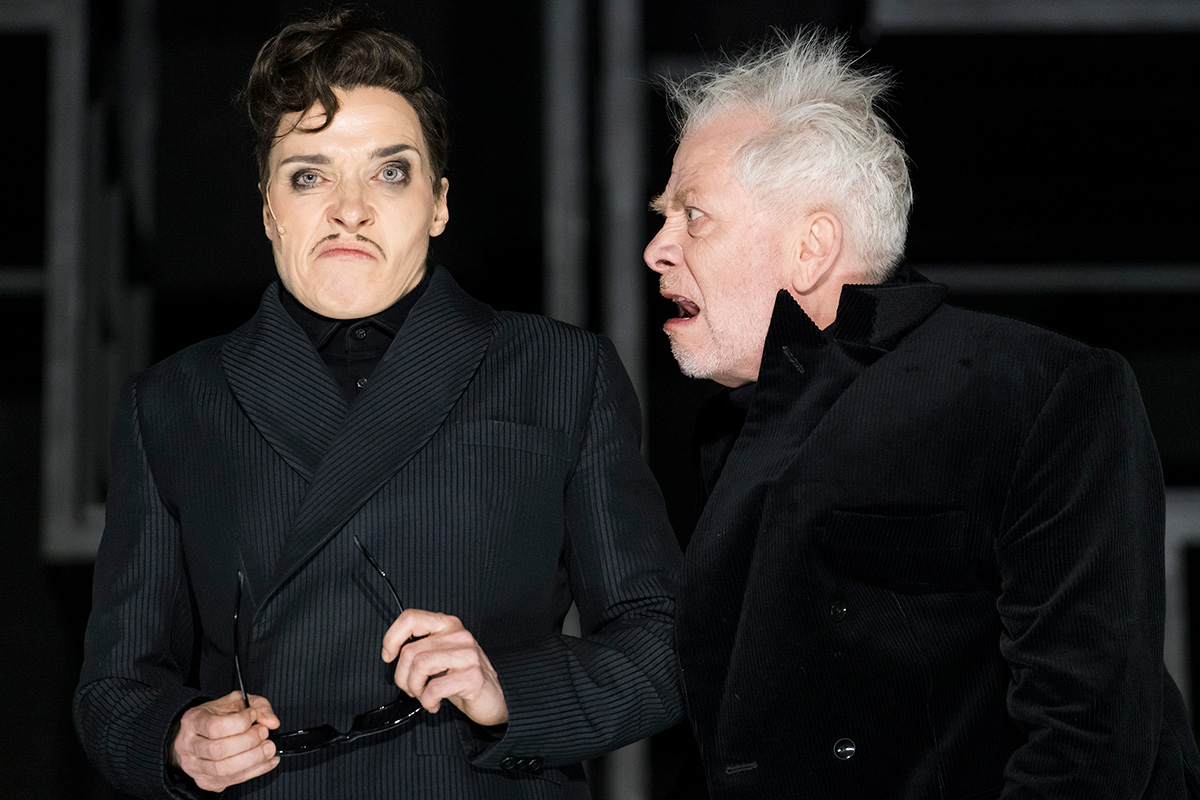 The Threepenny Opera (courtesy of Adelaide Festival/Berliner Ensemble and photograph by Jörg Brüggemann)
An enormous glitter curtain initially masks the stage, through which characters and body parts peep and emerge, beginning with the face of Dennis Jankowiak/Heidrun Schug as ‘The Moon Over Soho’ singing ‘The Ballad of Mack the Knife’, and followed by the dangling legs of Tilo Nest as the world-weary ‘controller of beggars’ Jonathan Peachum.
The Expressionist ‘flesh’ (or rather ‘bones’) behind the vaudevillian mask is revealed as soon as the curtain goes up, exposing a mostly empty stage apart from a huge climbing frame of ladders, platforms and apertures, which the performers ascend and descend, perch on and crawl through while acting and singing, in a manner that increasingly resembles a Kafkaesque circus.
The cast inhabit their roles in a broadly vaudevillian style, their performances becoming more frantic and animalistic throughout the show. Gabriel Schneider is outstanding as the coolly seductive killer Macheath (or ‘Mack the Knife’); Kathrin Wehlisch is similarly striking as his friend and betrayer, the Police Chief ‘Tiger’ Brown. The latter’s physicality mimics Chaplin’s ‘Little Tramp’, while the presence of sexual and gender ambiguity in the role echoes Macheath’s own shape-shifting nature, with its underlying hint of polymorphous perversity.
Laura Balzer’s portrayal of Brown’s daughter Lucy has a similarly burlesque energy. Cynthia Micas as Polly Peachum and Constanze Becker as her mother Celia Peachum embody their roles with more glamour; Becker’s laid-back rendition of the famous ‘Ballad of Sexual Obsession’ is one of the show’s highlights. Dinah Ehm’s contemporary costumes are mostly in black-and-white apart from lurid colours for Polly, Lucy and the prostitute Jenny (who is played by Julia Berger as arguably the only character with a shred of dignity in the show).
Musically, a similar sense of Expressionist vaudeville prevails. Conductor Adam Benzwi (who also plays piano and harmonium) leads a seven-piece band all playing multiple instruments, as per the original 1928 performance of the score. Benzwi plays fast and loose with the tempos, and extracts some ferocious timbres from the band, all which lends the music an extra degree of harshness and spontaneity. The overall singing style is similarly raw and unrefined – more reminiscent of Lotte Lenya than Ute Lemper or Teresa Stratas.
One of the most striking elements in the production is the interaction between stage and pit. Macheath enlists the musicians as members of his criminal band, asks them to play at his wedding, and at one point grabs a handful of the score from Benzwi, tears it up and sets fire to it in a metal bin. Later, he uses the top of Benzwi’s piano as a miniature thrust stage to sing and dance on. Kosky is similarly free with the score and libretto, chopping and changing or reprising numbers to suit his needs. Musically and dramatically there’s a sense that the entire work is being made anew.
In this light, Peachum’s commercialised begging company becomes not simply a metaphor for monopoly capitalism (as it was for Brecht) but a meta-theatrical reference to the culture industry, increasingly forced to ‘make things new’ or recycle old material in new disguises to satisfy the market. Kosky’s production reflexively points to itself as a cog in the machine, and the audience becomes complicit in the charade.
It’s this layer of cynicism (which is admittedly also present in Brecht) that ultimately drags things down. Kosky’s relentlessly parodic staging is untrue to his own musical premises and misses the note of ambiguous longing in Weill’s score as well as Brecht’s text. Macheath and Jenny’s ‘Love Song’ (‘Look at the moon over Soho’) may be trite (and even false on Macheath’s part) but it also contains an element of heartache and truth: ‘For love will endure or not endure / No matter where we are.’ Similarly, the finale at the end of Act One may end with the refrain: ‘The world is poor and man’s a shit, / And that’s all there is to it’; but it also contains the words ‘Who wouldn’t want an earthly paradise? / But our condition’s such it can’t arise.’ Without this tension – between despair and hope, falsity and truth, desire and fulfilment – The Threepenny Opera loses its hold on us.
The Threepenny Opera (Berliner Ensemble/ Adelaide Festival) continues at Her Majesty’s Theatre until March 10. Performance attended: 7 March 2024.