


- Free Article: No
- Contents Category: Television
- Custom Article Title: Nemesis
- Review Article: Yes
- Article Title: Nemesis
- Article Subtitle: A morbidly fascinating ABC docuseries
- Online Only: No
- Custom Highlight Text: Each episode of Nemesis, the ABC’s morbidly fascinating three-part retrospective series on the Abbott-Turnbull-Morrison governments of 2013-22, begins with a word association game. The ensemble of parliamentarians and former ministers is asked to describe the three featured prime ministers in a single word. Tony Abbott is called, among other things, ‘strong’, ‘negative’, ‘clever’, ‘dishonest’, ‘aggressive’, and ‘disciplined’, and, in the words of former deputy prime minister Barnaby Joyce, ‘pugilistic and [someone who is] also willing to] give you a hug’.
- Article Hero Image (920px wide):
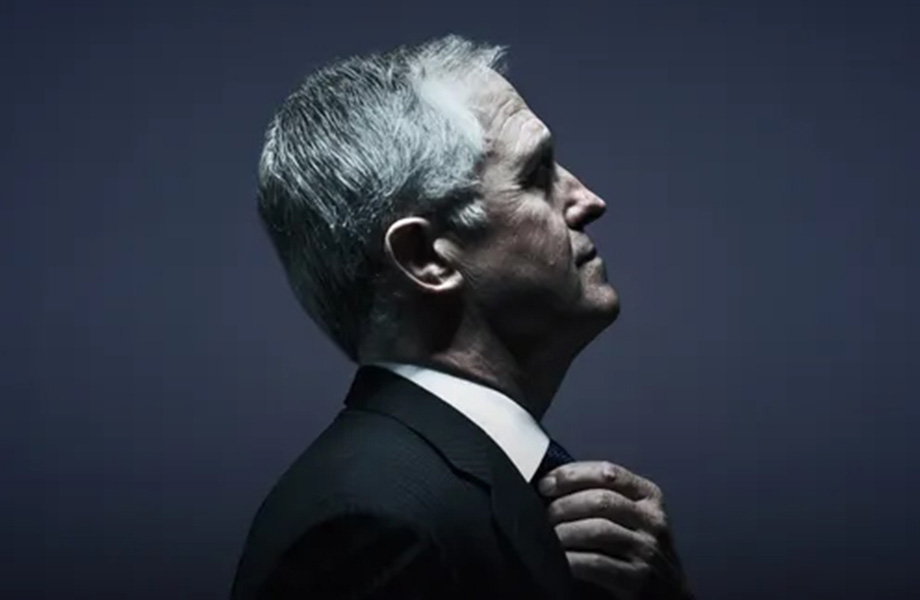
- Article Hero Image Caption: Malcolm Turnbull in Nemesis (courtesy of Australian Broadcasting Corporation)
- Alt Tag (Article Hero Image): Malcolm Turnbull in Nemesis (courtesy of Australian Broadcasting Corporation)
- Production Company: Australian Broadcasting Corporation
The same single-word device was earlier used by the creators of another ABC documentary series, The Howard Years (2008), with markedly different effect. Everybody was either generous or diplomatic, save for the melancholic former treasurer Peter Costello, who called Howard ‘relentless’. The respectable portrait shots and the measured, erudite vocabularies of yesteryear are superseded in Nemesis by intimate close-ups that capture every tortured sigh, every pulsation of the temporal vein as the interviewee struggles to repress some profanity. The differences reflect the rapid intensification of emotional conflict in Australian politics in the intervening years. That emotional conflict makes for compulsive television, if not for good government.
Episode one follows the Abbott government from its election in 2013, through its corrosive 2014 budget, the awarding of a knighthood to Prince Philip, the development of Robodebt, and the duplicitous debate about same-sex marriage. That debate is resolved (though not without an argument between Turnbull and backbench MP Warren Entsch about who could claim the most credit) in the second episode, which also revisits the close-run 2016 election, Turnbull’s handling of President Donald Trump, the Barnaby Joyce-Vikki Campion affair, and the ongoing argument over climate change and energy policy. The third episode covers the Morrison years (the latter three, at least), with a focus on the Black Summer bushfires, the Covid-19 pandemic, the formation of the AUKUS agreement, and the political mobilisation of women against the Coalition leading up to its defeat at the May 2022 election. Up to thirty per cent of the first two episodes is devoted to the leadership ructions of 2015 and 2018, which brought Turnbull and Morrison to the leadership respectively.
The focus on ambitions and emotions in Nemesis, along with the calculated choice of locations for interview backdrops, gives the impression of a Shakespearean drama. The interviewees invoke Shakespeare up to half a dozen times, as if to say that no matter how poor their performance in office, this performance on screen is worthy of the bard. But Shakespeare would never have written a play with a dramatis personae so lacking in redeeming features. Also, if he were scripting Nemesis, there would have been more deaths.
The series was presented partly as tragedy, and more realistically as ‘revelation’, that most modern of political commodities. But in fact, nearly everything in the series has been written, published, or broadcast already. Journalists such as Niki Savva and David Crowe have published book-length accounts of the Liberal Party’s repeated acts of self-destruction, and leading participants such as Turnbull and Christopher Pyne have told their stories in the form of (noticeably less candid) memoirs. Four Corners produced an excellent account of the Turnbull government’s downfall in 2018, and even Sky News has had a go with a disturbingly deficient program called Liberals in Power. The real value of Nemesis is its capacity to bring existing stories together and to pit them against one another under the glare of the spotlight, before a large national audience.
Revelatory it may not be, but it certainly is emotional. It keeps faith with an ABC tradition that dates back to Labor in Power (1993), in which serving ministers could be seen calling Bob Hawke a ‘gormless little shit’. In Nemesis, Entsch says that Abbott sanctioned ‘abuse’ in the party room, and ‘didn’t deserve to be a prime minister’. Joyce calls Turnbull a ‘shithead’ for his grandstanding press conference about the former’s extramarital affair. (Turnbull almost concedes the point, then watches the archival footage and decides that he was right after all.) The former prime minister cattily remarks that Mathias Cormann has ‘gained weight’ since departing Canberra for Paris in 2020. Backbench MP Bridget Archer, a powerful voice for moderates in this program, accuses Morrison of ‘coercion and control’. Mark Willacy, the program’s creator, has done a first-class job of presenting to us the intimate brutality and emotional violence that shape Australian political life.
The creators have also succeeded in placing gender at the heart of the story. There is the Abbott Cabinet, with just one woman in it; the argument about his powerful chief of staff, Peta Credlin; the bullying of women MPs during Peter Dutton’s push for the leadership in 2018; Morrison’s parliamentary tirade against Australia Post CEO Christine Holgate; and the myopic response to Brittany Higgins’s alleged rape in Parliament House, followed by the nationwide March4Justice in 2021. There is archival footage of Alan Tudge and Christian Porter to gesture to the ongoing discourse about male power and privilege in Canberra. Former minister Darren Chester verbalises the real problem when he says that ‘the issues surrounding women became something very difficult’ for the Coalition to manage. The ‘issues surrounding women’ were, of course, men. Nemesis treats some of these men with a light touch (Barnaby’s affair stands in for many others), but it recognises that the story could not be told without gender as a central frame of reference.
The program brilliantly illustrates what so many felt during those years; that there was little at stake in the successive leadership conflagrations save for the game of winning. Policy is peripheral. The final episode, it is worth noting, dramatises arguments about Australia’s external and defence relationships, its response to the Covid-19 pandemic, its policy on global emissions reduction, and its ‘religious freedoms’. The earlier episodes are rightly disturbing, though, for the sheer absence of substantive policy in so much of the interpersonal conflict they portray. (The Abbott government was, after all, elected with a policy agenda which took the form of a little pamphlet called ‘Real Solutions’.)
The absence of policy is also, in part, an editorial choice. It can be hard to make gripping television out of a crop of white besuited men talking about Commonwealth-state relations or fiscal reform. Hard, but as Labor in Power and The Howard Years demonstrated, hardly impossible either. If a few self-gratifying testimonies had been trimmed, there might have been room to revisit important policy debacles that were left instead on the cutting room floor. (Think of the proposal to repeal provisions against hate speech in the Racial Discrimination Act, or the dogged refusal to call a Royal Commission into banking sector misconduct until renegade MPs forced the government’s hand, or the recognition of Jerusalem as the capital of Israel, timed to extract advantage in a domestic by-election.) The absence of these issues from the program is troubling, but probably suits the participants just fine.
If policies are boring, institutions must be even more so. But again, their omission leaves something to be desired. The Senate, for instance – a critical handbrake on the Abbott government – goes largely unacknowledged in the first episode. It was the High Court that inflicted the Section 44 dual citizenship saga on the Turnbull government and the country, a story which did not make the cut. Cabinet occupies a marginal place, except when people complain that it was leaking. Parliament is, in their minds, an irrelevance, such that it can be closed down to accommodate a leadership spill. Save for one or two talking heads like Martin Parkinson (Secretary of the Department of Prime Minister and Cabinet from 2015 to 2019), the public service is invisible. And were it not for the importance of state premiers during the pandemic, the states might have been, too. Again, these are partly editorial choices, and partly authentic reflections of the personalised way that we and our representatives have treated modern politics of late.
The decision to dispense with narrators and rely solely on interview quotes to drive the story seemed, to me, a Faustian bargain. According to Willacy, it was a crucial component of his pitch to the many suspicious and instinctively anti-ABC Liberal MPs, who wanted to know that this story would be told ‘in their own words’. It was an insurance policy, too: if MPs didn’t like the final product, they could scarcely call Ita Buttrose (former Chair of the ABC) and complain about their own words.
The cinematography is all the more important in the absence of narration. The editing is creative enough to facilitate empathy and distrust on the part of the viewer, sometimes in the same frame. When they really needed to, the editors have designed montages that signal duplicity and dishonesty, and the inclusion of text such as ‘Scott Morrison rejects any suggestion that he is a bully and has a problem with the truth’ is devastatingly effective. All of this sets the program apart.
But the sans-narrator strategy had costs, too. Sometimes, that cost was a lack of context. The voice-over in Labor in Power and The Howard Years was an important mechanism for contextual and analytical depth. Nemesis valorises testimony and intimacy, but a breadth of vision is lost along the way.
In the end, I was still hungry for further interrogation. Sarah Ferguson has described her interviews with Kevin Rudd and Julia Gillard for the excellent series The Killing Season (2015) as a ‘battle of semantics’. When Willacy was asked recently about his interviews, he explained that the participants sometimes talked at length, uninterrupted. This affords much room for empathy, but also for distraction and dissembling. Morrison, who can be seen reprising his greatest hits of rhetorical evasion, replete with the trademark smirk, is emblematic of the problem. (‘I don’t recall that’; ‘I wasn’t a protagonist in this’; ‘Suburban dads can be a bit clumsy with their language’.) We remain unable to hold men like Morrison accountable in this program. In the penultimate Freudian slip, when asked if he had cunningly exploited Turnbull’s downfall in August 2018, Morrison protests, ‘It’s just not true. It’s not possible to be true.’
Nemesis (ABC) is available on ABC iView now.