


- Free Article: No
- Contents Category: Theatre
- Review Article: Yes
- Article Title: The Seagull
- Article Subtitle: Andrew Upton's new adaptation of Chekhov's classic
- Online Only: No
- Custom Highlight Text:
The setting is a country property somewhere in parched wheatbelt Australia. It is a four-hour drive from the city, with patchy phone reception. In Andrew Upton’s adaptation of Chekhov’s The Seagull, the character’s names remain the same, but we find Irina, Constantin, and Boris et al. in twenty-first-century Australia, dealing with mozzies and moaning about the internet, or lack thereof.
- Article Hero Image (920px wide):
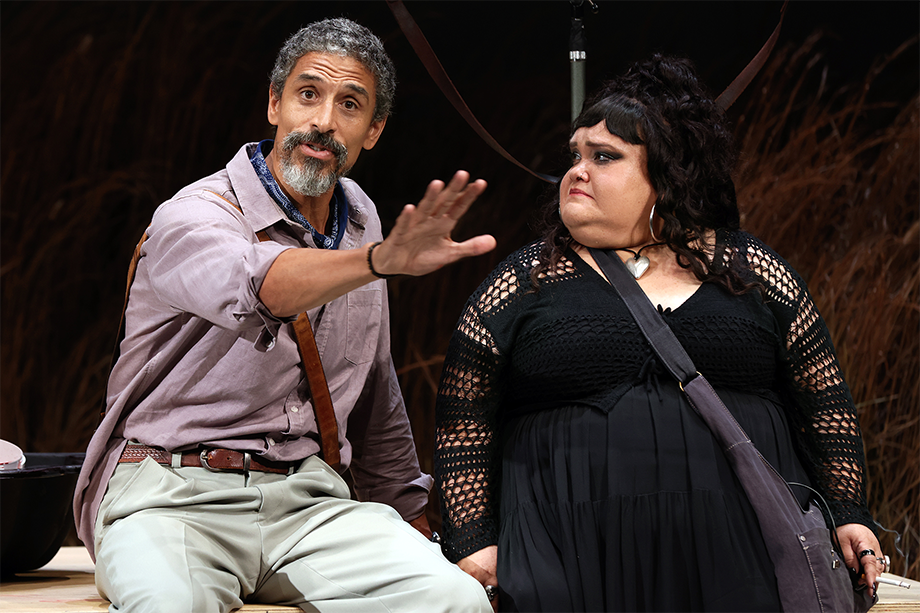
- Article Hero Image Caption: Markus Hamilton and Megan Wilding in Sydney Theatre Company's The Seagull (photograph by Prudence Upton)
- Alt Tag (Article Hero Image): Markus Hamilton and Megan Wilding in Sydney Theatre Company's The Seagull (photograph by Prudence Upton)
- Production Company: Sydney Theatre Company
The revised setting was distracting, as I waited attentively for the payoff throughout the play, optimistic that the dramatic logic of the move would become apparent. Unfortunately, the rationale for the setting never landed, and this failure constitutes the production’s major flaw.
Otherwise, The Seagull at the STC has a great deal going for it. The performers move adeptly between comic and dramatic registers as the script necessitates. Upton’s treatment ranges from broad humour to moments of heartbreak, and the actors match the words by toggling between expansive physical movement and occasional moments of lapidary precision and poignancy. Harry Greenwood, as Constantine, uses his lankiness to great effect, conveying his character’s self-consciousness and thwarted desire, as if the young writer hasn’t quite grown into his body. Sean O’Shea plays Constantine’s uncle, Peter, on whose property the story unfolds, with an excellent sense of ruefulness and frustration, funnily grumpy and often wise.
Constantine and Peter reside at the property, and the drama pivots on a visit from the former’s mother and the latter’s sister: the glamorous diva Irina Arkadina. She is accompanied by her younger writer-boyfriend, Boris Trigorin, a literary celebrity whom Constantine both envies and despises. As this stylish couple, Sigrid Thornton and Toby Schmitz are excellent when parodying the pretensions of the self-styled creative. The play exposes the couple’s feckless narcissism, as they use and abuse those who desire them. Constantine longs for his mother’s love and approval, and is repudiated with casual indifference at best, with mockery at worst. Boris ruthlessly captures the affection of Nina, Constantine’s beloved and muse, with little care for the fallout. Thornton and Schmitz’s comedic bravado offers laughs a minute, but they do not quite deliver the menace of their characters’ cruelty. Perhaps that absence is the point: it is their shallowness that does damage rather than their darkness.
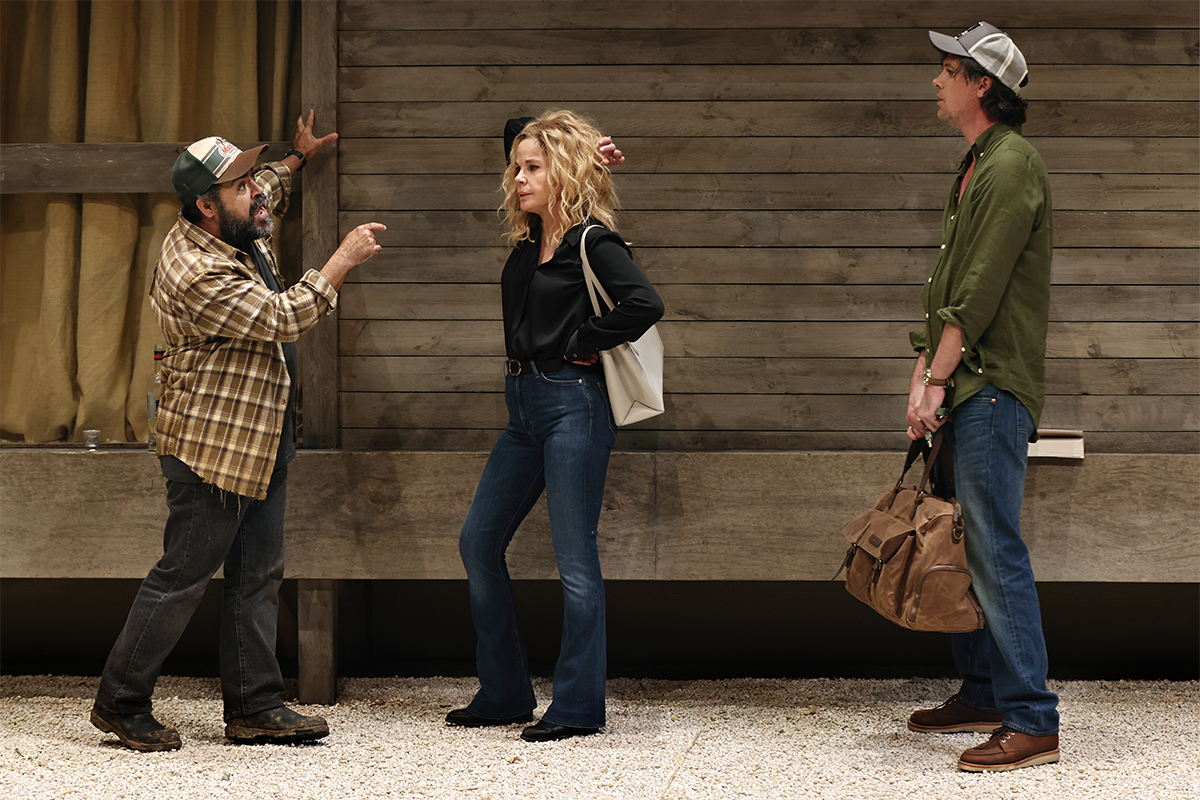 Michael Denkha, Sigrid Thornton, and Toby Schmitz in Sydney Theatre Company’s The Seagull (photograph by Prudence Upton)
In contrast, Mabel Li, as Nina, conveys and sustains the plays weightiness. As the young woman at the heart of the play’s action – part heroine, part sacrificial victim – Li is light on her feet and heavy of heart. Dexterous and mature in this role, she holds the whole thing together. The supporting cast of Arka Das, Michael Denkha, Markus Hamilton, Megan Wilding, and Brigid Zengeni play neighbours or employees of the property. In their interactions with Peter’s household, and in confessing to their own thwarted desires, they produce a feedback loop testifying to the sense of disappointment that pervades the play. Special mention must be made of Megan Wilding as Masha, a mordant goth stuck in her small town who takes grim pleasure in her griping. Wilding’s character may feel stuck, but Wilding elevates the production with her rigorous sense of comic timing, as she did in STC’s recent The Importance of Being Earnest.
Imara Savage’s direction gives us a Seagull which is expert in its conveyance of frustrated and claustrophobic mood, hilarious as a satire of artists and sometimes devastating in its portrayal of rejection and loss. The sets, designed by David Fleischer, move us from the expanse of a wheatfield in high summer inexorably towards the dark interior of the play’s conclusion. I was thoroughly entertained, and often very moved, by this production. But I still have no idea what we were doing in modern Australia rather than in nineteenth-century Russia. Ideally, this type of updating offers not only a meditation on the classic original by recontextualising its themes, while also casting new light on the substituted time and place through the prism of the venerable text. In this instance, The Seagull’s relocation achieved neither, and functioned to distract rather than illuminate.
The Seagull (Sydney Theatre Company) continues at the Roslyn Packer Theatre until 16 December 2023. Performance attended: 25 November.