


- Free Article: No
- Contents Category: Film
- Review Article: Yes
- Article Title: Napoleon
- Article Subtitle: An unconvincing biopic from Ridley Scott
- Online Only: No
- Custom Highlight Text:
Ridley Scott’s Napoleon Bonaparte is petulant, over-confident. He likes to make animal noises and is often ill at ease. He is deeply infatuated with his wife. He can fall asleep at crucial moments. His ambitions are boundless, his limitations often comical. He’s very into cannons. He combines the extraordinary and the extremely ordinary in disconcerting ways.
- Article Hero Image (920px wide):
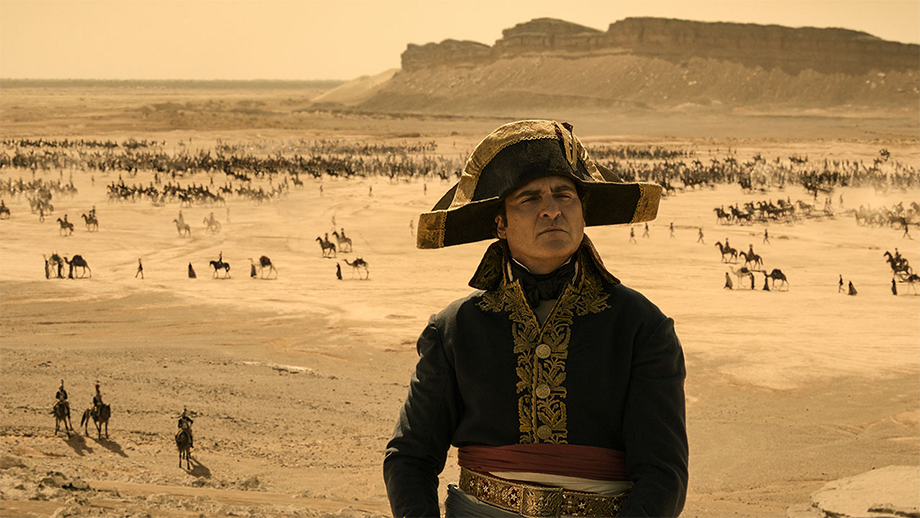
- Article Hero Image Caption: Joaquin Phoenix as Napoleon (Sony Pictures)
- Alt Tag (Article Hero Image): Joaquin Phoenix as Napoleon (Sony Pictures)
- Production Company: Sony Pictures
Within this straightforward, highly condensed timeline, there is Joaquin Phoenix’s Napoleon, a man making his way through the world, from soldier in the artillery to consul to emperor to prisoner and back again: a contradictory, preposterous figure, naïve, assertive, disingenuous, bewildered, vindictive, grandiose, sometimes all at once – a man who can proclaim at his coronation ‘I found the crown of France in the gutter. I picked it up with the tip of my sword, and cleaned it, and placed it atop my own head,’ or announce in a huff, at dinner, ‘Destiny has brought me here. Destiny has brought me this lamb chop.’
If anyone could play this awkward, uncomfortable, grand, self-mythologising yet petty Napoleon, it would be Phoenix. It almost works, and yet it is at its most absurd when it comes to the element that binds the public and the private aspects of the story: the relationship between Napoleon and his first wife.
Josephine, a widow with two children, once married to an executed noble and lucky to escape the guillotine herself, is played by Vanessa Kirby (The Crown, Pieces of a Woman). She gives the character a weary, knowing, alluring air, assured and reassuring when she chooses to be, deflating and dominating when she thinks it necessary. She and Napoleon first meet at a post-Reign of Terror ‘survivors ball’ in the summer of 1794, and he can’t stop staring at her. The dynamic is immediately created: his neediness, her confident sexual manipulation, and the to and fro of their games and power-plays are constants. His letters to Josephine, heard in voiceover, are his presentation of himself – assertions of devotion or upbeat accounts of campaigns and battles.
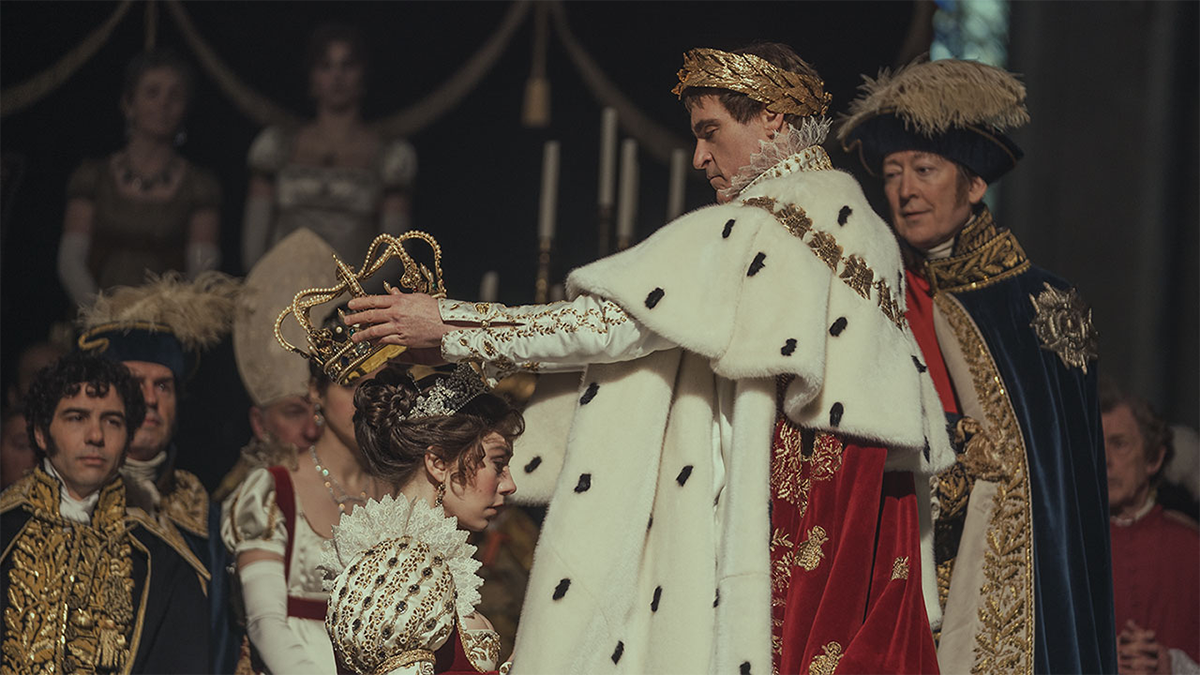 Vanessa Kirby and Joaquin Phoenix in Napoleon (Sony Pictures)
Yet the Napoleon-Josephine relationship sits awkwardly alongside moments of spectacle, physicality, and dramatic scale. At the 1793 siege of Toulon, the action that began Napoleon’s ascent as a military leader, he is in the thick of it as his horse is blown up underneath him. He hurls himself into the fray and we can hear the sound of his breathing, gasping for air, his face streaked with blood. We are never this close to him again as a combatant.
In another set-piece, at Austerlitz in 1805, Scott foregrounds one minor aspect of the decisive battle and makes it stand for the whole victory. Once again, it’s about Napoleon and cannons; as Russian cavalry and troops cross a snow-covered lake in front of the French forces, Napoleon shells the lake, and the cannonballs puncture it with holes. There are dramatic images of men and horses falling through the ice, underwater shots of them flailing and floundering, the water filling with blood, as an impassive Napoleon looks on.
Scott also has an instinct for the drama of unsatisfying victory and impending failure: Napoleon in Russia in 1812, riding through a deserted city, robbed of any sense of triumph, truculent as a thwarted child. But the depiction of the final battle adds little to what Sergei Bondarchuk conveyed in Waterloo (1970). Bondarchuk’s film was a box-office failure, but it is forceful impressive, and Rod Steiger is a memorably bleak Napoleon, one of more than a thousand such examples of film and television versions, as recorded by historian and film archivist Hervé Dumont. He has assembled a list of Napoleons that can be found in every conceivable genre, coming from countries such as Egypt, Greece, Russia, Argentina, Brazil, Finland and Cuba, as well as France and England.
Then there are the famous unmade films, notably those from Charlie Chaplin and Stanley Kubrick. Chaplin’s unrealised feature went through many iterations; it was to be based on a novel about the emperor and a humble doppelgänger, but much of the energy of the project went into the making of The Great Dictator (1940). Kubrick’s grand project, to which he devoted years of work and copious research, fell over when finance was withdrawn; he, in his turn, channelled aspects of this enterprise into Barry Lyndon (1975). The screenplay and research materials have been published, and the project remains a work in progress that Steven Spielberg has plans to make for a streaming service.
Scott himself has come full circle. His début feature, The Duellists (1977), is the story of two soldiers serving in Napoleon’s army, one (Harvey Keitel) a pugnacious Bonapartist, the other (Keith Carradine) a languid aristocrat. The pair are caught up and locked together in an endless cycle of encounters and challenges, the unfinished business of duels. Napoleon is never seen, but his influence and impact are everywhere. Scott went to considerable effort to ensure that the duels were protracted and realistic; as the story unfolds over the years, the sense of what it is to be part of that army, within that political climate, is clear and intriguing. In many ways, it is a stronger, more compelling depiction of Napoleon and his impact on the world than the film Scott has just made.
Napoleon (Sony) is on commercial release from 23 November 2023.