


- Free Article: No
- Contents Category: Film
- Review Article: Yes
- Article Title: The Zone of Interest
- Article Subtitle: Variations on Martin Amis’s novel
- Online Only: No
- Custom Highlight Text:
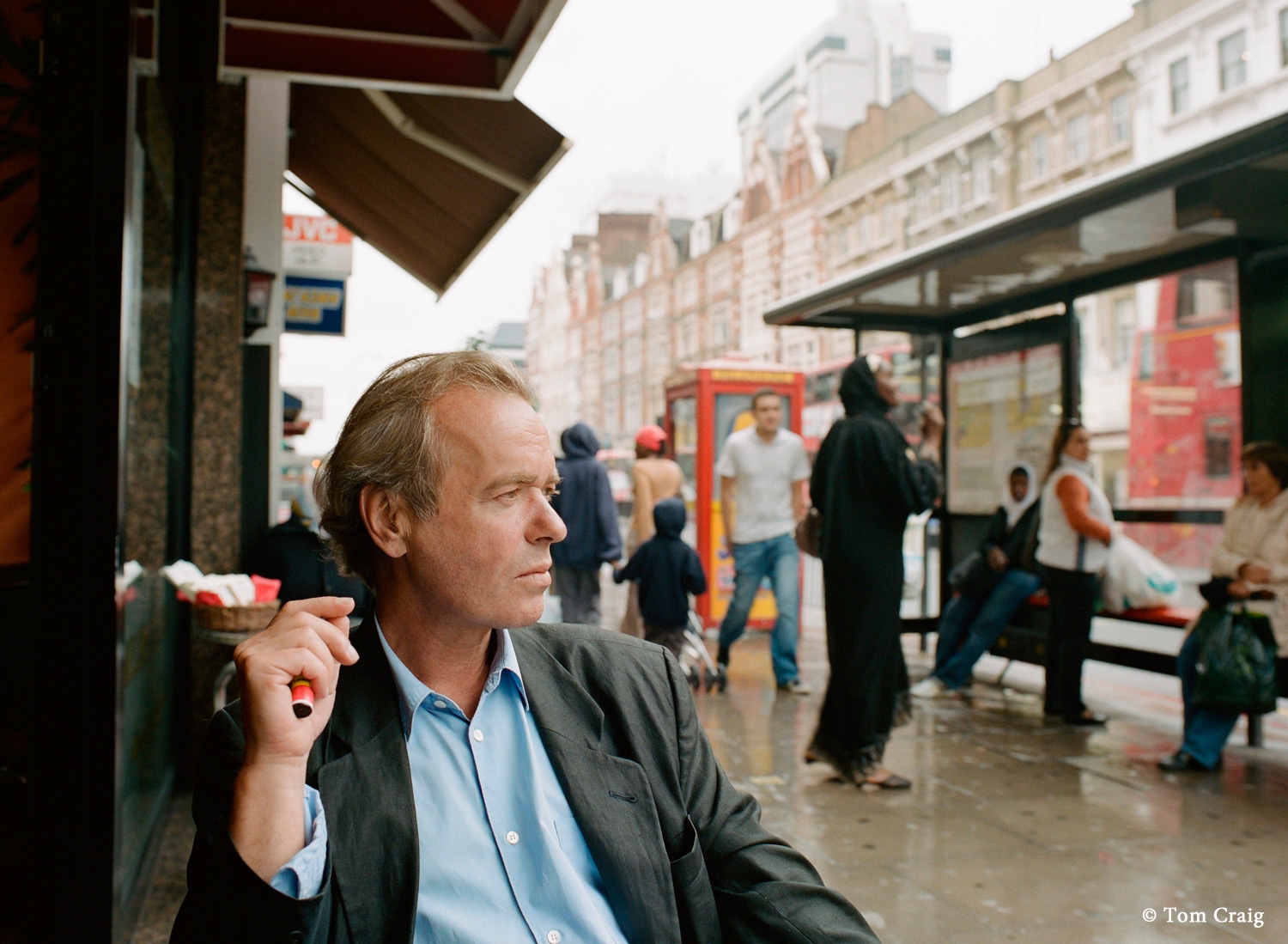
In Martin Amis’s novel The Zone of Interest (2014), Auschwitz Commandant Paul Doll asserts that to meet the objectives of the Reich it is necessary to ‘shut down a certain zone of the mind. I must accept that we have mobilised the weapons, the wonder weapons, of darkness.’ Doll is not a man seeking to absolve himself. Rather, he attempts to explain his dilemma, lamenting not so much the moral nightmare into which he has been thrust, but the bureaucratic one: how to balance the Reich’s need to exploit the prisoners for their labour with the desire to eradicate them as quickly and efficiently possible? ‘The Christian system of right and wrong, of good and bad,’ he muses, ‘is 1 we categorically reject … There are only positive outcomes and negative outcomes.’
- Article Hero Image (920px wide):
- Article Hero Image Caption: Sandra Hüller as Hedwig Höss in 'The Zone of Interest' (A24)
- Production Company: Jewish International Film Festival / A24
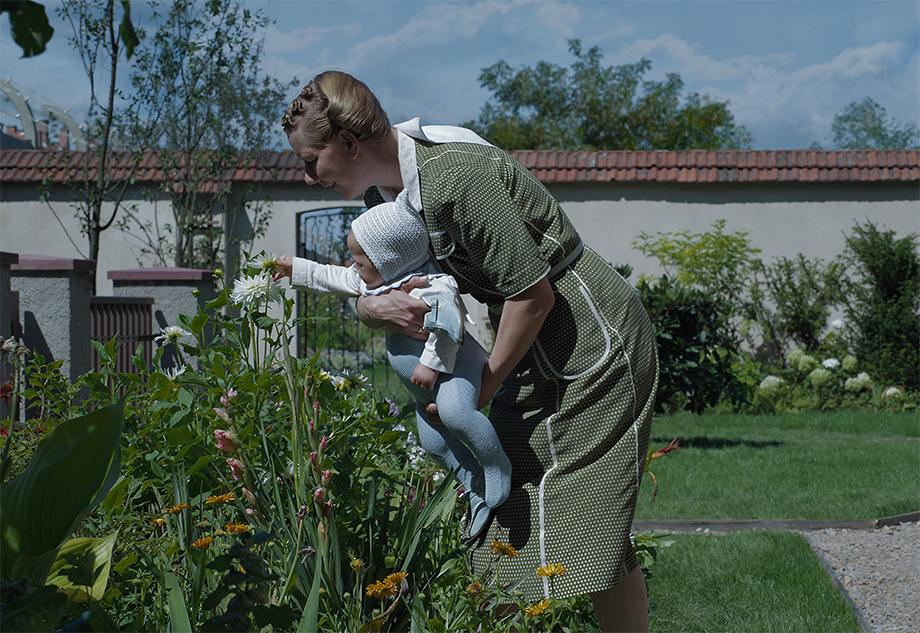
What marks the action of The Zone of Interest is its veneer of normality. A family lazes on a riverbank, a picnic spread out before them, the children squealing and splashing in the water. A father reads his children bedtime stories. A mother walks her baby around a flower garden, pointing out the dahlias, the ladybirds. There are squabbles. There is impatience. There is laughter. There is love.
We are never, however, permitted to empathise with this family, to invest wholly in its world view. The blank monochrome screen with which the film begins, the accompanying thrum of alienating noise (a tumult that seems to mask voices, perhaps even an incantatory chant, but that is ultimately inexplicable) might give way to birdsong and the gentle flow of a river, but this family, Glazer seems to suggest, is anything but ordinary.
The plot, such as it is, is simple. The family – Rudolf Höss (Christian Friedel), his wife Hedwig (Sandra Hüller) and their four children – live at Auschwitz. Höss is Commandant of the camp, while Hedwig has taken Hitler’s aspiration for Lebensraum to heart, creating out of its surrounding fields the consummate home within which her family can grow and prosper. When Höss is promoted to the post of ‘Commandant of Commandants’ in recognition of his administrative talents, Hedwig opts to remain at Auschwitz with the children, reluctant to abdicate what she has worked so hard to achieve.
Stylistically, The Zone of Interest bears similarities to Under the Skin (2013), Glazer’s loose adaptation of Michel Faber’s 2000 novel, which traces the odyssey of a woman – perhaps cyborg, perhaps alien – who abducts and consumes random men. Both films deploy minimal dialogue. Both observe their protagonists without attempting to explain them, as though any attempt to rationalise their actions can only ever be futile. And both are visually marked by an otherworldly quality, The Zone of Interest (cinematography by Lukasz Zal) reminiscent in its tone of archival black-and-white film that has been hand tinted.
 Martin Amis (Tom Craig at Bill Charles Agency via Penguin Random House)
The camera’s calm surveillance of the family as, within this loathsome environment, they go about their daily business, keeps us disoriented. So too the soundscape (music by Mica Levi; sound editing by Maximilian Behrens), the incessant ominous throb of the factories and crematoria underscoring everything the family says and does. We anticipate the mea culpa, the confession, the profound insight into the barbarity they are yoked to. But what we are given is the unspoken, the glossed over. Glazer shows us, through his muted, yet penetrating, use of juxtaposition, the degree to which horror has become assimilated into the quotidian: a barrow of ashes being spread over a garden, blood being washed from the sole of a shoe, a child studying a handful of yellowed teeth, the scars of dark grey smoke belching out of constantly burning chimneys, the gunshots, the screams.
A scene where four uniformed men are gathered around a coffee table discussing the plans for a new system of disposal, one that would allow the ‘pieces’ to be burned twenty-four hours a day without pause, is especially chilling (and evokes Frank Pierson’s 2001 telemovie Conspiracy which dealt with the bureaucratic machinations behind the ‘Final Solution’). Similarly shocking is a scene where Hedwig tries on a newly acquired fur coat, taking from its pocket a half-used tube of lipstick and applying the colour to her own lips. When Höss descends a staircase, his composure briefly giving way to nausea, what is remarkable is not only the mildness of his psychosomatic malaise, but also the suspicion that his suffering stems more from the administrative demands of his new position than its human cost.
Crucially, The Zone of Interest also incorporates an incandescent note of humanity. A young girl hides apples in the dirt, under the trolleys, and between the rails where the prisoners are made to work. Filmed using night vision, the girl is the inverse of all else we see, a stark white figure moving surreptitiously across a black background. In thanks for her beneficence, one of the prisoners leaves her a piece of music, a delicate piano work that accentuates the discordance inherent in rest of this milieu.
Glazer has achieved something truly astonishing here. The Zone of Interest is sufficiently literal that we do not forget the abominations of the Third Reich (a point reinforced by the shift to present-day Auschwitz that comes in the latter moments of the film). Even so, its preternatural elements allow scope for the figurative. In his novel, Amis writes that under Nazism ‘you looked in the mirror and saw your soul … We all discovered, or helplessly revealed, who we were. Who somebody really was. That was the zone of interest.’ The ordinariness of this family becomes something of its own mirror, reminding us that, in the pursuit of our own lives, in the face of our own desire for comfort and contentment, there are few of us who aren’t capable of disregarding the hateful truth of what is going on beyond our own walls and of thereby misjudging the boundary between right and wrong.
The Zone of Interest is currently screening at the 2023 Jewish International Film Festival and will open nationally from 15 December 2023 (distributed by A24).