


- Free Article: No
- Contents Category: Theatre
- Custom Article Title: Oil
- Review Article: Yes
- Article Title: Oil
- Article Subtitle: A play that marches back and forth across empire
- Online Only: No
- Custom Highlight Text:
Ella Hickson’s centuries-spanning epic Oil was first staged at London’s Almeida seven years ago. It has already been tackled by Australian companies, and Sydney Theatre Company’s production (directed by Paige Rattray) is able to draw on several local actors with recent experience in their roles. WA’s Black Swan mounted the play in 2022 (featuring Violette Ayad), and Red Stitch in 2019 (with Jing-Xuan Chan).
- Article Hero Image (920px wide):
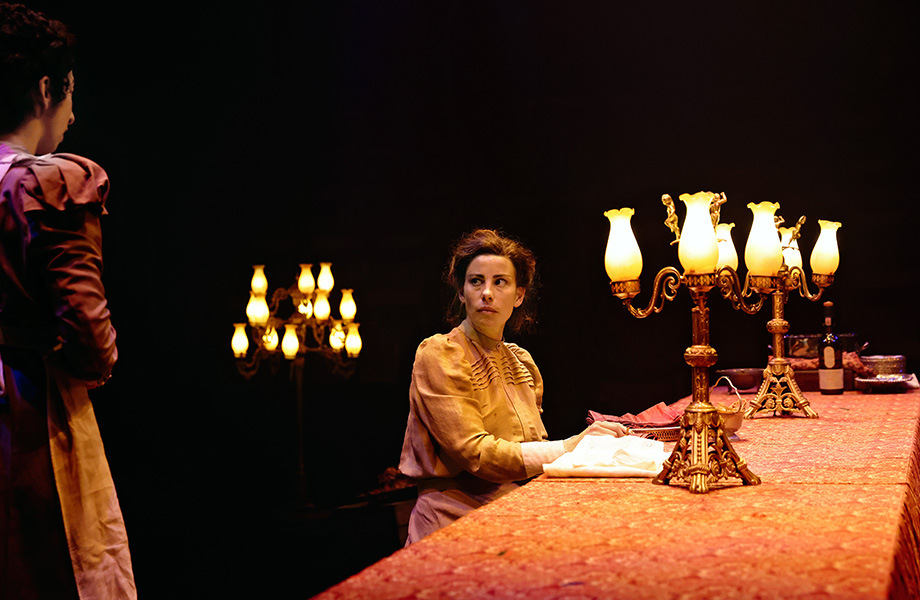
- Article Hero Image Caption: Violette Ayad and Brooke Satchwell in Sydney Theatre Company’s Oil (photograph by Prudence Upton ©).
- Alt Tag (Article Hero Image): Violette Ayad and Brooke Satchwell in Sydney Theatre Company’s Oil (photograph by Prudence Upton ©).
- Production Company: Sydney Theatre Company
The play opens in 1889. Protagonist May survives in a cage of cold, darkness, and in-laws. Life for this rural Cornish woman is dictated by the daily struggle to access heating and light, whether from within herself, the extended family around her, or their meagre candles and firewood. Change comes in the form of a mysterious stranger, who brings the novelty of kerosene, and the promise or threat of a different way of living.
As decades pass and oil begins to dominate geopolitics, May flees or marches back and forth across the British Empire. We find her in Tehran in 1908, Hampstead in 1970, Baghdad in 2021, and Cornwall in 2051. She ages slowly and changes plenty, constantly revolving around a sometimes-sidekick, sometimes-foil, her daughter Amy.
Through this lens, Oil juggles big ideas – empire, oil, family – with a dexterity that demonstrates both their weight and their nuances. As agents and subjects, May and Amy are simultaneously victims, beneficiaries, and perpetrators of the structures and materials that surround them; they are doomed to reproduce them. They do awful things in pursuit of a flourishing life, or just a life: abandoning family, stealing from the impoverished, making compromises with themselves and others. May negotiates an energy company’s Libyan interests in the midst of a coup, while simultaneously cooking dinner and eviscerating her teenage daughter’s underwhelming boyfriend. She may have all the time in the world but not the leisure to indulge in good and evil.
Oil is no morality play. No thing, character, or action here is evil in its essence; fossil fuels are just another permutation of energy, of power, which has equal capacity to enslave or emancipate. Despite the fantastical conceit of a near-ageless woman, Oil finds its meaning in the tangible world and the interpersonal relationships within it. Hickson invites audiences to examine the recurring power of the material. Again and again, May returns to the importance of light and heat, and the connection to place and family.
The play is obviously conversant with Orlando, Virginia Woolf’s 1928 novel about a young English noble who traverses time and gender through several centuries of British Empire. In its emphasis on materialism, it also harmonises with Woolf’s 1929 essay A Room of One’s Own.
Both A Room of One’s Own and Oil concern themselves with the importance of sovereignty and freedom in all their forms: whether land and property, bodily autonomy, energy independence domestic and geopolitical; the right, or privilege, of men and of women to physically and intellectually wander; and, crucially, what all this sovereignty costs.
Serving this play up in the round is a bold and fruitful idea; it fits Oil so well that conventional stagings now seem inappropriate. Each scene becomes an illuminated diorama, a museum exhibit, that emphasises both the epic and the quotidian in the play. Emma White’s set design packs us into the intimacy of domestic settings, but allows enough expanse for big ideas to flow.
Other elements of the production are creakier. Several pivotal moments in the first scene are marked by the lighting of candles or kerosene lamps; there were excruciating pauses when matches failed to cooperate, and in the performance that ABR Arts attended May was forced to march into the darkness with her beacon still unlit. Scene transitions are marked by distracting dance music.
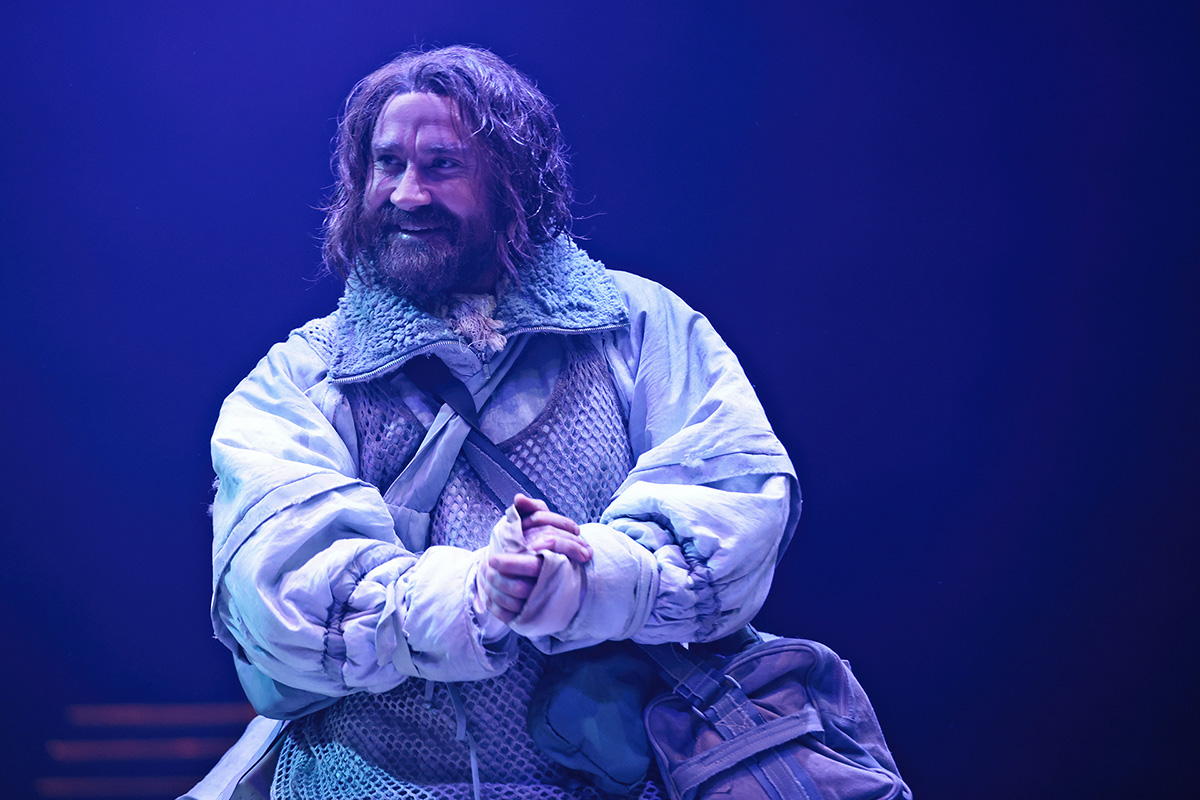 Josh McConville in Sydney Theatre Company’s Oil (photograph by Prudence Upton ©).
The cast is universally outstanding. Brooke Satchwell as May is clearly having a great time. She aims with enthusiasm at a Cornish accent, occasionally landing in Yorkshire, but not enough to detract from an excellent performance. Each scene finds May making great leaps in time and characterisation, without showing the development that takes place between, and Satchwell manages to embody both the transformation and the consistency from moment to moment. At times capricious, resolute, desperate, vibrant, or weary, Satchwell’s May contains multitudes but holds them together in a coherent and compelling performance.
Charlotte Friels as Amy is a good counterpart in a difficult role, portraying the character as a young child through to an older woman. She maximises the play’s humour without sacrificing depth. The male roles are deliberately more one-note, being largely devices, and the cast do well at representation without sliding into caricature. Benedict Samuel as a British naval officer is by turns comic, sympathetic, and ominous. Saif Alawadi is arresting as a Libyan negotiator, and Josh McConville makes good use of a more substantial role as a Cornish farmer.
Oil (Sydney Theatre Company) continues at the Wharf 1 Theatre until 16 December 2023. Performance attended: 10 November.