


- Free Article: No
- Contents Category: Theatre
- Custom Article Title: Orlando
- Review Article: Yes
- Article Title: Orlando
- Article Subtitle: An enigmatic new adaptation
- Online Only: No
- Custom Highlight Text:
Somewhere on West 24th Street in the early 2000s, Susan Sontag asked Terry Castle whether Virginia Woolf was a ‘great genius’. Castle agreed emphatically before offering a tongue-in-cheek follow-up: ‘Do you really think Orlando is a work of genius?’ Sontag’s response was quick and admonishing. ‘“Of course not!.” she shouts, “You don’t judge a writer by her worst work! You judge her by her best work!”’
- Article Hero Image (920px wide):
- Article Hero Image Caption: Orlando (Angel Leggas/3 Fates Media)
- Alt Tag (Article Hero Image): Orlando (Angel Leggas/3 Fates Media)
- Production Company: Antipodes Theatre Company / Fortyfivedownstairs
We can attribute the text’s enduring popularity, in part, to how well it has taken to adaptation over the years. Woolf’s other works have rarely been served well by cinema and only occasionally by theatre. Writers Rachel Lewindon and Willow Sizer began adapting Orlando in 2018. The most recent attempt at dramatising the novel had been by the American writer Sarah Ruhl, subsequently staged by Sydney Theatre Company in 2015. The production came and went without much fanfare; it was considered more of a vehicle for Jacqueline McKenzie than anything else. Five years later, theatre makers have returned to Orlando. In 2019, Orlando became the first female-composed opera presented by the Vienna State Opera. In 2022, a similar adaptation appeared at the Royal Ballet, and Emma Corrin became the first non-binary performer to tackle the title role in Neil Bartlett’s staging at London’s Garrick Theatre, in the same year.
This return to Woolf’s novel is unsurprising. In the early 1990s, theatre makers flocked to Woolf’s text, buoyed by the emergence of third-wave feminism. Robert Wilson’s infamous 1989 production enjoyed a number of successful remounts in the 1990s. Like Ruhl’s adaptation, it was ostensibly a platform for one central performance – including a one-woman showcase for Isabelle Huppert in Paris. Many remember Sally Potter’s 1992 film – which curbed Wilson’s ambition to turn his adaptation into a film; Tilda Swinton’s enigmatic central performance is as affecting now as it was thirty years ago. These successive adaptations reflect the individualism implicit in third-wave feminism’s emphasis on sexual autonomy and self-determination. The novel’s shape-shifting treatment of sexual identity afforded these theatre makers the perfect way to critique patriarchal systems through one person’s experience of them.
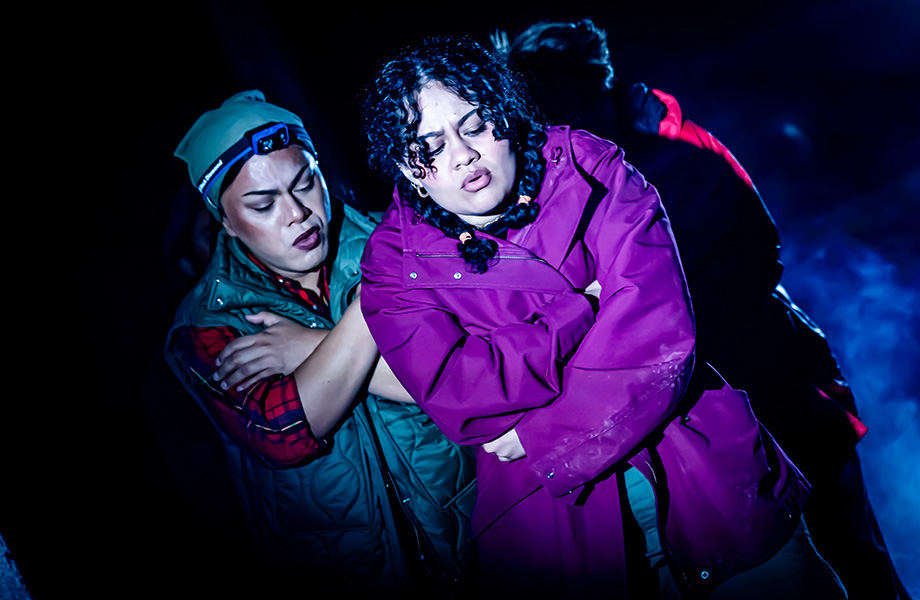
Lewindon and Sizer’s enigmatic new adaptation is interesting for a number of reasons. In the warehouse-style- theatre at fortyfivedownstairs (presented here in the round), the cast of five introduce themselves all as Orlando. From the outset, the production is interested in a plural identity. Here, it has much in common with Bartlett’s recent production, which included a diverse ensemble of narrators dressed as Virginia Woolf, and Katie Mitchell’s 2019 production for the Schaubühne that split Orlando across various overhead screens. Both productions emphasise the bifurcated self to better align with contemporary trans and gender-non-conforming perspectives, modelling that most Woolfian of ideas – that of a plural self, innumerable, unutterable; that ‘bewildering and whirligig state’ that understands, as Orlando does, that gender and sex are not fixed but rather in a near-constant state of becoming. There are ‘2052 selves lodging in the human spirit’ our narrator (an underused Kirsten Smyth) declares as the five-strong cast enter.
For Lewindon and Sizer, who are the first, to my knowledge, to adapt the novel into a musical, this idea has informed their entire creative approach. We see this influence first in Lewindon’s resplendent compositions, which are some of the best to come out of Australian musical theatre in recent years. it is impossible to overstate just how impressive her formal innovations are in such a notoriously risk-averse industry. These are compositions that move like Woolf’s prose – dense harmonies and complex looping filled with poetic images that cohere into something atmospheric and deeply affecting, despite their fragmentary style. Atonal harmonies and the complex gymnastic rhythms of her phrasing – lyrics are often drawn from the novel – remind us of the operatic spectacle of Stephen Sondheim’s Sweeney Todd passed through an electro-futuristic folk style.
 Orlando (Angel Leggas 3 Fates Media)
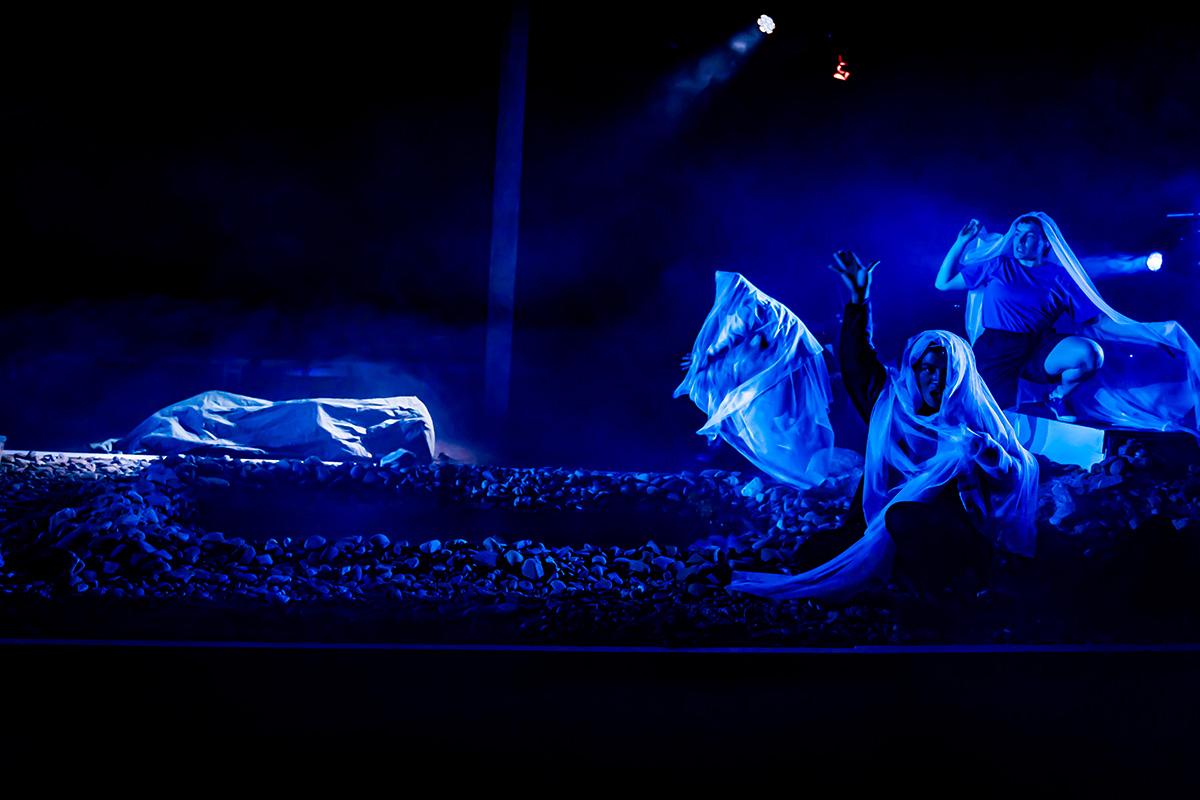
Orlando’s lust for the Archduchess Henrietta (played with magnetic poise by Kiki Temple) assumes an almost hymn-like resonance in Lewindon’s hands, underscored by powerful choral arrangements and heavenly vocal performances. The Great Frost of 1608, signalled by billowing dry ice, becomes a heart-wrenching Gothic anthem in the style of Brian Eno via Kate Bush; and the arrogant Nicholas Greene (played with vaudevillian flare by Manali Datar) spurs a chamber opera accompanied by tightly choreographed body percussion.
This is not an easy score to sing, and some cast members cope better than others. Sizer’s voice – a near-mystical head voice with the tight vibrato of a 1920s crooner – struggled with the shorter phrases and more comedic numbers. Louie Dalzell’s vocal performance was notably flat. It was Marty Alix’s pristine falsetto and tight vocal control and Manali Datar’s buttery vocal tone that proved the most capable in terms of navigating Lewindon’s pop-style rhythms and folky refrains. On opening night, many of the cast struggled with problematic sound balancing.
Where the production falters is in its inconsistent book. This production, the first to come from Antipodes Theatre Company’s innovative Winter Lab initiative, favours a more collaborative process; a ‘FLUID style’, meaning that it has been co-created alongside its cast. Allowing space for actors to absorb their personal experience in the show’s construction has created moments of magic throughout, injecting an electrifying lived-in quality to its depiction of trans, gender-nonconforming and epicene perspectives. Orlando’s ‘transition’ part way through (a moment of emotionally affecting gender euphoria, played beautifully by Temple), and Princess Sasha’s reproach of Orlando’s racist and élitist presumptions (depicted with biting passion by Datar), deepen our understanding of the novel. Too often, these are paired with contrastingly lazy nods to contemporary progressive talking points, played almost exclusively for comedic effect.
Past, present, and future co-exist in this production, for better or worse. A pair of soldiers turning to the audience to say ‘ACAB’ or a performer requesting ‘something upbeat, like Britney’ before searching for a ‘Dyson hair curler’ is the worst of it; Princess Sasha snapping a selfie in a T-Shirt emblazoned with ‘JUICY’ on the front is the best. Each modern reference seems intended as a playful nod to Woolf’s characteristic blending of temporalities; ‘an hour,’ as Woolf writes, ‘once it lodges in the queer element of the human spirit, may be stretched’. Most of them, however, feel unhelpfully shoe-horned into the show. Rarely do they add to characterisation or any clear thematic concern, existing purely as throwaway lines that muddy our understanding of a plot as dense and meandering as Woolf’s novel. The line between the performer offering winks to contemporary audiences and their character are unhelpfully blurred to such an extent that we gain little sense, or understanding, of either. By the show’s anthemic final number Lewindon’s music felt as if it were telling a completely different story to that of the book, struggling to land an emotional climax centred around Orlando’s character arc that previous scenes and references had progressively decentred and confused.
Orlando is a tale, Vita Sackville-West wrote in a letter to Woolf, much ‘like being alone in a dark room with a treasure chest full of rubies and nuggets and brocades’. This Orlando is much the same. If some treasures shimmer less than others, it’s simply a matter of polish. There’s certainly enough of this teams ‘best work’ to make it a treasure trove.
Orlando (Antipodes Theatre Company) continues at fortyfivedownstairs until 11 November 2023. Performance attended: 3 November.