


- Free Article: No
- Contents Category: Film
- Custom Article Title: The Old Oak
- Review Article: Yes
- Article Title: The Old Oak
- Article Subtitle: Ken Loach's palatable late style
- Online Only: No
- Custom Highlight Text:
According to the Palestinian-American literary critic Edward Said, when some artists, musicians, and writers enter the last period of their lives, the sense of their own ending (whether from old age or ill health) occasions a change in their craft, a kind of ‘new idiom’ that he calls ‘late style’. While we might intuitively tend to think of old age bringing a sense of ‘reconciliation and serenity’, of ‘harmony and resolution’ to an artist’s portfolio, Said is more interested in those artists for whom the end actually marks a turning point, a shift towards ‘intransigence, difficulty and contradiction’.
- Article Hero Image (920px wide):
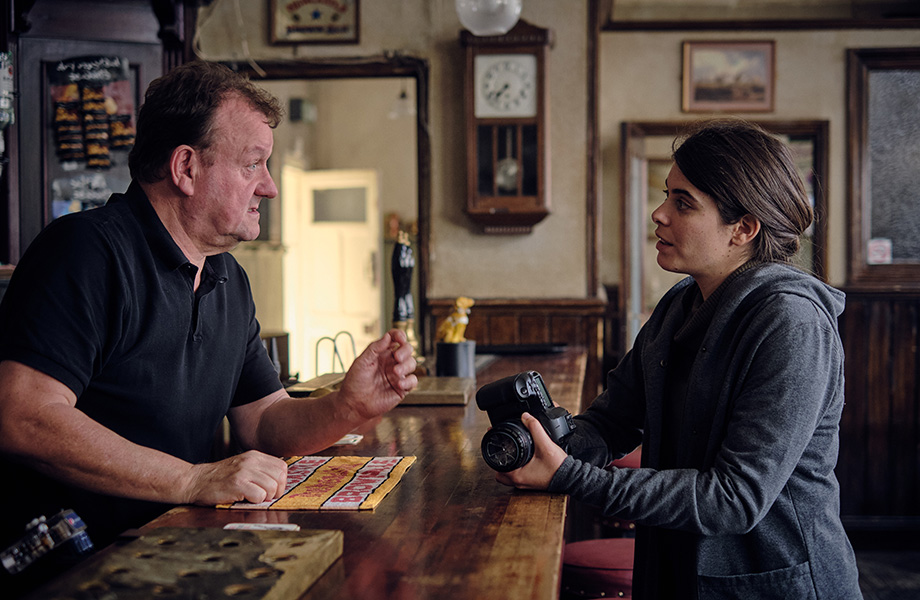
- Article Hero Image Caption: Dave Turner as T.J. Ballantyne and Ebla Mari as Yara (courtesy of Palace Films).
- Alt Tag (Article Hero Image): Dave Turner as T.J. Ballantyne and Ebla Mari as Yara (courtesy of Palace Films).
- Production Company: British Film Festival
In the realm of cinema, late style for an auteur might mean something like Orson Welles’s play with documentary form in his F for Fake (1973), or Jean-Luc Godard’s bold experiment with 3D-technology in Adieu au langage (2014). More recently, following the announcements of ‘retirement’ from directors such as Steven Soderbergh, Hayao Miyazaki, and Quentin Tarantino, we might also consider last films as either safe career capstones or daring final turns.
According to the eighty-seven-year-old British director Ken Loach, whose storied career began almost six decades ago, The Old Oak will be his final film. It certainly beats a similar path to some of the other works in his late output. Like his last two films – the Palme d’Or-winning I, Daniel Blake (2016) and Sorry We Missed You (2018), a portrait of a troubled ‘white van man’ and his family – this latest example also takes aim at a Britain broken by austerity, depicting both its horrible effects on the population and some hopeful cracks where the light still manages to get in. As with others in his recent filmography, here Loach is joined again by regular cinematographer Robbie Ryan. Loach works well with a cast of non-actors, and his sympathies for the working poor are on display, just as they were from his very first efforts for BBC Television: the Wednesday Play anthology series of the mid-1960s.
What The Old Oak adds to the well-known Loach mix is the intersection of white working-class and refugee interests; what it loses is some of the documentary impulse that allowed for the tangential and the unexpected. In this sense, the final notch on Loach’s filmography does not express a kind of late style, as Said would have it, but rather a neatly packaged career summation, and one of his more palatable crowd-pleasers.
The film is set in 2016, the year of the Brexit referendum, and depicts the arrival of a busload of Syrian refugees at a sleepy town in the north-east of England, much to the chagrin of the locals. There are enough kind hearts in the town to make space for the new inhabitants, and enough in common to unite them against the scourges of poverty, displacement, and cultural dilapidation. Among the many faces on screen, the narrative chooses for its main players town publican T.J. Ballantyne (Dave Turner) and refugee Yara (Ebla Mari, herself from Israeli-occupied Golan Heights), a pairing that calls to mind the paternal Daniel and younger Katie from I, Daniel Blake.
After Yara has her camera destroyed by one of the more forthright racists in the town, T.J. brings her into the fold, eventually working alongside community leader Laura (played by real-life local activist Claire Rodgerson) to set up a supper club in the disused backroom of TJ’s pub, The Old Oak. As with many a well-intentioned plan in Loach’s films, trouble brews from the start, and we know that the paradise that sees poor Syrian families break bread with British food stamp recipients cannot last forever. Within this focused narrative, we are given some fine moments of seemingly improvised local colour, and a clear sense of place courtesy of first-time actors Rodgerson and Mari, and a host of real-life Syrian refugees who have settled in the area.
There are also predictable elements here. As with some of Loach’s later films, there is more than a touch of didacticism, as the narrative rehearses one of the big leftist talking points of the time: whether the Leave campaign was deceptive and traded in part on xenophobic fears, and whether there was more to the outcome than ‘working-class racism’. The nativist wedge driven between local and foreign workers over several decades by the ruling class and the conservative media may have stoked nationalist fervour to new dangerous levels, but it does not tell the whole story. In The Old Oak, we quickly learn there is more in common between the struggling Syrian newcomers and the poor souls of County Durham, groups that have either lost or are in fear of losing their connections with their places of origin. Just as Yara speaks of the Islamic State’s desecration of Palmyra, so too do the ruinous streetscapes of the north speak of a region that cannot be made whole again. The displaced refugees arrive with only the shirts on their backs and the war-torn memories of home they carry with them. The townsfolk, many without gainful employment, are also losing touch with their past; with the titular pub as the final public meeting place available to them, and with the coal mining history of the area, which is all but buried. (Indeed, perhaps there is an oblique, unspoken relation between those from home and abroad in their respective transitions to a post-fossil-fuel future.)
There is, of course, enmity as well as camaraderie here. Bad apples in the town rear their heads from the get-go. But the villains of the piece seem at times too ready to hand; the fact that they are the saboteurs of the Old Oak’s new utopia (rather than the austerity measures that hit the post-industrial landscape especially hard) seems like a letdown. One could object that the resulting vision of the north-east of England in this film focuses more on the dog-whistled few rather than the structural causes that led to the present crisis, and more on local individual solutions over wholesale institutional change.
Perhaps this is unfair: by now we know more or less what to expect from Loach. But the relative familiarity of the experience also takes a little of the sting out of the film; it seems to tread old ground, even if the story is a new one. While the future of the town – and that of the supper club – remains undecided at the end of the film, and there is no clear solution for the abiding financial and social problems, The Old Oak strikes a sentimental note. (In particular, the welcome introduction of foreign cuisine into the barren British culinary landscape seems a pat short-cut to a multiculturalist success story). The idealistic conjoining of working-class battlers and diasporic Syrians, as well as the heartbreaking meet cute scene that unites T.J. with his beloved terrier, Marra, will warm the cockles of even the most hard-hearted viewer, but with a plot that ties things together too neatly, and seldom leaves room for the raw documentary touches that represent some of the filmmaker’s most exciting moments, it never quite sparkles. In any case, Ken Loach’s career, like the pub at the centre of his film, boasts a sturdy trunk and many branches more solid than this final bough.
The Old Oak is currently showing at Palace cinemas as part of the British Film Festival and will be released nationally on 30 November 2023.