


- Free Article: No
- Contents Category: Opera
- Custom Article Title: Juan Diego Flórez in Recital
- Review Article: Yes
- Article Title: Juan Diego Flórez in Recital
- Article Subtitle: The Peruvian tenor’s Melbourne début
- Online Only: No
- Custom Highlight Text:
Juan Diego Flórez, now fifty, rose to prominence in his early twenties. His first La Scala success, in 1996, was promptly followed by débuts at Covent Garden (1997), the Vienna State Opera (1999), and the Metropolitan Opera (2002), houses where he still performs regularly. His major roles have included Count Almaviva and Nemorino. Alfredo Germont, in La Traviata, is a new addition; he was singing it in Vienna during the recent ABR tour.
- Article Hero Image (920px wide):
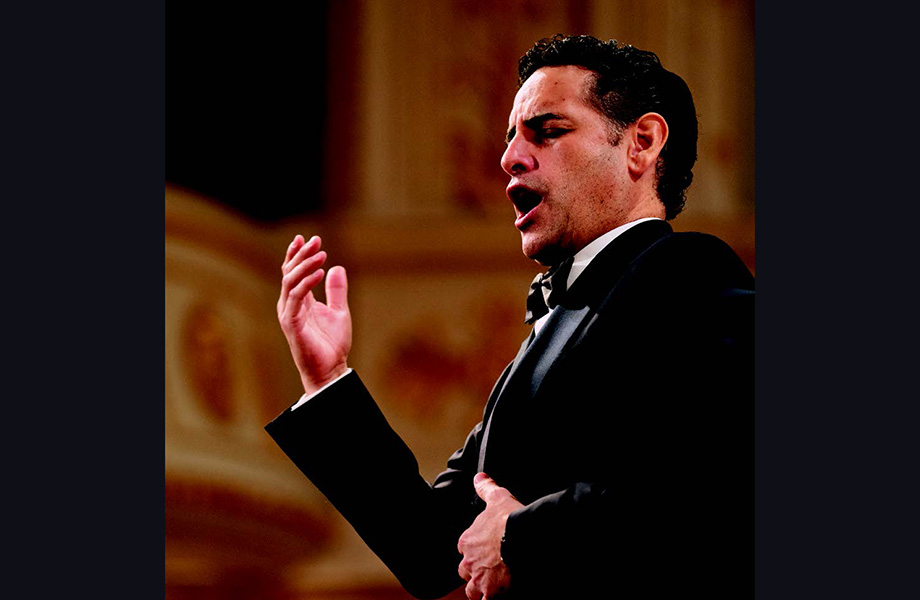
- Article Hero Image Caption: Juan Diego Flórez (courtesy of Castiglione Arts & Culture).
- Alt Tag (Article Hero Image): Juan Diego Flórez (courtesy of Castiglione Arts & Culture).
- Production Company: Castiglione Arts & Culture
Hamer Hall was impressively full for Flórez’s Australian début. The stage was sensibly compressed by the introduction of a vast box at the rear, presumably to push the sound forward. Rows of seats had been added at the foot of the stage. Apart from the piano, the wide stage itself was bare – not a single bouquet. Further ornamentation might have been deemed de trop given the Peruvian tenor’s vibrant personality and stage manner. (Stylish tailoring and Latin good looks don’t hurt either.)
This was the start of a national and international tour for Flórez. His accompanist is Cécile Restier, solo repetiteur at the Vienna State Opera, where she has appeared in recital with Flórez.
The extensive, ultimately elastic, program featured nine arias, none of them facile fillers. The first half – in many ways the better – was devoted to the bel canto composers with whom Flórez is principally associated. ‘Deh, tu m’assisti amore’, from Rossini’s Il Signor Bruschino – which opened the recital – immediately announced not just the famous technical accomplishments (the trill, the evenness of execution, the superb enunciation) but also the expressive warmth and carry of the voice – unusual for such a light tenor presented in a massive hall. ‘Una furtiva lagrima’, from Donizetti’s L’elisir d’amore (most difficult of tenor arias after ‘Dalla sua pace’ perhaps) was sung with notable control and panache. Flórez ended the first half with Edgardo’s death scene from Lucia and a rarity from Bellini’s I Capuleti e I Montecchi.
Perhaps not since Renée Fleming’s recital here in 2002 has a soloist displayed such vocal command of Hamer Hall. If nothing was forced (Flórez is much too suave for that), nothing was lost, hurried, or smudged either. Words, trills, grace notes carried to the circle where ABR Arts was seated – and presumably to the balcony, which had also been opened. The effect was oddly intimate, enveloping.
The second half brought out the big guns, roles which Flórez has added to his repertoire in recent years, including Werther, Alfredo, and Rodolfo. At times one almost worried about the demands being made on the voice, especially when it came to ‘Quando le sere al placido’ (Luisa Miller) and ‘Che gelida manina (La Bohème). Flórez shirked none of the high notes: all night they kept pinging, accurate and sure.
Restier’s accompaniment was unfailingly sympathetic, and her several solos were welcome, especially the Bizet Nocturne. Restier’s positively orchestral colours and flourishes brought real authenticity and roundedness to this concert. The entire program was shaped with the utmost intelligence and refinement.
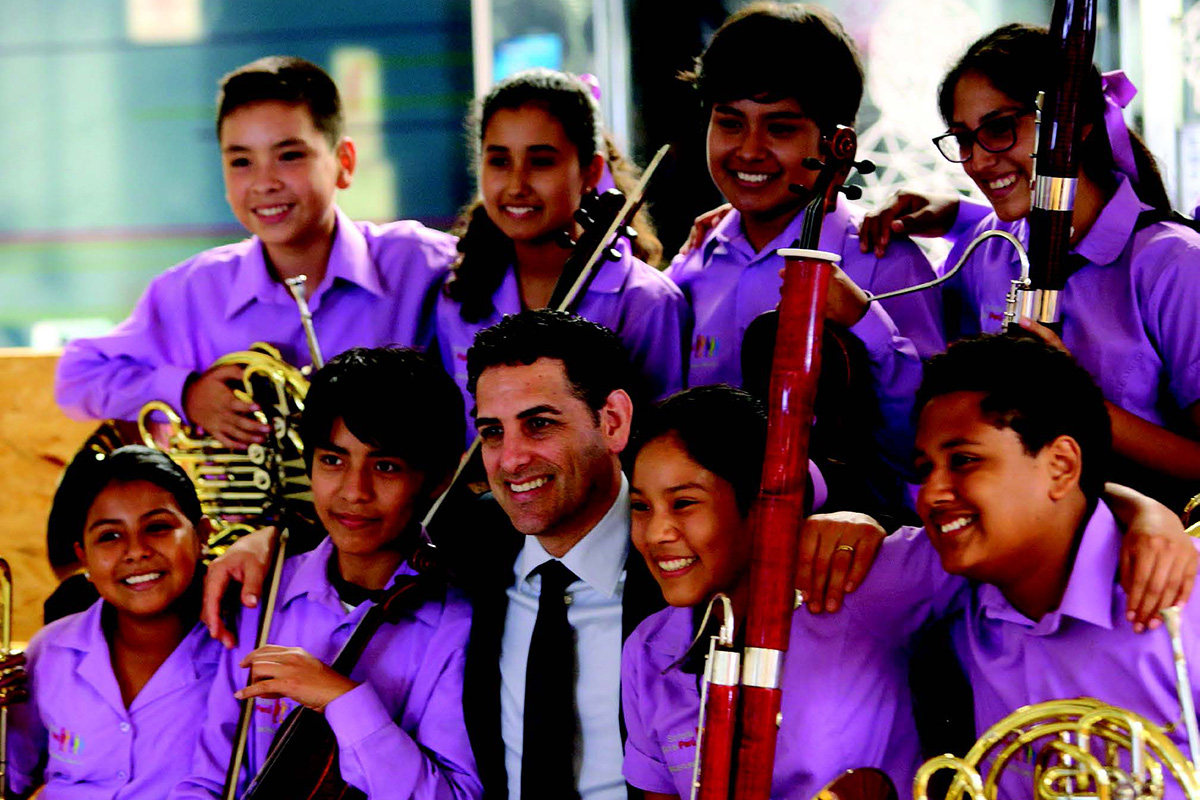 Juan Diego Florez with recipients of music education from his charity Sinfonía por el Perú (courtesy of Castiglione Arts & Culture).
Then the encores began – all seven of them – starting with three Peruvian and Mexican songs. The tenor accompanied himself on guitar, as he is wont to do. Flórez is much associated with música criolla, a distinctive music from the coast of Peru, often in a waltz style. It is an important feature of his charity, Sinfonía por el Perú, which he founded in 2011 to provide disadvantaged children and adolescents with a musical education (this year, 7,000 of them are the beneficiaries).
Best of all was the third encore, Tomás Méndez’s ‘Cucurrucucú paloma’, which was capped by the sweetest, longest high note ever held in Hamer Hall, sadly overwhelmed by the excited audience. (Flórez sings it on YouTube.)
Then we had ‘La donna è mobile’, ‘Pour mon âme’ from La fille du regiment (with its nine high C’s), and two Neapolitan songs. By then, the entire audience (including a healthy, flag-brandishing Peruvian contingent) had lost much of its self-control. The night had been all about music, buoyant and uninhibited.
On a day when John Howard – the great cynic and opportunist of Australian public life – declared that he had always been ‘troubled’ by the concept of multiculturalism, Melbourne gave yet another demonstration of the joyous possibilities of diversity and pluralism. But then, John Howard never strummed a guitar or held a sweet note.
Bravo to Castiglione Arts & Culture for bringing Juan Diego Flórez to Australia. Let us hope this memorable concert will encourage the national company to present Flórez in a full production.
Juan Diego Flórez (Castiglione Arts & Culture) appeared in Hamer Hall on 2 November 2023. The concert was repeated in Sydney on 5 November and will be repeated in Canberra on 7 November.