


- Free Article: No
- Contents Category: Music
- Custom Article Title: Melbourne International Jazz Festival
- Review Article: Yes
- Article Title: Melbourne International Jazz Festival
- Article Subtitle: The most exciting MIJF to date
- Online Only: No
- Custom Highlight Text:
Building on the success of the 2022 Melbourne International Jazz Festival (MIJF) – never guaranteed, coming off Melbourne’s lockdowns – the MJIF’s artistic team, at first glance, looked to have voted for more of the same, casting a wide net to ensure that plenty of musical diversity was on offer. After the triumph of last year’s Big Saturday event at Sidney Myer Music Bowl, featuring New Zealand funksters Fat Freddy’s Drop, the Festival rebranded this year’s event Jazz at the Bowl, headlined by 1980s soul diva Chaka Khan and funk producer Nile Rodgers, best known for his pioneering work with Diana Ross and David Bowie.
- Article Hero Image (920px wide):
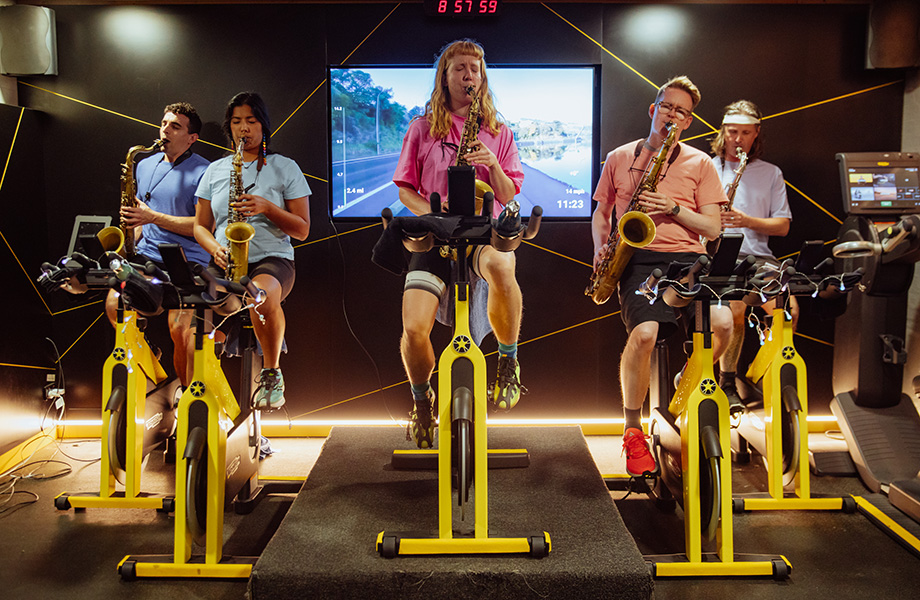
- Article Hero Image Caption: Dead Weight at the Melbourne City Baths (photograph by Will Hamilton-Coates).
- Alt Tag (Article Hero Image): Dead Weight at the Melbourne City Baths (photograph by Will Hamilton-Coates).
- Production Company: Melbourne International Jazz Festival
You could be forgiven for asking: is it jazz? The short answer is: no. But I suspect few of those dancing to Chaka Khan’s ‘What Cha’ Gonna Do for Me’ at the sold-out event cared either way. On the flipside, this year’s program celebrated jazz’s roots with a Saturday-afternoon street parade, led by New Orlean’s Hot 8 Brass Band. Elsewhere, eighty-seven-year-old Ghanian guitarist Ebo Talyor joined forces with local afrobeat exponents The Public Opinion Afro Orchestra, while the Australian Art Orchestra mixed it up with Tokyo beat artists Kojoe and Hikaru Tanaka. In the twenty-first century, jazz continues to broaden its reach, continuously morphing, finding nourishment in, and at the same time influencing, a hotchpotch of musical styles. If searching for a theme for this year’s Festival, this was it. The 2023 MIJF, to its credit, showed it has a firm eye on where jazz is at, and where it is likely headed.
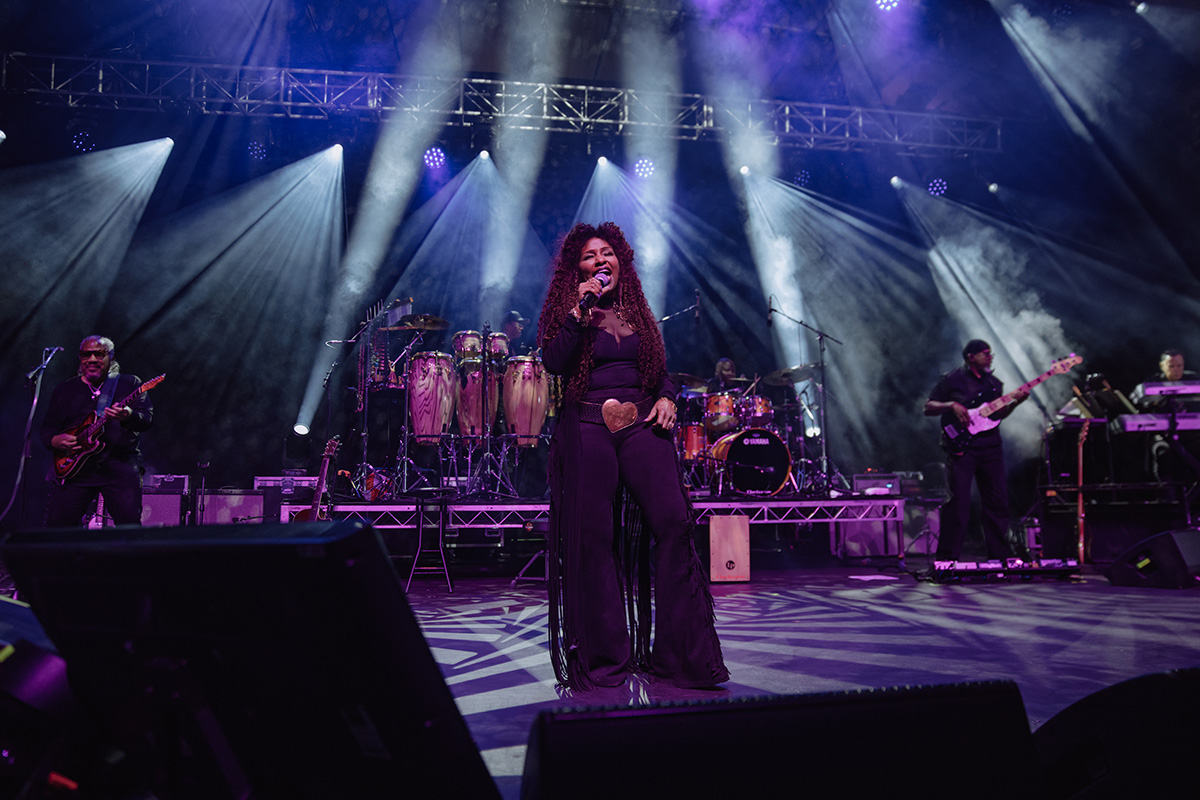 Chaka Kahn at the Sidney Myer Music Bowl (photograph by Will Hamilton-Coates).
In what has become something of a tradition, MIJF opened with a performance by the 2023 Take Note Jazz Leader, saxophonist Cheryl Durongpisitkul. Now in its fifth year, the Take Note program, an MIJF initiative, is designed to help address the under-representation of women and gender-diverse musicians in jazz.
Durongpisitkul has been a marked presence on the Melbourne jazz scene for the past few years, ever since her outstanding début album, Follow Me Through the Red Ash (2017). For her sold-out performance at Brunswick’s Jazzlab, Durongpisitkul presented her hour-long suite – I still Miss You – scored for twelve musicians. She was frank, in the concert liner notes, about the work having its roots in her personal experience of trauma, after the untimely loss of her parents, and subsequent battles with depression.
The six-part suite, a complex mélange of jazz, avant-garde and classical, was riven with tension from the outset, driven by the amplified contrast between the strings – performed by cellist Anita Quayle and violinist Xani Kolac – and vociferous brass, played by trumpeter Reubin Lewis and trombonist Josh Bennier. Vocalists Harriet Allcroft and Emily Bennett contributed an affective overlay, especially Bennett’s sporadic recitations, rife with facial contortion, which provided an air of theatricality.
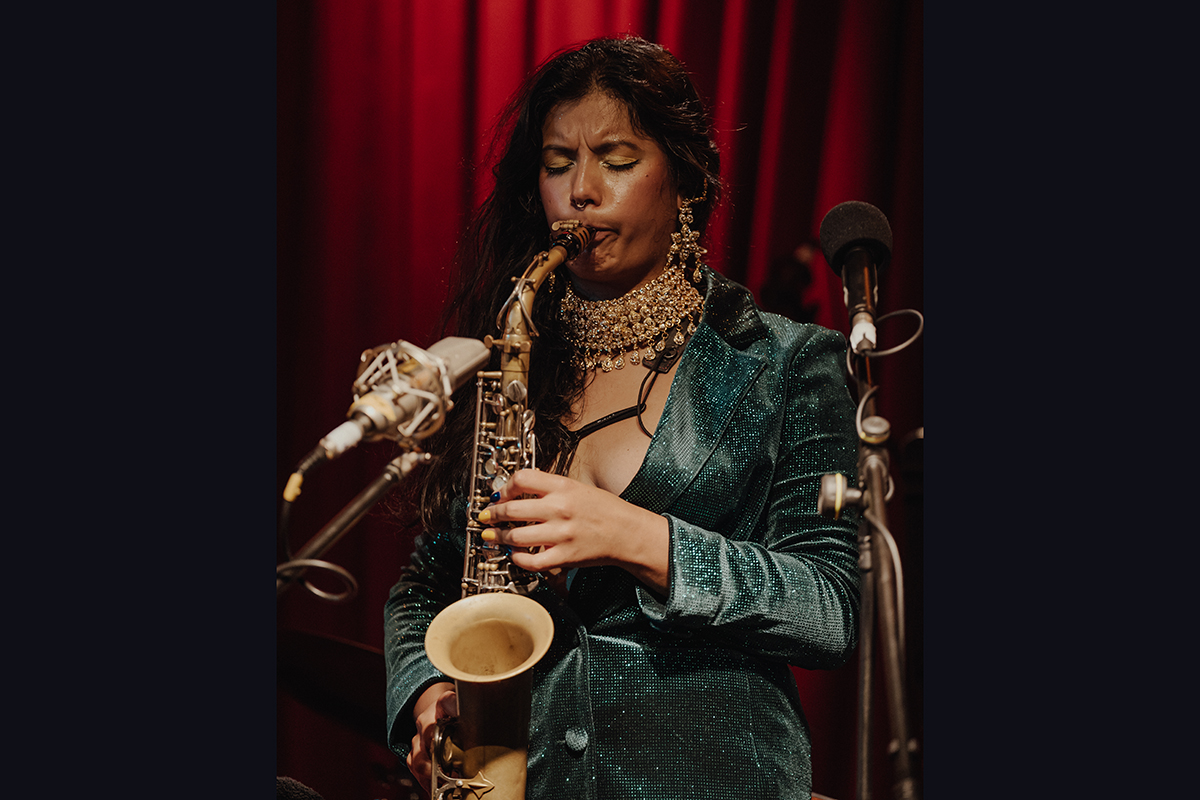 Cheryl Durongpisitkul at the Jazzlab (photograph by Max Roux).
Midway through the concert, the ensemble cast aside their instruments to engage in an extended a capella sequence, unexpectedly invoking Brian Wilson’s preternatural harmonies. This segued into the funereal overtones of the fifth movement, filled with dark and swirling overtones, followed by the suite’s final movement, delicately spun from voices and strings, its overall tenor restorative and healing. Durongpisitkul’s deep dive into her past – a triumph of compositional acumen and leadership – demanded much of the listener, and I found myself returning to it again and again in the days following.
Canadian trumpeter Ingrid Jensen was an inspired choice for this year’s Festival. The work of this mid-career artist, with nearly a dozen albums to her name, is distinguished by its lyrical style and open-ended arrangements. For her Melbourne début at Jazzlab, she was capably supported by a quartet of local musicians: pianist Andrea Keller, bassist Sam Anning, guitarist Stephen Magnusson, and drummer Felix Bloxsom. The fact that Jenson had only met several of these musicians a few hours prior to the concert, in the throes of jetlag, made her performance all the more remarkable.
Jensen’s opening piece, ‘Blue Yonder’, showed off her strengths: shifting time signatures, melodic contours, attentiveness to musical space. She favours a warm, wide-open playing style, though there were plenty of moments when she ratcheted up the heat. Her muted trumpet work, frequently multi-tracked, was exemplary, conveying a glass-like fragility. There were shades of Miles Davis, but the crafted, dynamic flow of her music has more in common with Canadian trumpeter Kenny Wheeler, an acknowledged influence and the inspiration behind her latest album, Invisible Sounds: For Kenny Wheeler. Among the many highlights was Jensen’s interpretation of Andrea Keller’s ‘Time Takes Us’, which segued mid-stream into Wayne Shorter’s tender ballad ‘Penelope’. Built upon long, fluid lines, it unfolded seamlessly, suffused with intense beauty.
American drummer Kendrick Scott, performing at Chapel Off Chapel, in Prahran, offered a masterclass in contemporary jazz, executed at the highest level. Surrounding himself with fellow musicians from the SF Jazz Collective – also appearing at MIJF – Scott channelled the spirit of drummers like Max Roach and Art Blakey, putting his own brash spin on hard bop and beyond. Saxophonist Chris Potter, one of the outstanding musicians of his generation, was a fiery presence throughout, discharging spirited volleys on tenor and soprano; while vibraphonist Warren Wolf’s agile and supple flights bore witness to why he is considered the heir to the late Bobby Hutcherson, legendary Blue Note artist and one of the founding members of the SF Jazz Collective. Scott’s composition, ‘Corridors’, the title track of his new album, was a standout, its pared-back, moody theme motivated by his apartment’s long corridors, which he all-too frequently paced during the Covid pandemic. In the main, however, Scott’s performance proved a high-octane workout, bristling with energy and blistering solos, as he took full advantage of his quintet’s surfeit of musical talent.
Performing at Jazzlab, Chicago-born trumpeter Marquis Hill delivered his futuristic take on jazz, steeped in hip hop, neo-soul, and funk beats. Crucial to his sound was the presence of self-styled beat scientist, drummer Makaya McCraven, alongside electric bassist Junius Paul, and Pittsburgh-born, Melbourne-based pianist Brett Williams, whose propulsive electric keys, especially, contributed a spacey, psychedelic feel. Employing chimes and tiny bells to good effect, Hill inserted occasional recorded voices into the mix, building aggregated backdrops for his improvisations. Largely, the quartet’s music followed a languid approach, mingling robust elements with spirited soulfulness. Leveraging off strong grooves, Hill dispensed slippery, gnarly solos, frequently multi-tracking his instrument, as he steered a labyrinthine course through McCraven’s hard-driving, staccato percussion.
Hill was back on the podium a few nights later, this time as part of Makaya McCraven’s quartet, performing at the Croxton Bandroom, in Thornbury, a large, darkened, cavernous space, crowded to boot. By its very nature, this proved a vastly different experience. The Chicago-based McCraven is part of an adventurous vanguard expanding jazz’s audience, integrating samples, beats, pulses, rhythmic grooves, to build rich sonic tapestries. Playing music from his latest album In These Times (2022), he was unflagging in the drum-seat, coming across as an irrepressible beat machine. Junius Paul’s resounding bass filled the room, while Marquis Hill’s trumpet generated squalling drones. But the dominant voice was Matt Gold’s guitar, full of spiky and angular hooks, which danced above the metronomic beats, weaving endlessly hypnotic patterns, especially on McCraven’s prepossessing composition ‘Dream Another’.
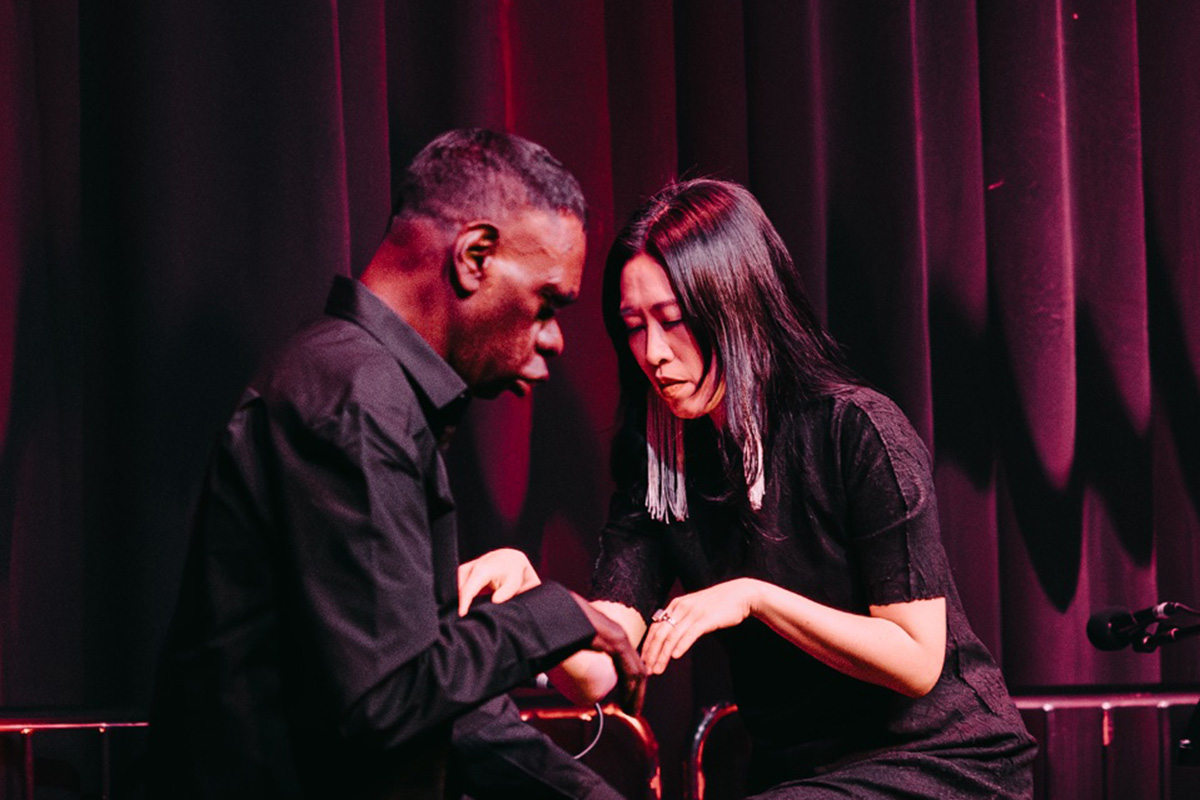 Hand To Earth at The Substation (photograph by Eloise Coomber).
The post-pandemic landscape allowed 2023 MIJF to dramatically scale up the number of international acts. While the Australian headliners shrank accordingly, primacy was given to premières of new work, often requiring the sort of medium-to-large-scale forces rarely accommodated – for financial reasons – by the local club scene. Chief among these were Hand to Earth’s The Crow, a newly devised collaboration between Polish violinist Amalia Umeda, and trumpeter Peter Knight’s genre-crossing ensemble, featuring Korean-born voice artist Sunny Kim, Yolngu songman Daniel Wilfred, and his Yidaki-playing brother David, and clarinettist Aviva Endean; as well as the première of the Vanessa Perica Orchestra’s new album, being launched at the Festival; and a concert by a large contingent of Sydney musicians, presenting two works: Empty Voices + Ghosts Between Streams. Added to which, arguably the quirkiest presentation in living memory: the Australian première of Shannon Barnett’s site-specific Dead Weight, performed inside the Melbourne City Baths, which saw a team of saxophonists performing on exercise bikes, double bassists engaging with a rowing machine, and a funk workout with gym instructor.
There was heightened expectation around composer Vanessa Perica’s concert at the Recital Centre. On the back of her début album, Love is a Temporary Madness (2020), Perica was catapulted to the forefront of Australian composers, winning Best Jazz Album at the Music Victorian Awards, and Work of the Year at both APRA Art Music Awards and Australian Jazz Bell Awards. Performing her new album, The Eye is the First Circle, in its entirety, she once again drew upon her hand-picked, seventeen-piece ensemble, comprising some of the top-calibre jazz musicians in the country. Like Duke Ellington, she clearly relishes the opportunity to compose with particular musicians in mind.
Perica’s seven new compositions were distinguished by a rotating roster of outstanding soloists, including trumpeters Matt Jodrell and Paul Williamson, trombonist Jordan Murray, and saxophonists Julien Wilson, Carl Mackey, Jamie Oehlers, and Tessie Overmyer. For the most part, Perica’s music eschewed the swing of early big bands, instead looking to the impressionistic sounds of arrangers like Gil Evans, George Russell, and Maria Schneider. Perica’s multi-layered compositions, awash with tonal colour and texture, were elevated by her bold use of romantic embellishments and by her capacity for building musical stories. Her compositional strategy beautifully pitched Andrea Keller’s earthy piano, and Theo Carbo’s delicate guitar hooks, in opposition to the soaring, free flights of the horns, generating a thrilling tension. Emotionally charged, densely crafted, and lyrically woven, Perica’s performance was testimony to her exceptional artistry.
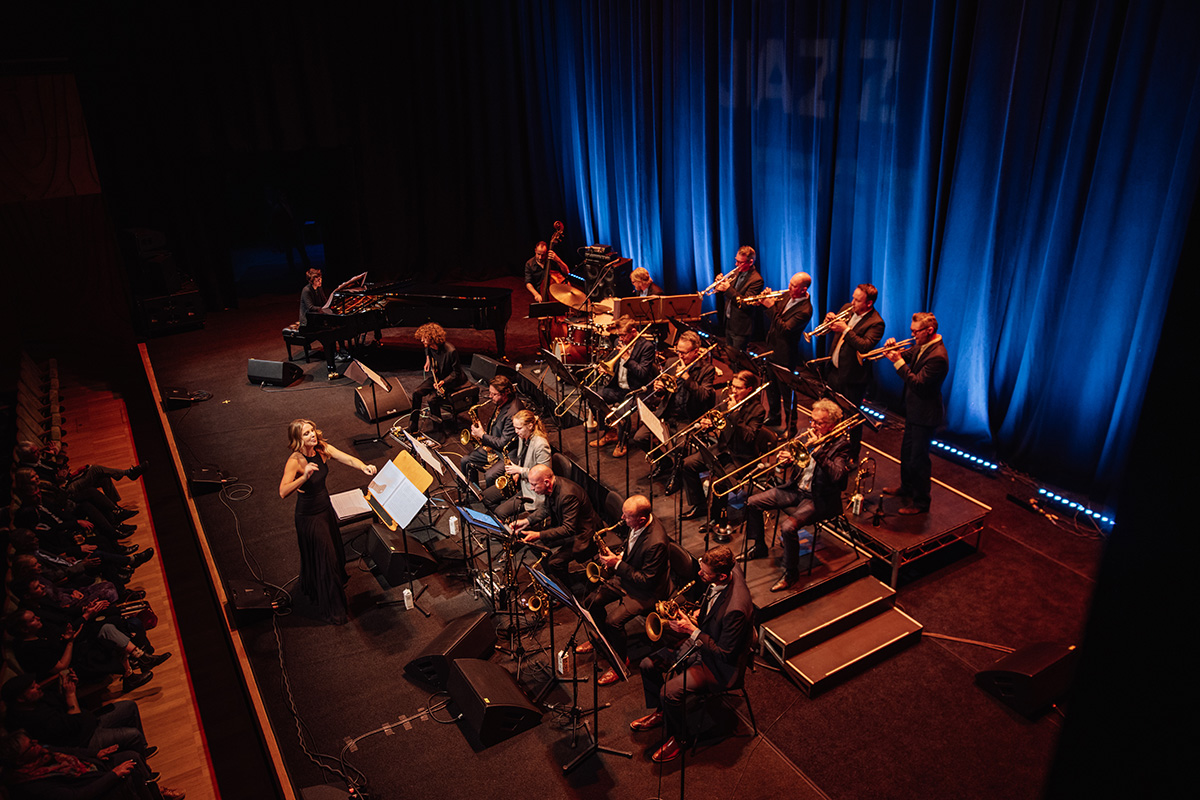 Vanessa Perica at the Recital Centre (photograph by Will Hamilton-Coates).
The two works Empty Voices + Ghosts Between Streams, performed at Chapel off Chapel, were tenuously linked by the presence of Sydney trumpeter and 2022 Freedman Jazz Fellow Tom Avgenicos, who featured in both. First up, he presented his own suite Ghost Between Streams, which arose out of his daily walks through Stringybark Creek Reserve, near his home, during the Covid lockdowns. Performed by his quartet Delay 45, and augmented with a string quartet – the entire ensemble strikingly garbed in white – the piece’s elegiac tone, generated by long, brooding trumpet lines, reflective strings, and darkened electronic overlays, manifested the composer’s disquiet as he observed this natural retreat increasingly threatened by urban development.
Empty Voices, performed by a septet of Sydney players, was led by Hamed Sadeghi, the Sydney-based, Iranian-born tar player (a form of Iranian lute). Inspired by Sufi mysticism, and his Persian ancestry, Sadeghi’s music was rooted in hypnotic grooves, as he improvised freely, elegantly weaving melodies over Lloyd Swanton’s sinewy bass and Adem Yilmaz’s delicate hand percussion. Sandy Evans’s lengthy soprano sax solo, on the final piece, ferocious and intense, proved utterly magnetic, further evidence – should we require it – that she remains as one of our greatest musical treasures.
The final weekend of MIJF witnessed two contrasting acts re-imagining one of jazz’s classic formats: the piano trio. Manchester’s GoGo Penguin rocked Melbourne’s Forum, before a huge crowd, with Chris Illingworth’s piano producing booming, repetitive and shimmering patterns, full of reverb, on top of Nick Blacka’s roiling bass lines and Jon Scott’s driving percussion. Animated by their hometown’s electronica and rave scene, along with bands like Esbjörn Svensson Trio (E.S.T.), and Nik Bärtsch’s Ronin, GoGo Penguin doled out a frenetic, trancey outpouring of high-voltage, futuristic jazz.
Pianist Nduduzo Makhathini – the first South African musician to be signed to the prestigious Blue Note label – brought his trio, featuring bassist Zwelakhe-Duma Bell le Pere and drummer Francisco Mela, to the Jazzlab over two successive nights, offering up his own brand of spiritual jazz, which leans heavily on his Zulu heritage. From the outset, the trio’s music flowed like a mighty river of sound, full of unexpected twists and turns. Makhathini possesses a huge sound, his left hand laying down rumbling chords, over which he freely improvises, recalling the work of McCoy Tyner and Randy Weston. He restlessly leapt from one melodic idea to the next, interspersing his playing with chant, song, and African flute. The overall effect was mesmerising, as the trio segued between densely cluttered, frenetic passages, and serene spiritual themes.
There was a celebratory air about MIJF’s final night, held at Hamer Hall, a concert featuring American vocalist Cécile McLorin Salvant, three-time Grammy winner, and arguably the greatest jazz singer of her generation. Performing with a piano trio, she delighted the audience with her astonishing vocal range, breathing new life into standards, many drawn from the classic American songbook: Leonard Bernstein, Stephen Sondheim, Rodgers and Hammerstein. She brought the house down with her rendition of ‘Haunted House Blues’, a song made famous by Bessie Smith, and finished her second encore with a superlative rendition of Nat King Cole’s ‘Nature Boy’, achingly whispered over gentle piano, thoroughly deserving the warm, standing ovation she received.
Over ten days, and nearly a hundred events, MIJF exposed audiences to new artists – such as Makaya McCraven and GoGo Penguin – helping to shape jazz’s future. It mounted memorable, large-scale productions; it highlighted the overwhelming diversity of contemporary jazz. It delivered world-class acts, like Cécile McLorin Salvant. It offered up unique events, pairing trumpeter Ingrid Jensen with local singer Kristin Berardi; and Nduduzo Makhathini with didgeridoo player, and Kalkadunga man, William Barton. It programmed a healthy mix of free and paid events, spread across the city and suburbs. More importantly, it demonstrated a preparedness to push boundaries and challenge assumptions. It did, in short, what great festivals should do.
To my mind, the 2023 MIJF ranks as the most far-reaching, and exciting to date, establishing it without doubt as the pre-eminent jazz event in the country. In the wake of the recent demise of the long-running Wangaratta Jazz Festival, MIJF’s stature and its contribution to the future of Australian music are even more paramount. It’s to be hoped that funding bodies will recognise and support its continuing growth. While it will be no easy matter to surpass this year’s program, I find myself already eyeing off the year ahead.
The Melbourne International Jazz Festival ran from 20–29 October 2023.