


- Free Article: No
- Contents Category: Theatre
- Custom Article Title: Flake
- Review Article: Yes
- Article Title: Flake
- Article Subtitle: Dan Lee's dark and comic Hanoi play
- Online Only: No
- Custom Highlight Text:
Dan Lee’s first play, Bottomless, premièred at fortyfivedownstairs in 2018 after receiving the last R.E. Ross Trust award four years previously. Critics drew attention to the unusually star-studded cast for a début – Mark Coles Smith, Julie Forsyth, Jim Daly, Alex Menglet, Uncle Jack Charles – but its depiction of the residents of a dry-out facility in Broome garnered a mixed reception. The effect of Lee’s writing, wrote Tim Byrne typically, ‘may be unwieldy and overstuffed, but at least it feels rich. At least it has ambition.’
- Article Hero Image (920px wide):
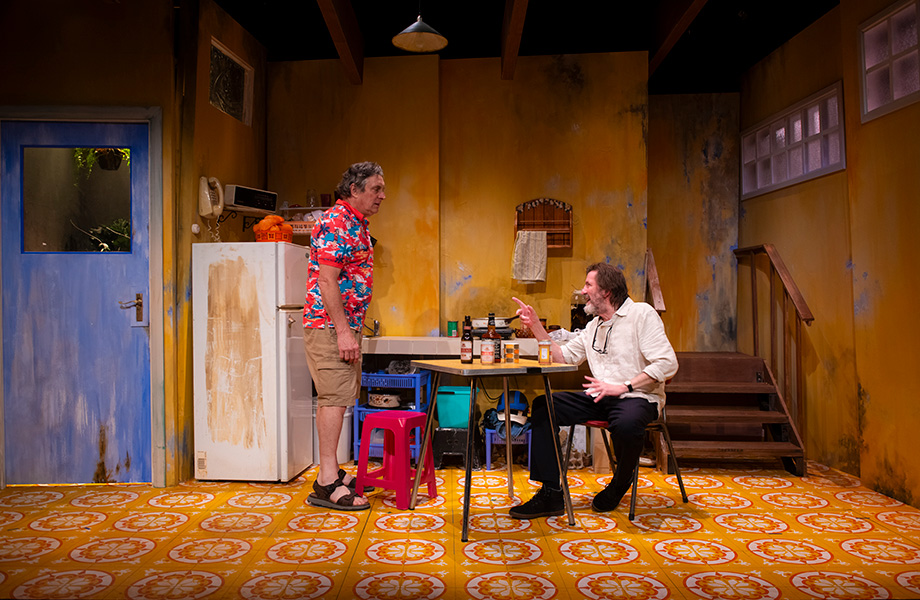
- Article Hero Image Caption: Joe Petruzzi and Robert Menzies in Flake (photograph by Jodie Hutchinson)
- Alt Tag (Article Hero Image): Joe Petruzzi and Robert Menzies in Flake (photograph by Jodie Hutchinson)
- Production Company: Red Stitch Actors’ Theatre
Much the same could be said of Lee’s new play, Flake, a darkly comic three-hander set in a claustrophobic Hanoi apartment. As with Bottomless, Flake evinces a sometimes sparkling, sometimes uneasy mixture of naturalism and a heightened, occasionally flamboyantly literary style. When it works, it is riveting; when it doesn’t, it retains the air of a first-time playwright trying entirely too hard.
The play’s set-up is straightforward. Hawaiian-shirted larrikin Murph (Joe Petruzzi) is visiting his lifelong friend, the misanthropic Bob (Robert Menzies), in his apartment on the edge of the Vietnamese capital. The pair are an archetypal odd couple – think Sideway’s Miles and Jack, Withnail and I’s titular duo, or the Neil Simon play/movie which gave the trope its name – bonded more by shared history and mutual contempt than by anything approaching conventional friendship. A triangle forms when, in the play’s opening scene, Murph brings a young Vietnamese-Australian medical student, Duyen (Phoebe Phuoc Nguyen), back to the flat after a night on the beers.
Over the course of two acts, Lee reveals more about what has brought each of the characters to their present juncture. Murph has, in fact, been tasked with checking in on Bob by the latter’s son, Zac, with whom Bob – in denial about the dementia that is slowly overtaking his ability to remember and reason – has little contact. All, in their way, are in flight from familial responsibility, the play’s overarching theme. It is also concerned with the consequences of ageing in an increasingly atomised society. Bob, we learn early, is contemplating suicide, and has sourced a vial of morphine for the task. Alternating between disdain and a kind of veiled reverence, he broods over a bonsai tree gifted to him to assuage his loneliness, and which inhabits one corner of the apartment. At one point, Duyen explains that a branch which has been irritating Bob, conspicuously jutting out from the base of the tree, is in fact purposeful, facilitating new growth. It is a powerful symbol of the play’s exploration of how to age – and, moreover, die – well in a society which would, much like Murph, prefer not to think about the matter at all.
Lee’s facility for language – elevated and lyrical but shot through with coruscating invective – reminded me of an earlier generation of Australian playwrights, especially those like Jack Hibberd and John Romeril, who emerged from the crucible of the Australian Performing Group in the 1970s. Most of the laughs – and there are many – arrive at the expense of Murph, brutally but wittily cut down by Bob. His multiple families, spread around the world, represent an ‘international experiment in genetic diversity’. He is ‘like a dog being shown a card trick – enthusiastic but baffled’. In Murph’s increasingly undignified attempts to woo women young enough to be his daughter, Bob charges him with being a ‘libidinous Nosferatu’.
While enlivening, the verbosity of Lee’s characters feels at times more literary than theatrical. In the end, it’s a fine line. A different director or dramaturg might have pushed for the excision of Bob’s evocative, almost dreamlike second-act monologue on everything from Hanoi’s resilience to the horrors of late-stage capitalism. But that would be to deny Lee’s natural strength as a writer and to accede to what I’ve heard described as ‘Pinterising dramaturgy’, whereby anything deemed dramaturgically extraneous – namely, all the jokes and the poetry – is filleted out to the detriment of the whole. While cumbersome at times, Lee’s script is nevertheless that rare thing on the contemporary stage, a play that bucks the trend for stripped-back naturalism, aiming instead for a loftier, more allusive mode.
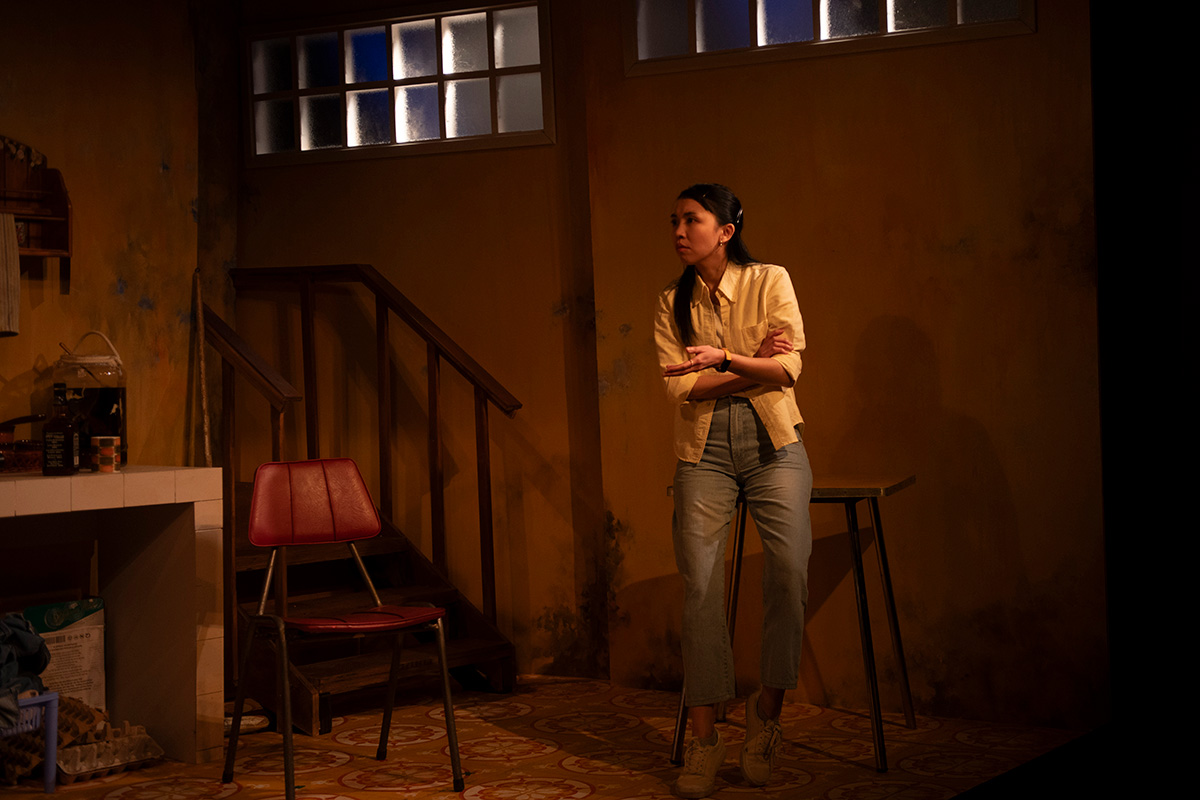 Phoebe Phuoc Nguyen in Flake (photograph by Jodie Hutchinson)
If the play ties for itself another Gordian knot, it is that Duyen rarely presents as a fully developed character. Lee may state in his program note his desire for the role to have ‘depth and authenticity’, but, even with the assistance of Vietnamese-Australian co-creator Chi Nguyen, I am not sure he succeeds. Duyen is, for the most part, a prop to the men’s stories, and even when we learn more about her past in the second act her comfort around Murph and Bob – even extending to an uninvited back massage – registers as dramaturgically convenient rather than believable at the level of character. It doesn’t help matters that Nguyen’s performance is rather tentative at first, although she undoubtedly comes into her own during the play’s second half.
It may be unfair to contrast Nguyen’s performance with those of her far more experienced co-stars, but it is also unavoidable. Petruzzi and Menzies are simply outstanding, the latter especially impressive given a recent bout of illness meant that he was still partially on-book on opening night. Together, they are the ideal vehicle for Lee’s shaggy-dog story, relishing the couple’s baroque sparring and the play’s myriad opportunities for their finely honed, though never indulgent, comic sensibilities. Under the astute direction of Ella Caldwell, the pair navigate the play’s darker turns equally well, Menzies able to draw our sympathy despite, to paraphrase Dylan Thomas, his almost relentless ‘burning and raving at close of day’.
The staging makes excellent use of the tiny theatre. Jacob Battista’s apartment set, with its yellowed flats, begrimed fridge and benchtop, and general air of squalor, is a masterpiece in spatial economy. A doorway leading to a courtyard filled with potted plants, and a staircase trailing off into other, unseen parts of the apartment, ingeniously extend the play’s otherwise oppressively small world. Jason Ng Junjie’s lighting design similarly gestures to larger, out-of-sight places, its warm, sunlight-evoking side lighting particularly expansive. Daniel Nixon’s soundscape subtly but effectively conjures the bustle of Hanoi with its car horns, motorbike growls, and bursts of K-pop and traditional Vietnamese music.
Flake is, ultimately, a chamber play, but one unafraid to tackle weighty subjects or take formal risks. While it feels of a different time in its high-flown language and relative blokeyness, its rich vein of humour, coupled with a deeply human core, elevate what might otherwise have ended up as a mere stylistic exercise. It is telling that the play’s final image challenges rather comforts the audience, refusing any temptation to let us off the hook with another witticism.
His hand tremoring, Bob stands alone with a monumental decision in front of him: to remain, in the handful of years he has left to live, in his adopted home or to return to Australia to be with his son. The image is both bleak and hopeful. He may yet make the ‘right’ choice or he may not. In between is all the ambivalence, anguish, and potential of what it means to be human.
Flake continues at the Red Stitch Actors’ Theatre until 5 November 2023. Performance attended: 18 October.