


- Free Article: No
- Contents Category: Opera
- Custom Article Title: The Visitors
- Review Article: Yes
- Article Title: The Visitors
- Article Subtitle: Christopher Sainsbury’s new opera
- Online Only: No
- Custom Highlight Text:
The birth of a new opera is always exciting. Unlike a play or a sonata, an opera brings together a variety of art forms, with performers and creatives drawn from many different backgrounds. The libretto of Christopher Sainsbury’s The Visitors draws on a new, more gender-balanced version of an existing play, Jane Harrison’s The Visitors (2020), currently running in Sydney and Wollongong.
- Article Hero Image (920px wide):
,%20Jess%20Hitchcock,%20Lillian%20Fromyhr,%20Zoy%20Frangos,%20Eddie%20Muliaumaseali%E2%80%99i.jpg)
- Article Hero Image Caption: The cast of The Visitors (photograph by Charlie Kinross).
- Alt Tag (Article Hero Image): The cast of The Visitors (photograph by Charlie Kinross).
- Production Company: Victorian Opera
Victorian Opera, under Richard Mills’s long artistic direction, has been an intrepid commissioner of new work. This was not the company’s first venture into the First Nations space, but was probably their most systematic, with all seven singers, as well as composer, librettist, and director, Isaac Drandic, sharing Indigenous heritage.
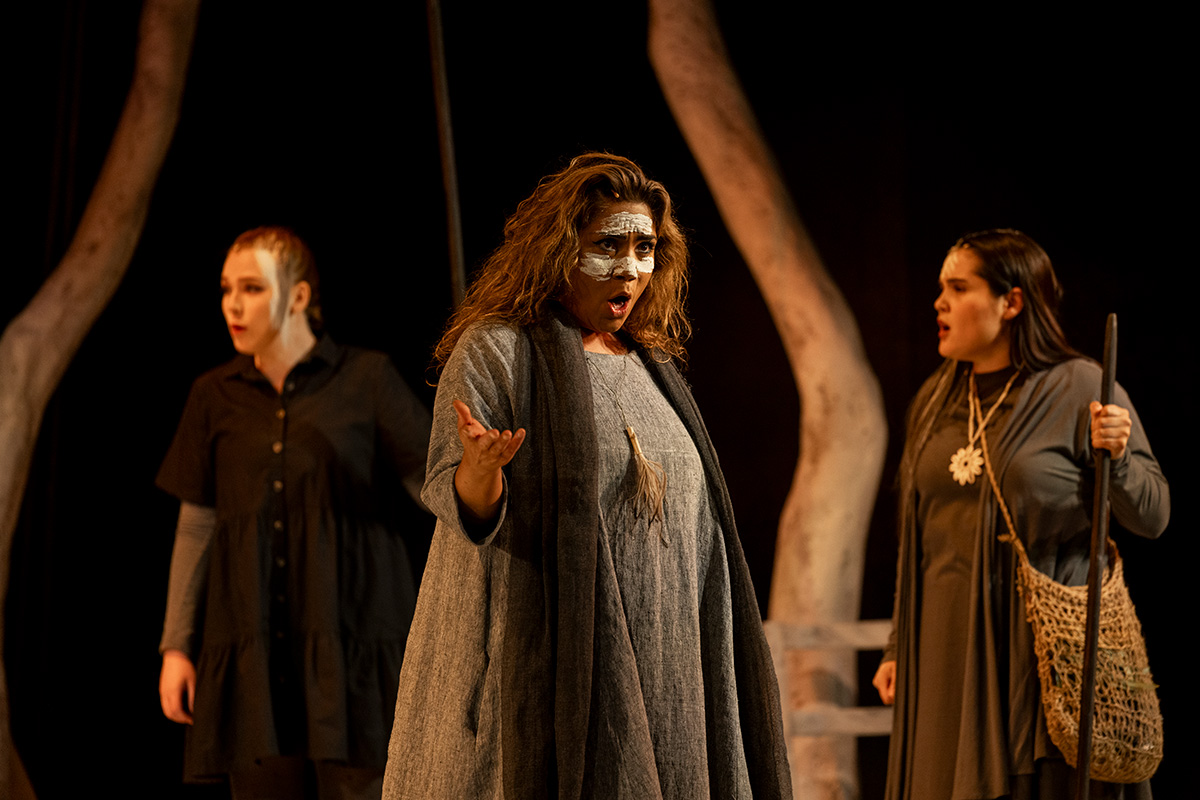 Lillian Fromyhr, Shauntai Sherree Abdul-Rahman and Jess Hitchcock (photograph by Charlie Kinross).
In an interview with ABR Arts, Sainsbury took pains to explain that his opera is a comedy, based on ‘Blackfella humour’: ‘a journey in culture and protocols, in humour and emotions, as we wait to see whether the locals shun or welcome “the visitors”’. Drandic sees it in more epic terms, as a ‘big ceremony’ in song. As in Harrison’s play, these British visitors are never seen on stage, but their ships, habits, and actions (including a hanging) drive the discussion and decision-making of the elders. Sainsbury’s one-hour ‘number opera’ has thirty-five discrete sections, and its musical form largely follows the three votes of the elders as they search with difficulty for a common stance towards these visitors.
Sainsbury’s style is one of mild modernism, sometimes verging into jazz, and once or twice into rock. He mentions Harrison Birtwistle and Hans Werner Henze as compositional influences, as well as Maurice Ravel, whose one-act, twenty-one scene musical comedy, L’Heure espagnole (1911), clearly influenced his concept. The Visitors, then, skilfully sweeps the listener through these many short sections, with the chamber orchestra of twelve players (string quintet, wind/brass quintet, guitar/mandolin, percussion), setting a generally benign pace, which favours easy intelligibility of the sung, and occasionally, spoken words. Aboriginal melodies from Sydney, the Blue Mountains and Central Coast regions, as well as local birdsong, particularly the pied butcher bird, feature repeatedly, notably in the flute (Kim Falconer) and clarinet (Lachlan Davidson) parts. Sainsbury’s texture is consequently very light; indeed, he talks about using impressionistic, ‘small brush strokes’, especially in musically representing the flow of opinions this way and that during the elders’ debates.
Many of those brush strokes, and minor points of punctuation, are played by the battery of untuned percussion instruments that Sainsbury specifies (all played by drummer Niko Schauble). This gives a crisp, nutty, contemporary tone to the ensemble. The frequent use of the guitar and occasionally mandolin (both played by Ken Murray) also fills out the spiky, sinewy texture.
While his instrumental style has a high homogeneity, Sainsbury devises his vocal lines to highlight the different characters of the six adult elders and a young girl, Lois (Lillian Fromyhr), representing her south clan elder. Indeed, Sainsbury had the luxury of composing most of these vocal parts with this première’s actual performers in mind, some drawn from traditional opera, with others coming from backgrounds in popular music or musicals. Hence, the naïve, cocky petulance of Jacob (Marcus Corowa); the stalwart nature of the meeting’s Chair, Gary (Elias Wilson); the steadiness of Albert (Eddie Muliaumaseali’l), who ‘knows how things work’, and the diagnostic precision of medicine-woman Joycie (Jess Hitchcock). More dynamic across the work is the musical change from aggressive leader to emotionally intense diplomat in the character of coastal elder Gordon (Zoy Frangos).
The ‘clever one’, up-river Winsome (Shauntai Sheree Abdul-Rahman), is a more complex character and, hence, harder musically to read. She successively challenges the others’ suggestions of shooing the visitors away, allowing them to land, somehow helping the ‘poor things’, giving everyone a chance, or welcoming the strangers but demanding respect for their Indigenous ways. But she is the one who speaks forthrightly for all in affirming their late consensus that the visitors ‘must go’. In their individual solo numbers, and numerous ensembles, reflecting their changing opinions, Sainsbury adopts a simple syllabic word-setting, and only half a dozen times in these ensemble scenes ventures into the more emotional, but less comprehensible polyphony beloved of high opera. At its conclusion, The Visitors elegantly side-steps the question of what historically came next by using the device of a slow fade to darkness and silence. For we all know that these visitors did not go. They stayed, became colonisers, and many of the portents of doom repeatedly referred to in the opera, notably illness (represented by the spluttering young Lois), did come to pass.
As the audience’s reception showed, this première hit its mark. The whole enterprise relied upon gripping the audience from start to finish with the ebb and flow of approaches from the elders to an event normally told in our national narrative from the ‘other side’, of the visitors. The spare set – nothing more than four leafless trees, four chairs, and occasional projections of ship rigging, but subjected to brilliant red, ochre and shadowy lighting effects –
the comfortable, everyday couture, and a somewhat less predictable sound system, were all designed to concentrate the audience’s attention upon the weighty questions under debate. While all the characters were fine singers, some were better actors than others, most notably Corowa and Abdul-Rahman. The small orchestra, ably conducted by Victorian Opera’s Head of Music, Phoebe Briggs, and led by violinist Jaso Sasaki, never overstepped its vital role of musically contextualising the story. Sometimes, in their enthusiasm, they nudged up the middle-of-the-road tempos that Sainsbury had carefully specified. Just a little more lingering would have been nice. After all, the audience’s surtitles did diligently record the increasing heat, to 44 degrees, of this auspicious day.
There was, however, an elephant in the Playhouse on Wednesday evening. Coming just four days after the national referendum rejecting an Indigenous Voice to Parliament, this première of an opera about finding consensus through voting could have become more a wake than a celebration. In an interview, Sainsbury was nonchalant: ‘I was disappointed but this referendum does not close matters … I was sad for people in remote communities; they were not listened to … but we continue to make art and to make music.’
The Visitors (Victorian Opera) was at the Arts Centre Melbourne from 18 to 21 October 2023. Performance attended: 18 October.