


- Free Article: No
- Contents Category: Film
- Custom Article Title: Killers of the Flower Moon
- Review Article: Yes
- Article Title: Killers of the Flower Moon
- Article Subtitle: Martin Scorsese's depiction of the Osage killings
- Online Only: No
- Custom Highlight Text: Martin Scorsese’s Killers of the Flower Moon begins and ends with a ceremony, starting with a ritual of mourning and concluding with affirmation of community. In between, over the course of 206 minutes, it is a story of murder, manipulation, and survival, an engrossing, deliberate work that also has expansive, unexpected moments and disconcerting juxtapositions. It is packed with vivid cameos and has three striking performances at its centre.
- Article Hero Image (920px wide):
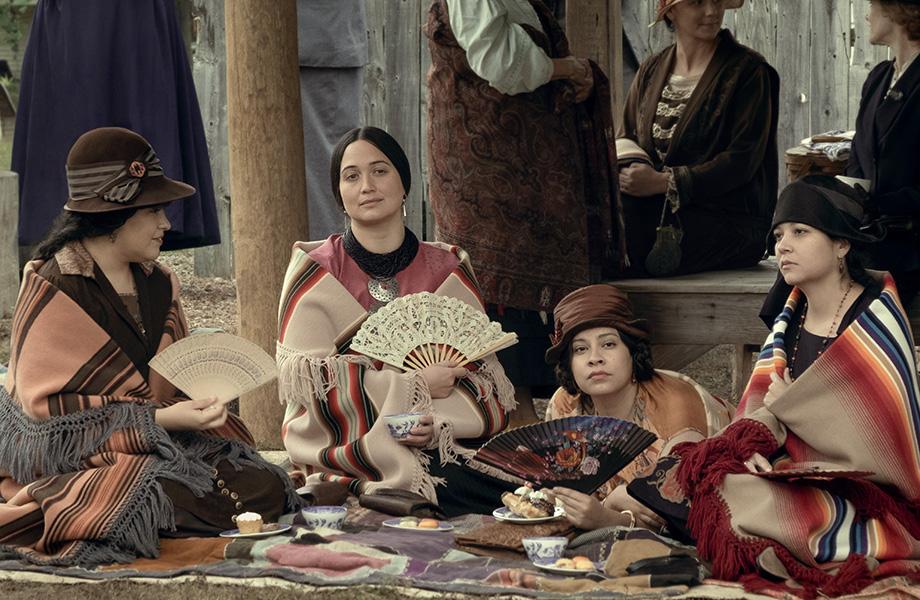
- Article Hero Image Caption: Janae Collins as Reta, Lily Gladstone as Mollie Kyle, Cara Jade Myers as Anna Brown, Jillian Dion as Minnie (photograph by Melinda Sue Gordon and courtesy of Paramount).
- Alt Tag (Article Hero Image): Janae Collins as Reta, Lily Gladstone as Mollie Kyle, Cara Jade Myers as Anna Brown, Jillian Dion as Minnie (photograph by Melinda Sue Gordon and courtesy of Paramount).
- Production Company: Paramount
Its subject is a series of killings in the 1920s that devastated the Indigenous Osage community. In the late nineteenth century, the Osage were driven from their territories by the US government to seemingly inhospitable land in Oklahoma. Early on, Scorsese uses a mixture of newsreel-style footage, photographs, and intertitles to show what happened next. Oil was discovered on their tribal land and Osage lives were transformed: they became, per capita, among the wealthiest people in the world. The newsreels – images relayed to American audiences of the time – play up excess and extravagance, but say nothing about the constraints and the exploitation we see in later scenes. The Osage had money without power, material comfort without security or autonomy. White locals took on official guardianship roles that gave them control over Osage individuals’ spending and decisions. An apparatus of exploitation is constructed around them.
In the midst of all this seeming prosperity, Osage men and women are being killed, sometimes in mysterious circumstances. There is a bluntness and matter-of-factness about the first depictions of the murders, which seem to be committed with impunity. They are happening almost in plain sight, but no one is held to account.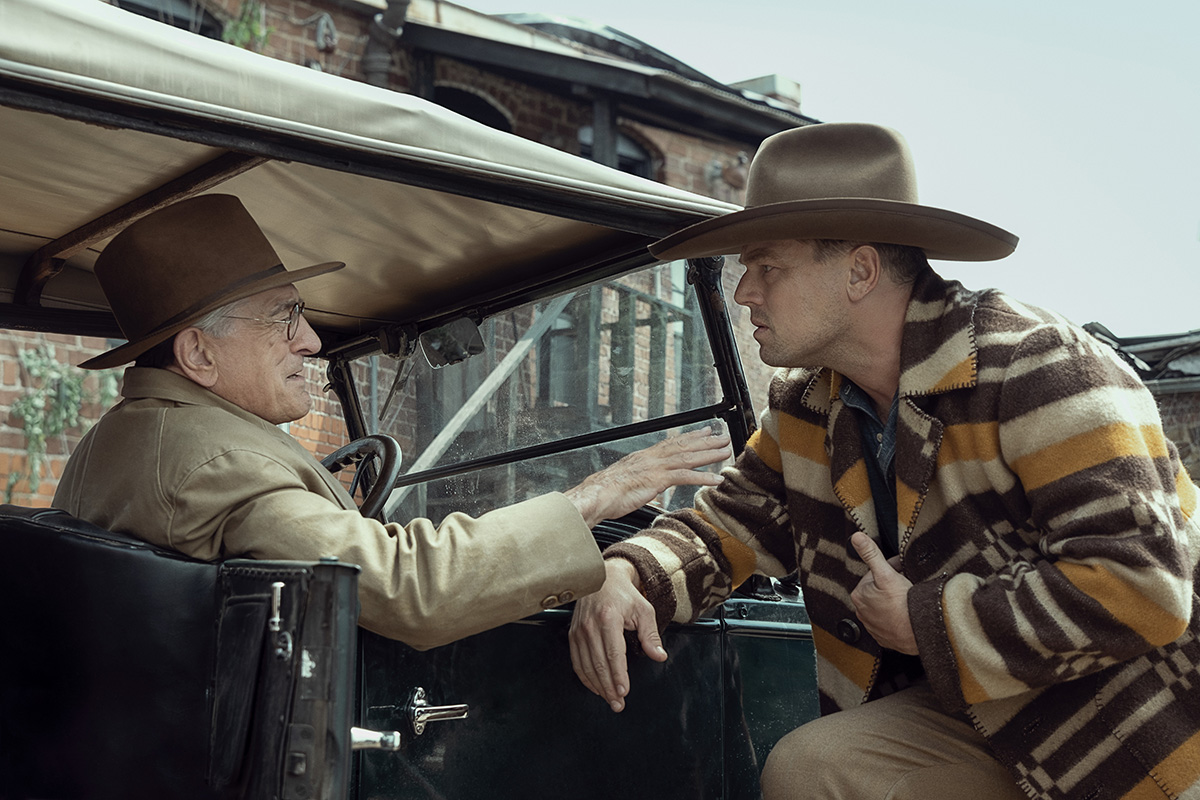 Robert De Niro as William Hale and Leonardo DiCaprio as Ernest Burkhart (photograph by Melinda Sue Gordon and courtesy of Paramount).
Killers of the Flower Moon, which Scorsese co-wrote with Eric Roth, is based on David Grann’s 2017 non-fiction work of the same name. Initially, the screenplay shared the emphasis of Grann’s book, which is subtitled Oil, Money, Murder and the Birth of the FBI (UK edition). Grann’s central figure is Tom White, an agent in the fledgling Bureau of Investigation who stubbornly pursued the case. In this iteration, Leonardo DiCaprio was to play White. But Scorsese, prompted in part by DiCaprio, decided to change direction, and the procedural aspect took second place in the story. It is only in the final stages that an official investigation becomes part of the narrative.
The emphasis shifted towards the embrace of an Osage point of view. The opening scene, for example, comes directly from a book called A Pipe for February (2002), a novel by Osage writer Charles H. Red Corn that begins in 1904, years before the killings, with a burial ceremony that mourns not a person but a way of life, an acknowledgment of how much has already been lost.
The central Osage character, Mollie Kyle, is played by Blackfeet and Nez Perce actor Lily Gladstone. Robert De Niro is William Hale, cattle rancher and man of influence; and Leonardo DiCaprio plays Hale’s nephew, Ernest Burkhart, who comes to Oklahoma for a fresh start and becomes an instrument of his uncle’s lethal ambitions. This is De Niro’s tenth feature with Scorsese, and DiCaprio’s sixth, but it is the first time they have appeared together in one of his films.
As Hale, De Niro combines menace and bonhomie with tightly wound certainty. ‘Call me Uncle, or call me King,’ he tells Ernest, before making it clear that he prefers ‘King’. De Niro gives Hale a kind of unnerving equanimity. Hale can appear magnanimous, and he has found a way to become a respected figure among the Osage. He knows their language, has an awareness of their customs, contributes to local causes, is present at tribal council meetings. This is the worst kind of knowledge, based on self-interest and devoid of feeling. In Hale’s case, it seems only to confirm his feelings of murderous entitlement.
As Mollie Kyle, Gladstone has a distinctive, compelling presence. She had a breakout role in Kelly Reichardt’s Certain Women (2016), in a part that made the most of her ability to convey emotion with wordless delicacy and directness. In Killers of the Flower Moon, she is both self-contained and sociable, poised and self-aware, part of a family and a community. There are occasional shots from her point of view, including one in which she walks through a crowd, the subject of the white townspeople’s aggressive, dismissive gaze.
Physically vulnerable, emotionally strong, Mollie is the axis of the film. She first meets Ernest when he works as her driver; she is taken with him, although she feels she knows his weaknesses far better than he does. In a joking conversation with her three sisters, in Osage language, she makes it clear that she understands that ‘he wants money, but he wants to be settled’, and that suits her. She calls him coyote; sees him as a trickster, a clown, rather than the snake a sister suggests. She singles him out, invites him into her home, replaces his flat cap with a Stetson she places on his head.
The marriage of Ernest and Mollie is what William Hale is angling for, for his own terrible reasons, but it is also something Mollie wants. Where this leads, and what that relationship contains and implies, is a crucial aspect of Scorsese’s vision.
Reflecting on the figure of Ernest, Scorsese and DiCaprio referenced Montgomery Clift and the characters he played in The Heiress (1949) and A Place in the Sun (1951), duplicitous yet ambiguous characters with a hunger for wealth and advancement that seems achievable through relationships with women. Ernest, however, is not alone: his uncle is drawing him into an increasingly terrible course of action, and it takes a long time for him even to consider any kind of resistance.
There have been a few cinematic depictions of the murders of the 1920s, including a lost silent film, Tragedies of the Osage Hills (1926), from producer James Young Deer, and Mervyn LeRoy’s The FBI Story (1959), a fictional account of the bureau’s work in which there is a twenty-minute segment loosely based on the Osage killings. It mentions Mollie but does not depict her; the focus is on James Stewart as an agent going undercover to unmask the conspiracy and using forensic science to provide proof of guilt.
In Killers of the Flower Moon, there is a kind of coda that reflects on decisions and depictions of this kind; it is best not to spell out in a review exactly how this scene works. This startling variation, which harks back to the recreated newsreels at the beginning of the film, functions as a challenge to storytelling – to how we depict and reflect on crime and on the past. This is, however, not the final image we see; what concludes the film is another affirmation of ritual and community, a reminder of where the film began and what it has to offer the future.
Killers of the Flower Moon (Paramount) is released nationally on 19 October 2023.