


- Free Article: No
- Contents Category: Opera
- Custom Article Title: The Makropulos Case
- Review Article: Yes
- Article Title: The Makropulos Case
- Article Subtitle: Janáček at the Paris Opera
- Online Only: No
- Custom Highlight Text: A week in Paris (Billy Strayhorn’s moody panacea) gave ABR Arts a perfect opportunity to savour some of the city’s abundant musical life. We’ll start with an important revival at the Opéra National de Paris, performed at the Bastille.
- Article Hero Image (920px wide):
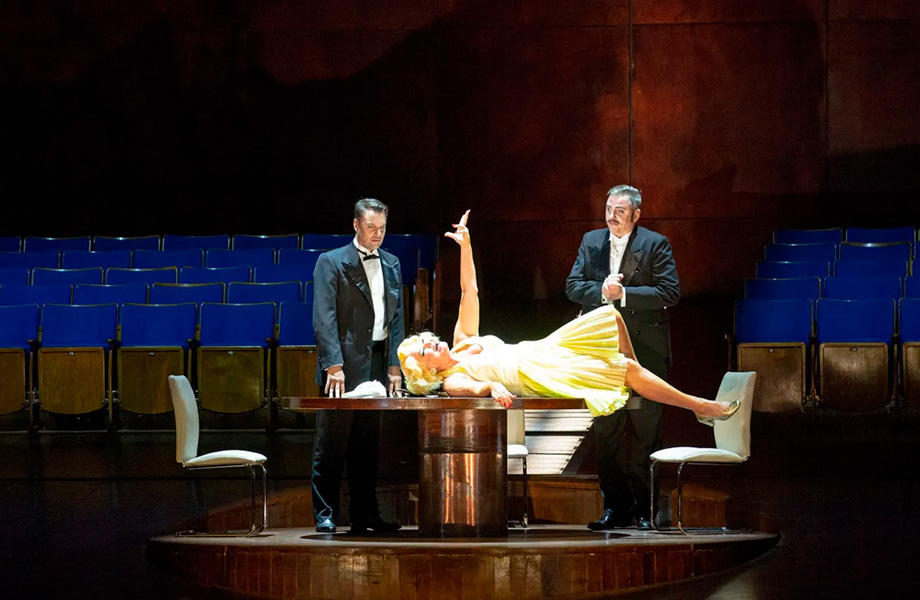
- Article Hero Image Caption: Pavel Černoch as Albert Gregor, Karita Mattila as Emilia Marty and Károly Szemerédy as Dr. Kolenaty (photograph by Bernd Uhlig and courtesy of Opéra National de Paris).
- Alt Tag (Article Hero Image): Pavel Černoch as Albert Gregor, Karita Mattila as Emilia Marty and Károly Szemerédy as Dr. Kolenaty (photograph by Bernd Uhlig and courtesy of Opéra National de Paris).
- Production Company: Opéra National de Paris
This is the second revival of the Paris Opera’s sole production of Janáček’s eighth and penultimate opera. It was first seen in 2007, then revived in 2013. The director is Krzysztof Warlikowski, creator and artistic director of the Nowy Teatr in Warsaw. He moves the opera from 1922 to Hollywood in the 1950s. A little distractingly, the wonderful Prelude (so redolent of Janáček’s percussion- and trumpet-laden Sinfonietta, which he would write as he was finishing the opera) is dominated by fabled footage of Marilyn Monroe at her most lustrous and distraught, a certain swimming pool in Sunset Boulevard, and a shackled King Kong before he runs amok.
As the program notes, Warlikowski ‘underlines the power of cinema to make its stars immortal. For a long time, extending human life was the sole preserve of elixirs of youth or other philosopher’s stones, but the cinematographic revolution that began in the last century contributed to fixing its actresses and actors in a mythical time, transforming them into super-beings.’
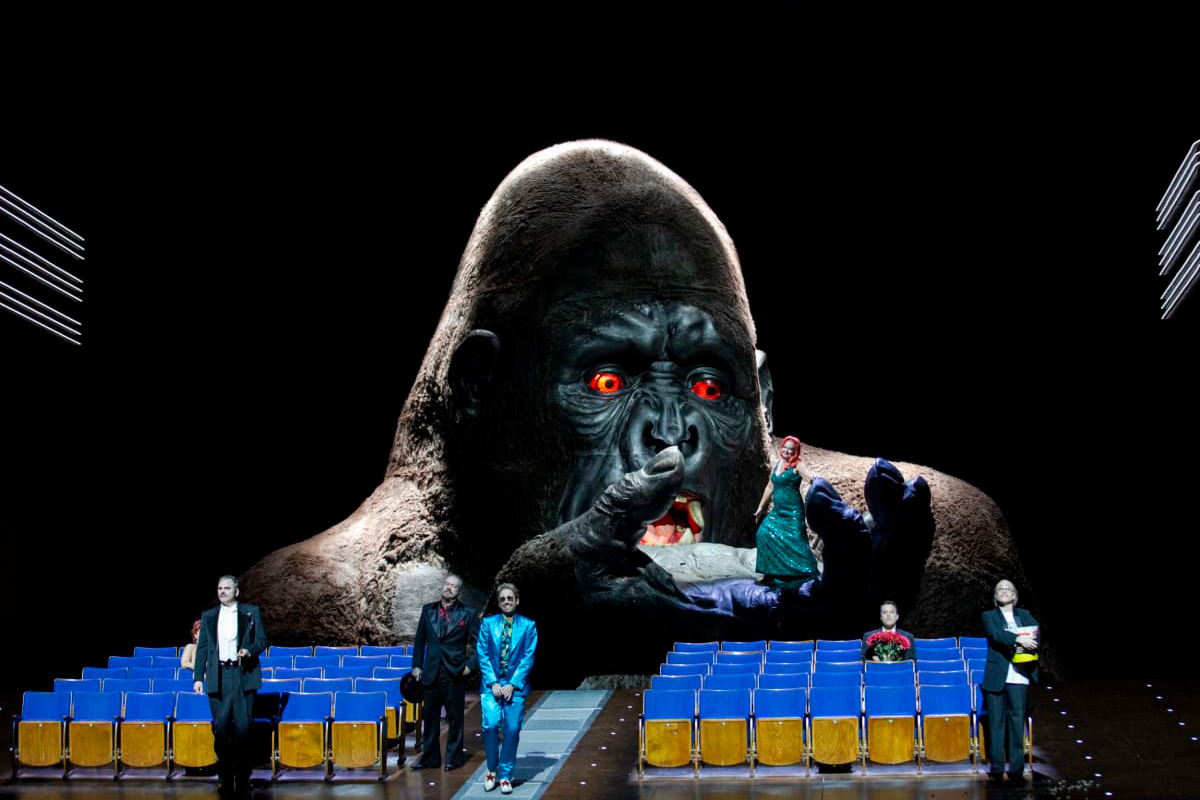 Photograph by Bernd Uhlig and courtesy of Opéra National de Paris.
Curiously, after correct attributions on the page listing the creative team involved in the production, the program goes on to state that Czech novelist, journalist, and playwright Karel Čapek wrote the libretto, but that’s not the case, though Janáček did stick closely to Čapek’s 1922 play of the same name when he wrote his own libretto.
Čapek’s Vĕc Makropulos may be a response to Bernard Shaw’s Back to Methuselah (1922), Shaw’s sole venture into science fiction. Most of Čapek’s plays and novels deal with science fiction – e.g. atomic fission, the world overrun by robots. He did not share Shaw’s view that longer life might lead to greater happiness and wisdom. His great character, Emilia Marty – a mere 337 years old as she delights in reminding people – in the end decides not to prolong her life.
Čapek was surprised when Janáček sought permission to turn his play into an opera. He wrote to the composer: ‘I have too high an opinion of music – and especially yours – to be able to imagine it united with a conversational, fairly unpoetic and over-garrulous play.’ He offered to write a different libretto. But Janáček – always a brisk, decisive artist – persevered, and the opera followed in 1923–25.
Čapek called his play a comedy, but Janáček’s libretto is very different – a much more tragic portrait of Marty’s predicament. It is an audacious study in obsession, with few compromises to bourgeois morals. Andrew Porter (who thought Čapek’s work a ‘cruel, cold play’) wrote: ‘Janáček cut it skilfully and filled it with the strong, strange poetry of his music, transforming cynicism and irony into compassion for the aged, terrified, still beautiful, still brilliant heroine.’
Janáček – ever economical – never invented lines himself. He was a great believer in short operas. (At the Bastille, the three acts are performed without a break; the show runs for one hundred minutes.) His triumph was to make opera out of the unlikeliest material – an interminable legal case that makes Jarndyce v Jarndyce look like a divorce in Reno. The whole thing is wonderfully loquacious – like Noël Coward on speed.
Čapek’s conceit is wonderfully preposterous. Rudolf II – the last Habsburg emperor, long attracted to astrologers and alchemists – orders a physician, Hieronymus Makropoulos, to devise a way to give him another 300 years of life. First, though, Makropoulos must try the potion on his daughter, Elina – first of the EMs, now personified (after many loves, travels, conquest, deaths, sorrows) as Emilia Marty, a great opera singer.
Marty is a great role for a dramatic soprano with charisma, deep vocal reserves, and a huge emotional range. She is arch, spiteful, callous, vindictive, bitchy, provocative – then tender, knowing, and capable of seeking spiritual redemption. Floria Tosca – that other great singer in an opera – she is not.
Those fortunate enough to hear the Adelaide Festival production in 1984 still effuse about the performance of the great Swedish soprano Elisabeth Söderström in the title role. Other notable Martys have included Anja Silja and Marie Collier. Karita Mattila, the Finnish soprano, has been singing it for years, though not, until now, in Paris.
The time is 1922. The three acts are set in a lawyer’s office, backstage at the opera, and in a Prague hotel. The first productions (Brno, 1926) and Prague (1928) were designed by Josef Čapek (the playwright’s brother) in elegant Jugendstil. Here, the opera opens in a Deco cinema where Marty – the femme fatale of all time – appears as Marilyn in the famous wind-blown skirt from The Seven Year Itch (1955). The second half of this act, flooded in yellow, is set in a toilet. Marty props on the toilet for one of her many costume changes, but mercifully Albert Gregor (Pavel Černoch) does not use the urinal.
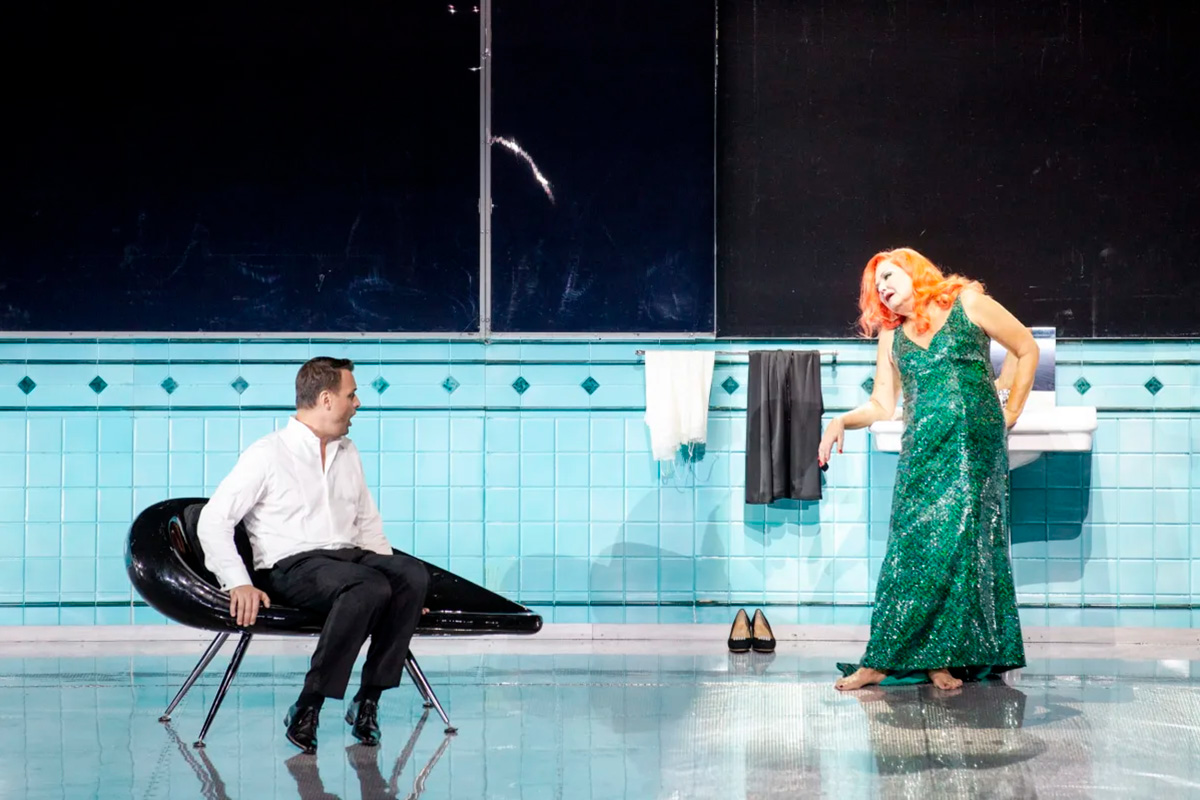 Pavel Černoch as Albert Gregor and Karita Mattila as Emilia Marty (photograph by Bernd Uhlig and courtesy of Opéra National de Paris).
Notable throughout is Janáček’s control and originality. The music, full of urgent motifs and piquant harmonies, is never conventional. Mostly, the orchestra dominates while the characters bicker or chatter. In this most talkative of operas, any arias remain monologues or narrations. There are no extended instrumental entr’actes like the ones in The Cunning Little Vixen (1923). Unlike Janáček’s other operas, there is no chorus – except for an off-stage male chorus that repeats some of Marty’s phrases in the last scene. This is the only time the soloists sing together as a group. The whole thing is unusually epigrammatic.
There is a wonderful dialogue between Marty and Gregor in Act One, set by the urinal. It is sung superbly by Mattila and Černoch. Gregor is falling in love with the great diva, unaware that she is his great-great-great-great-great-great grandmother. But he is terrified of her, mindful of her amorality. (‘Nothing means anything to you … / To love you is perversion. / Yet I love you so much.’) Murder, as so often, is not out of the question. Marty, unmoved, recalls other murder attempts. (‘I don’t propose to strip / and show you all the mementoes you men have left me.’).
For much of the opera, Marty – scornful, impatient, fast running out of time (breath) – limits herself to one short line of dialogue at a time, but this changes in the extended scena that ends the final act – one of the great scenes for a true tragedienne. Mattila is very moving as she portrays Marty’s decline and indifference. Having duped Jaroslav Prus into giving her the formula, she dares him to spit in her face and refuses to respond conventionally when he tells her of the death of his son, Vitek, who has made the mistake of falling in love with her. (‘Pooh! The number of men who kill themselves!’)
Janáček was fond of his ‘icy’ heroine. He wrote to the companion of his later years, Kamilla Stroesslova: ‘They take her for a liar, a fraud, a hysterical woman – and at the end she was so unhappy! I want everyone to like her then. Without love it won’t work for me.’
Mattila did full justice to this conception. Completely uninhibited and magnetic, she was in radiant voice. All those Salomes she has sung over the years must have steeled her for this role, and how reminiscent of Strauss’s opera The Makropulos Case becomes in the final scene.
Janáček also remarked: ‘I penetrate because there is truth in my work, truth to its very limit. Truth does not exclude beauty.’
Janáček always gives individuality to even the smallest part. Apart from Marty, there are seven other principals. All of them were good, especially Johan Reuter as Prus and Nicholas Jones as Vitek.
Susanna Mälkki – former music director of Ensemble InterContemporain – was the conductor, as was the case in the 2013 revival. She brought out all the colours, all the violence, all the melodic versatility in this captivating score, and her rapport with the singers was apparent.
Let us hope that it’s not too long before the new regime at Opera Australia gives us a fresh production of this captivating drama.
The night before that, ABR Arts trekked to the Philharmonie de Paris beside the Boulevard Périphérique. The Philharmonie may not be the most prepossessing concert hall in the world, with its impersonal foyers and ponderous metal exterior, but what a drawcard it is for the world’s major orchestras. This season alone it will host nineteen of them, including the Berliner Philharmoniker, the Boston Symphony Orchestra, the Chicago Symphony Orchestra, the Royal Concertgebouw Orchestra, and the Gewandhausorchester Leipzig. (Cue general lamentation among ABR Arts readers.)
The Philharmonie was full for this performance by the Symphonieorchester des Bayrischen Rundfunks under its chief conductor, Simon Rattle, heard recently in Sydney with his former band, the London Symphony Orchestra.
The symphony dates from 1906, when Mahler conducted the first performance in Essen. Rattle – very much at home with Mahler (no score needed) – used the critical edition of the International Gustav Mahler Society.
What a performance this was – Mahler’s Sixth Symphony rightly on its own, without any short, well-intentioned sop to the contemporary. From the start this was taut, keen, attentive playing, with inspired work from the brass, oboe, and harps. The peripatetic Andante moderato – played on this occasion after the massive Allegro that opens the symphony – was especially luminous, accentuated by the Philharmonie’s limpid acoustic. In the many transitions, Rattle produced hushed effects that few conductors would attempt.
While ABR Arts seeks to eschew pop psychology, this concert exemplified how Mahler’s music seems to still us, irradiate us, making us (temporarily of course) more accepting. (According to Bruno Walter, Mahler christened his Sixth the Tragic Symphony, and the epithet did appear in the program of the 1907 Vienna première.) The Finale, taken very fast, was remarkable: daring, almost reckless, in attack, with two mighty smotes on the hammer-box that almost jettisoned the percussionist off the stage. Hard it was to recall a finer performance of Mahler, who seems to galvanise players and conductors as few other composers do. The ovation from the Paris audience was long and impassioned.
At the weekend, ABR Arts moved to Amsterdam for long days at the inexhaustible Rijksmuseum. On Sunday evening (8 October), the Rotterdam Philharmonic Orchestra – now shot of its long association with the pro-Putin Valery Gergiev – performed at the Concertgebouw, conducted by Conrad van Alphen. The concert began with a considerable rarity: the Sixth Symphony of Johann Wilhelm Wilms, a contemporary of Haydn and Beethoven. Then Maxim Vengerov gave a sensational account of Brahms’s Violin Concerto, virtuosic playing with the sweetest tone in this warmest of concert hall acoustics.
The Makropulos Case (Opéra National de Paris) continues at the Opéra Bastille until 17 October 2023. Performance attended: 5 October. Don Giovanni continues there until 9 October 2023. Performance attended: 4 October.