


- Free Article: No
- Contents Category: Music
- Custom Article Title: Mozart and Beethoven Concertos
- Review Article: Yes
- Article Title: Mozart and Beethoven Concertos
- Article Subtitle: MCO’s conversation with the Viennese classics
- Online Only: No
- Custom Highlight Text:
Sophie Rowell’s first year as Melbourne Chamber Orchestra’s Artistic Director continues to impress with its attractive and intelligent programming and strong musical leadership on stage.
- Article Hero Image (920px wide):
- Article Hero Image Caption: Photograph by Lucien Fischer and courtesy of Melbourne Chamber Orchestra.
- Alt Tag (Article Hero Image): Photograph by Lucien Fischer and courtesy of Melbourne Chamber Orchestra.
- Production Company: Melbourne Chamber Orchestra
The two works are linked by much more than just their key (B flat). Completed within a few years of each other, Mozart’s concerto would to be the last of his essays in the genre, while Beethoven’s would be his first, notwithstanding the numbering. Performing them together gives the audience the opportunity to hear how one cornerstone of the Viennese classical music tradition was passed on, bringing to mind Count Waldstein’s famous message to Beethoven in 1792 as he left Bonn for Vienna that he would ‘receive the spirit of Mozart from Haydn’s hands’.
That spirit saw the piano concerto become a vehicle for a composer – who was usually also the soloist – to demonstrate the quality and sophistication of their musical oratory. Only later did it become characterised more by musical showmanship, wherein the pianist is more pitted against the orchestra than in dialogue with it.
 Photograph by Lucien Fischer and courtesy of Melbourne Chamber Orchestra.
In his celebrated A Companion to Mozartʼs Piano Concertos (1948), Arthur Hutchings compared Mozart’s works to operatic finales in which various ‘characters’ (i.e. distinctive musical themes) engage in various forms of dramatic argument. It was no coincidence that ‘the same mind’ excelled in the development of both. In this respect, the Piano Concerto No. 27 was, for him, ‘worthy to stand at the end of a great series’.
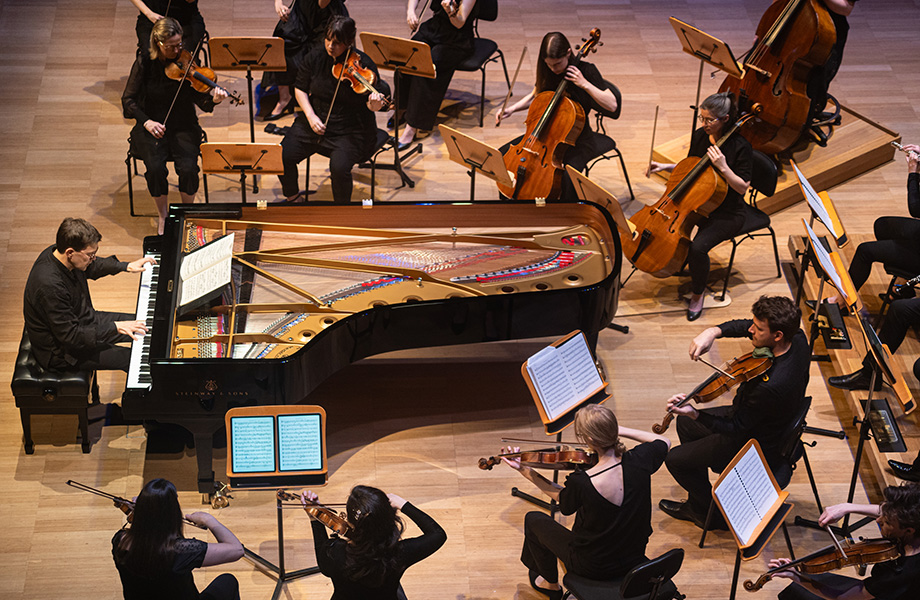
Written for a small orchestra, even by Mozart’s standards, this concerto has also been described as nostalgic and introspective in character, as if the composer knew it would be his last. Jumppanen’s rendering of it was in this vein; gentle virtuosity and grace were the order of the day, supported by his clear articulation and beautiful legatos.
Less agreeable to the ear was the orchestral balance. One of the acoustic quirks of the Elisabeth Murdoch Hall is that the rear stage wall amplifies any instrument placed against it; here the two French horns (and to a lesser extent the two bassoons) were, as a result of their placement there, frequently too loud.
This proved to be less of an issue for the performance of Beethoven’s concerto because of the heightened role these instruments play in its orchestration. In other respects, the composer’s honouring of his predecessor’s legacy is evident in both its form and character. Nevertheless, Beethoven would continue to revise the concerto in the years that followed its first performance in 1795, later providing a new finale, and later still a new first movement cadenza for the soloist. It seems he was also increasingly keen to signal to his audience that his was to be a new musical voice for a new historical era; this was around the time, after all, of the rise to power of Napoleon Bonaparte.
One of things that made this pairing by the Melbourne Chamber Orchestra so fascinating and rewarding was that it gave us an opportunity to hear that new voice emerging. Here, the soloist subtly assumes a more ‘heroic’ and individualistic posture from within a conversational rhetorical style between soloist and orchestra.
Appropriately, Jumppanen’s delivery was also more individualistic in character, though this in turn made the lack of a conductor more of a challenge. There were a few moments in which the ensemble was not as tight as it might otherwise have been in a more traditional stage set-up.
Nevertheless, the performance of both concertos was an impressive musical achievement – above all from Jumppanen himself, who, having set himself the challenge of delivering (and directing) these two substantial works in the one concert, met it with intelligence and poise.
The concert also included two sonic ‘palate cleansers’. The first was Melbourne composer Stuart Greenbaum’s The Rotation of the Earth. A pleasant and effective ‘feel-good’ curtain-raiser, it was written in 2017 for the ACO Collective (the Australian Chamber Orchestra’s mentoring and regional touring ensemble) for their Hush Foundation ‘Collective Wisdom Album’.
The other addition was ‘Pelimannit’ (‘The Fiddlers’), an arrangement for string orchestra by Finnish composer Einojuhani Rautavaara (1928–2016) of an earlier piano suite. He had crafted it out of an album of Finnish folk fiddle tunes collected and published in the eighteenth century. Each of the tunes had been ascribed to a particular folk musician, and this inspired the composer to create a suite of aphoristic tone-pictures that at once honoured and haunted the originals.
The Mozart and Beethoven Concertos (Melbourne Chamber Orchestra) was performed at the Melbourne Recital Centre on 8 October 2023. It will be repeated there on 12 October and screened online at the Australian Digital Concert Hall.