


- Free Article: No
- Contents Category: Film
- Custom Article Title: Caravaggio's Shadow
- Review Article: Yes
- Article Title: Caravaggio's Shadow
- Article Subtitle: Caravaggio as an artist of the people
- Online Only: No
- Custom Highlight Text: Visceral, extreme, beautiful, disturbing, genial, blasphemous, sacred, moving: these are just some of the words commonly used to describe Caravaggio’s art. Viewers will find the same qualities in L’Ombra di Caravaggio (Caravaggio’s Shadow, 2022), the latest film by Italian actor and director Michele Placido, screening nationally as part of the Italian Film Festival.
- Article Hero Image (920px wide):
.jpg)
- Article Hero Image Caption: Riccardo Scamarcio as Caravaggio.
- Alt Tag (Article Hero Image): Riccardo Scamarcio as Caravaggio.
- Production Company: Italian Film Festival
In those days, the Council of Trent outlined the exact coordinates of how sacred art should be depicted. Caravaggio rebelled against those rules by employing prostitutes, thieves, homosexuals, and vagabonds as models for his religious paintings. Informed about this, Pope Paul V (Maurizio Donadoni) commissions the Vatican’s secret service to carry out a proper investigation on the artist and decide whether to grant him clemency or not. L’Ombra, the Shadow, is the investigator (Louis Garrel) who has in his hands the power of life or death. Like a shadow, L’Ombra begins a real journey following Caravaggio and his work, discovering his vices and virtues, in search of the truth.
The ‘truth’ is the central theme of the film: a moving target lying between the lights and the shadows of the artist’s life and work, of the Church’s polished façade and inner violent contradictions, and broadly, of sixteenth- and seventeenth-century Italy. Far from appearing simply as a dishevelled proto-rock star, as he is often portrayed, Caravaggio emerges here as an artist of the people and for the people, who knows the gospel by heart. The artist searches and finds God among the outcasts with whom he lives, studies, and celebrates, with genuine empathy and love. ‘I was ordered to repent,’ he says, ‘but I do not know what to repent of. I have loved everything in my violent life, full of fury, colours, loves … I see a new light, an infinite divinity that lives in everything.’ Embodying Caravaggio’s deepest passions and sufferances, Scamarcio delivers a masterful performance, often without uttering a word, simply through his edgy eyes, face, and physicality.
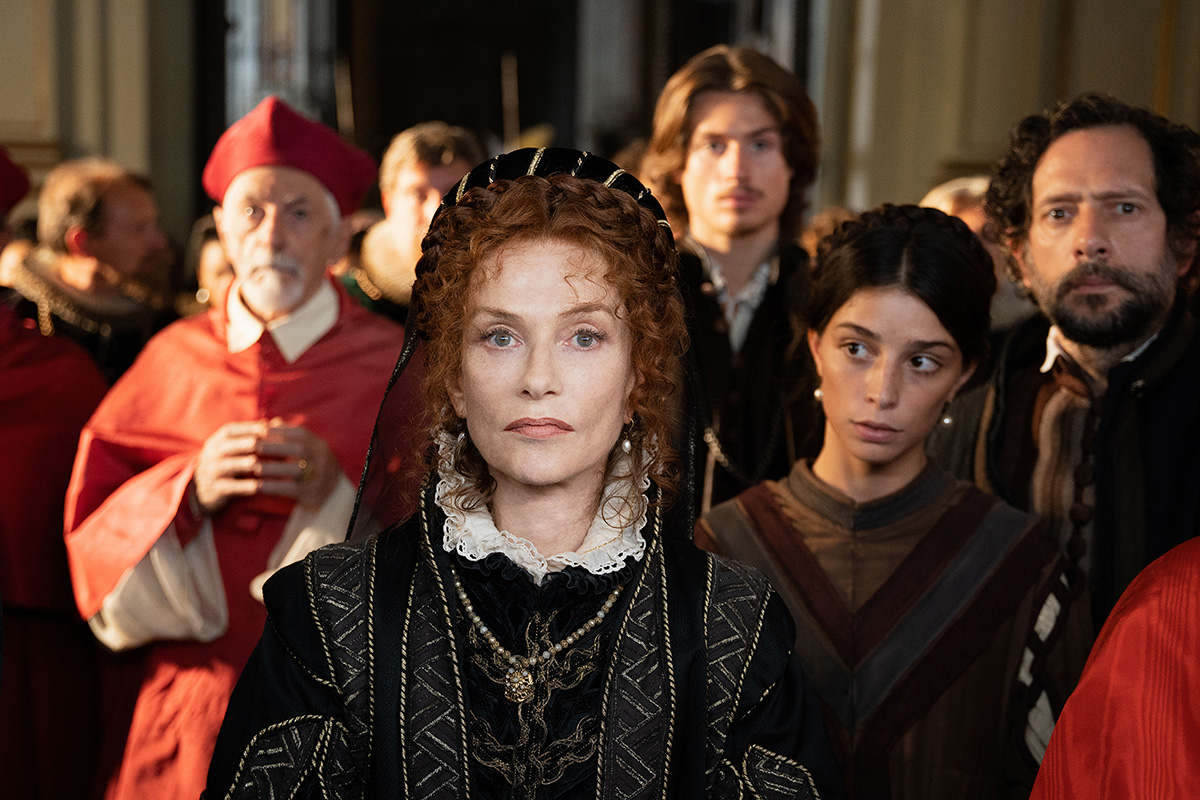 Isabelle Huppert as Marquise Costanza Colonna.
Placido’s film is like a Caravaggio canvas: each scene is masterfully shaped through a violent contrast between light and shade, the camera suddenly pointing to close details and then zooming out slowly, revealing the big picture, the characters around and the environment containing them, often taking our breath away with his bird’s eye perspective. Like a bird, the camera swoops down again towards other details, closer to the ground: dancing feet and half-naked bodies rolling in the dust during the orgies that Caravaggio visits frequently, where he picks the subjects for his next work. The film skilfully shows the theatrical setting that the artist creates in his studio before painting a scene: complex compositions of bodies on pop-up stages, ropes, lights, and clothes, the effect of which Caravaggio transposes on canvas while maintaining dynamicity and realism.
Those who have had the fortune to view Caravaggio’s paintings in person, especially the large-size altarpieces, know that it is like experiencing a real-life scene in three dimensions that overwhelms you with the force and richness of the work. The viewer’s eyes, wide open, dance incessantly between the tiny touches of paints detailing the head of a snake, so pulpy and translucent as to seem alive in La Madonna dei Palafrenieri (Madonna and Child with St Anne, 1605–6) and the rest of the image unfolding inexorably one brush stroke after the other, the oblique light cutting across darkness as a knife wound.
A knife wound on Caravaggio’s face violently introduces him to us in the second scene of the film, which, by contrast, opens with a peaceful view of the Naples sea in 1610, where the story begins. Placido paints his work with the same realism with which Caravaggio paints his: the blood, dirt, sex, and desperation of the slums aren’t sugar-coated or sublimated. Nor are the profound humanity and raw beauty that Caravaggio sees in the last, whom he turns into saints and madonne in his canvases, without angel wings and halos (‘Those things aren’t real,’ he cries). In Genesis it is said that ‘God created man in his image, in God’s image he created them; male and female.’ Caravaggio’s art mirrors this. What is sacred is given the bodies and clothes of real people, who love the artist for making them seem closer to divinity. The Church cannot tolerate this subversion because the people feel themselves close to God and thus are difficult to control. The truth that Ombra sees in Caravaggio’s art, and must reluctantly acknowledge, goes against what is professed by the Holy See. This tears the investigator apart: Garrel never smiles, almost never moves his face, his body as inflexible as the institution he represents.
A corollary of characters populates the story, feeding the structure of the film that, like Caravaggio’s art, consists of an encounter between opposites: light and shade, sacred and profane, life and death, opulence and scarcity. On one side, we see Caravaggio and his court of untouchables, and the supporters of his art such as the Marquise Costanza Colonna (Isabelle Huppert), Cardinal Borghese (Gianluca Gobbi), and Cardinal del Monte (Placido himself). Then there are Ombra and the rest of the Clergy, Ranuccio and his friends, and the mannerist painter Giovanni Baglione (Vinicio Marchioni) from the Accademia dei Lincei.
The ending gives the film its circularity, closing down peacefully by the sea, with the words from the title of one of his most celebrated and controversial paintings: Amor Vincit Omnia, ‘love conquers all’. This is Caravaggio’s truth.
Caravaggio's Shadow (Italian Film Festival) is screening nationally until 28 October 2023.