


- Free Article: No
- Contents Category: Film
- Custom Article Title: Sick of Myself
- Review Article: Yes
- Article Title: Sick of Myself
- Article Subtitle: The work of a merry prankster
- Online Only: No
- Custom Highlight Text: Over the course of the past five years, the Norwegian-born, Los Angeles-based filmmaker Kristoffer Borgli has acted in many of the films he has directed, more often than not playing a thinly veiled version of himself. In shorts such as A Place We Call Reality (2018), The Loser (2019), and Willem Dafoe (2023) – all available online – Borgli portrays, respectively: a director who has lost his way; an interviewer who cannot think of any questions to ask his idol; and an artist who cannot remember a famous actor’s name.
- Article Hero Image (920px wide):
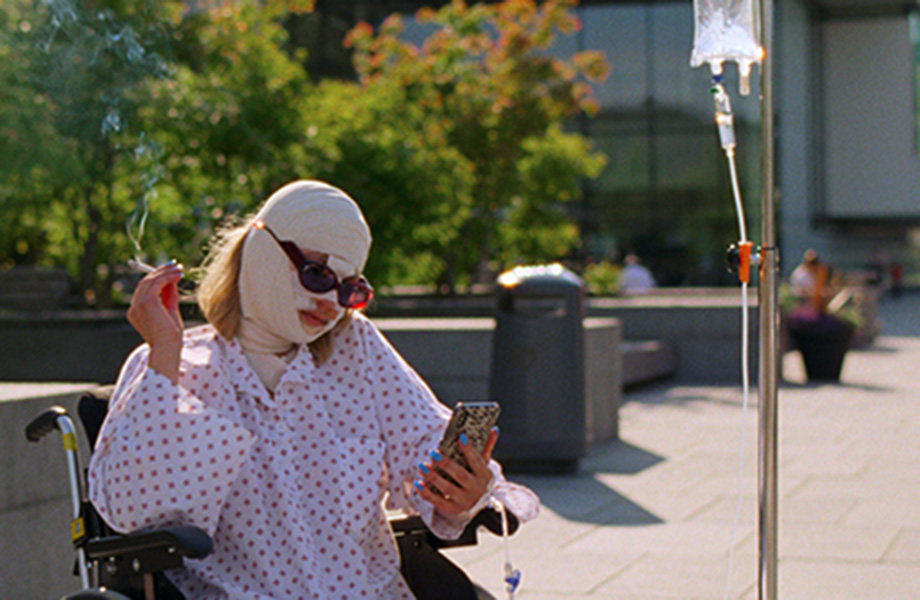
- Article Hero Image Caption: Kristine Kujath Thorp as Signe (©Oslo Pictures).
- Alt Tag (Article Hero Image): Kristine Kujath Thorp as Signe (©Oslo Pictures).
- Production Company: Static Vision
Borgli is also present in his recent feature Sick of Myself, appearing in a cameo as the director of a fashion shoot trying his best to make art under difficult circumstances. Sighting the filmmaker late in the piece, we are encouraged to think once again about the act of artistic creation alongside the management of one’s ‘real’ public persona, and how these overlapping questions inform our reading of his own body of work. As with their director, the two main characters in this film must navigate the fine lines between art and life, between their unlikeable private personas and what they want the world to know of their respective achievements. Thomas (Erik Sæther) works hard to curate a particular image of himself as an artist. He crafts his backstory and his reputation at parties, through a magazine interview, and at his first major exhibition, but cannot disguise the fact that the found objects so important to his practice have simply been pilfered from furniture stores. Thomas’s partner, Signe (Kristine Kujath Thorp), on the other hand, works an unremarkable café job with few career prospects, and clearly resents her boyfriend’s rise to fame. ‘Narcissists are the ones who make it,’ Signe tells a friend, suggesting the recipe for Thomas’s success. She, on the other hand, is ‘not a narcissist’ – hence why she still works at a café.
Nevertheless, it is a shocking dog attack at this café that is the catalyst for Signe’s shift in fortunes. Blood is shed, disrupting the otherwise pristine vision of Oslo in summer. Signe is clearly rocked by the attack, in which she has a starring role. A glob of jam dropped on the floor triggers a memory of the blood and prompts Signe to provoke a dog on the street in one of many intensely uncomfortable scenes. Like a shark at the first scent of burley in the water, Signe begins circling back to the incident in conversation, before considering how she might leverage this meagre fifteen minutes into something more substantial. She starts taking an illicit Russian drug, Lidexol, when she learns of its nasty side effects: facial and bodily scarring, exactly the kinds of visible signs of illness that will bring her the attention she craves.
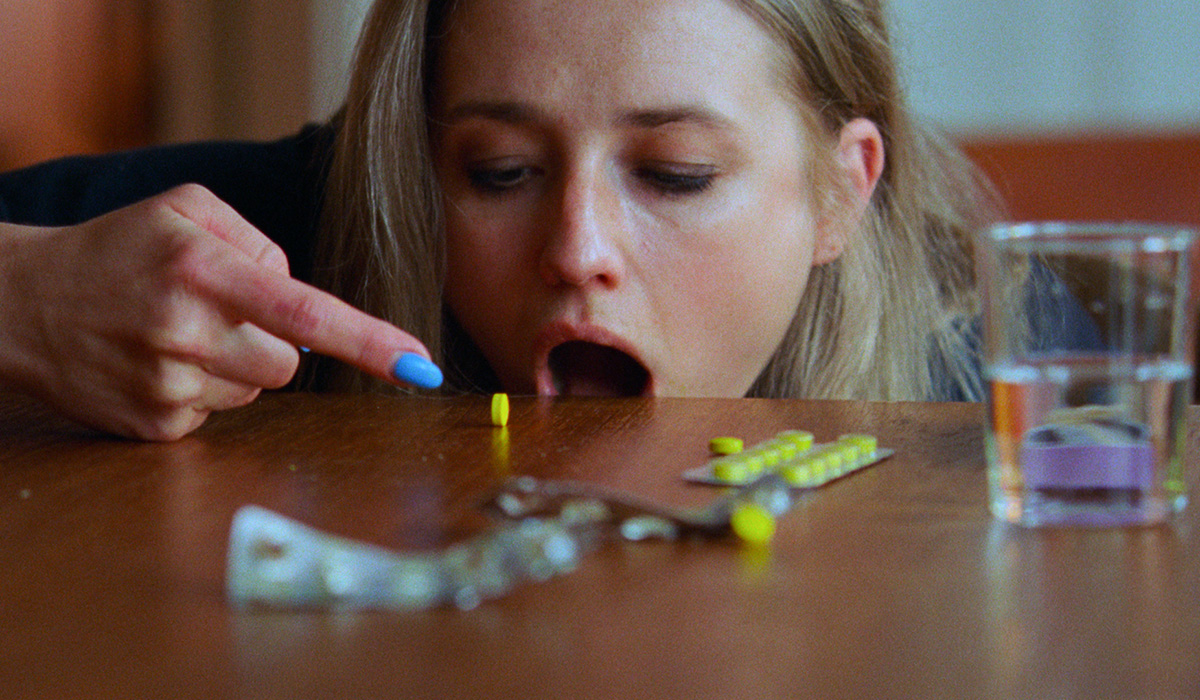 Kristine Kujath Thorp as Signe (©Oslo Pictures).
While the drug itself is not real, it is in keeping with Borgli’s notoriously slippery approach to filmmaking that he also created a website and Instagram profile for Lidexol. The internet is the platform both for reaffirming one’s own hypochondriasis and for broadcasting one’s visible symptoms. The skin disease brought on by Signe’s pill-popping is – as she repeatedly tells the now affection-averse Thomas – not contagious, but our protagonist is determined to go viral in another sense, landing a newspaper interview, front-page photoshoots, and a modelling contract in an opportunistic bid at self-creation. The necessary fictions underpinning Signe’s life multiply, as she projects the different possible outcomes of her plan. Her false victimhood also extends to a therapy group for fellow sufferers of mystery illnesses, but as her wounds become more pronounced, and her condition worsens, will she become the woman who cried wolf?
Body horror has become part and parcel of Borgli’s work. But here, alongside the effective make-up that transforms Signe’s face into something monstrous, we have a model suffering from acromesomelia, and a vision-impaired woman made to perform tasks that belittle her. The film forces us to confront the differences and similarities between these visible impairments, and brings them together in the climactic fashion shoot, a scathing set piece in which Borgli has his walk-on role. The stage is set for the advertising world to celebrate a diversity of body types, but there is little sympathy here for such corporate attempts at real feeling. Wherever we look, it is irony all the way down.
The press has been quick to point out that Sick of Myself shares a production house (Oslo Pictures) with another Norwegian success story from Cannes, Joachim Trier’s Oscar-nominated hit The Worst Person in the World (2021). For me, especially in its juggling of awkward humour and moments of genuine unhappiness, Sick of Myself calls to mind Maren Ade’s Toni Erdmann (2016), a film that injects a father’s comedic high jinks into the life of a daughter who takes life a little too seriously. In any case, as we can see from Borgli’s previous work, this is a film that definitely bears his own stamp, the work of a merry prankster with a deeply cynical take on the inauthentic process of self-actualisation.
Interestingly, relative to the rest of his work (which now also includes Dream Scenario, with Nicolas Cage, premièred in Toronto in September 2023), we can sense one slight shift perhaps in Borgli’s use of music. While he has been most noted for his collaborations with big names in Scandinavian electronic dance music (EDM) such as Todd Terje and Lindstrøm, Sick of Myself plays with a predominantly classical soundtrack. Does this form part of a more serious approach to the material? Or are we supposed to read the inclusion of refined compositions by Messrs Schubert, Bach, Mozart, and Fauré as a parodic undercutting of the high-seriousness of some European festival films? Such music often provides an ironic point of difference to the adolescent exchanges of Thomas and Signe, a thin veneer that does not mesh with their unscrupulous views of the world. Coupled with many slow zooming shots throughout the film, it also casts a melancholic pall over proceedings, and redoubles Signe’s downbeat expressions as she struggles to live a life on the sidelines.
However we read such music, the last words belong to a paradoxically upbeat and mournful electronic pop song, Discovery Zone’s ‘Dance II’: ‘I’m only doing the best I can / I got the shadow but lost the heart.’ Unlike his characters, Borgli’s film itself has far more heart than shadow; tongue is firmly in cheek here, but it is a cheek scarred by real pain.
Sick of Myself (Static Vision) is on commercial release from 5 October 2023.