


- Free Article: No
- Contents Category: Opera
- Custom Article Title: Das Rheingold
- Review Article: Yes
- Article Title: Das Rheingold
- Article Subtitle: The opening of Barrie Kosky’s new Ring
- Online Only: No
- Custom Highlight Text:
Wagnerians are like elephants: they never forget. Though the Royal Opera House may have become less conscientious about printing performance histories in its handsome red-covered programs, for many the memories of past Ring cycles at Covent Garden live on. That may not always be a healthy thing – there are of course few more necrophiliac artforms than opera – but it’s impossible to view the opening of Barrie Kosky’s new Ring in isolation.
- Article Hero Image (920px wide):
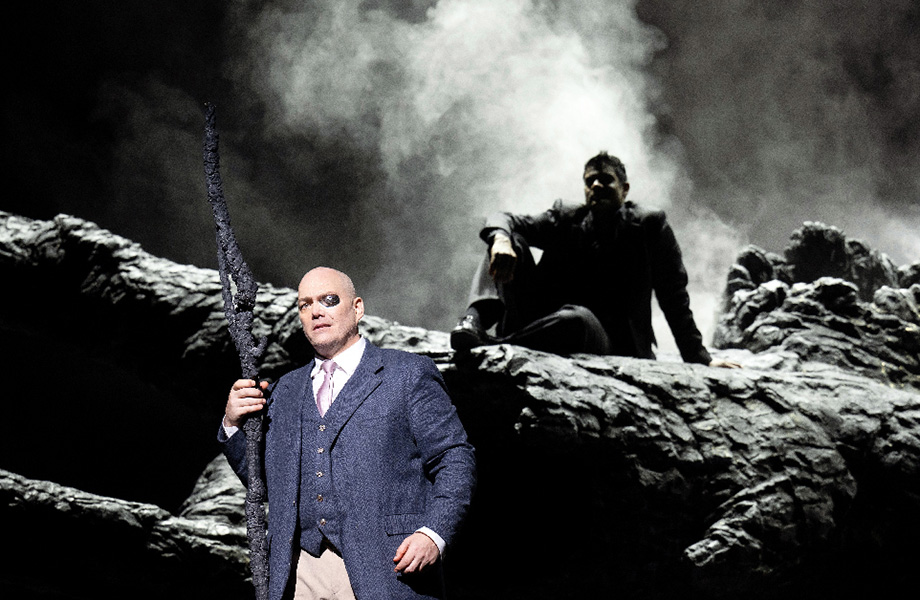
- Article Hero Image Caption: Christopher Maltman as Wotan (© 2023 ROH photograph by Monika Rittershaus)
- Alt Tag (Article Hero Image): Christopher Maltman as Wotan (© 2023 ROH photograph by Monika Rittershaus)
- Production Company: Royal Opera House
If it feels in some ways underwhelming, let’s remember that Das Rheingold is but the Vorabend, the preliminary evening of the tetralogy. Even by the standards of other methodically assembled Ring cycles, this is a slow-burning project due for completion only in 2027. Already, though, there is a feeling of vibrant theatricality, as one might expect in a Kosky project. If the ideas haven’t all yet fallen into place, that’s also because Das Rheingold is a series of tableaux that find fulfilment in subsequent instalments, and it’s always impossible to judge a Ring cycle fully until the end of Götterdämmerung. Equally, there’s little point in fretting already about the casting, which could be more exciting: Das Rheingold is an ensemble piece and the star turns come later. Under Antonio Pappano’s meticulous baton, this performance boasts a very even cast.
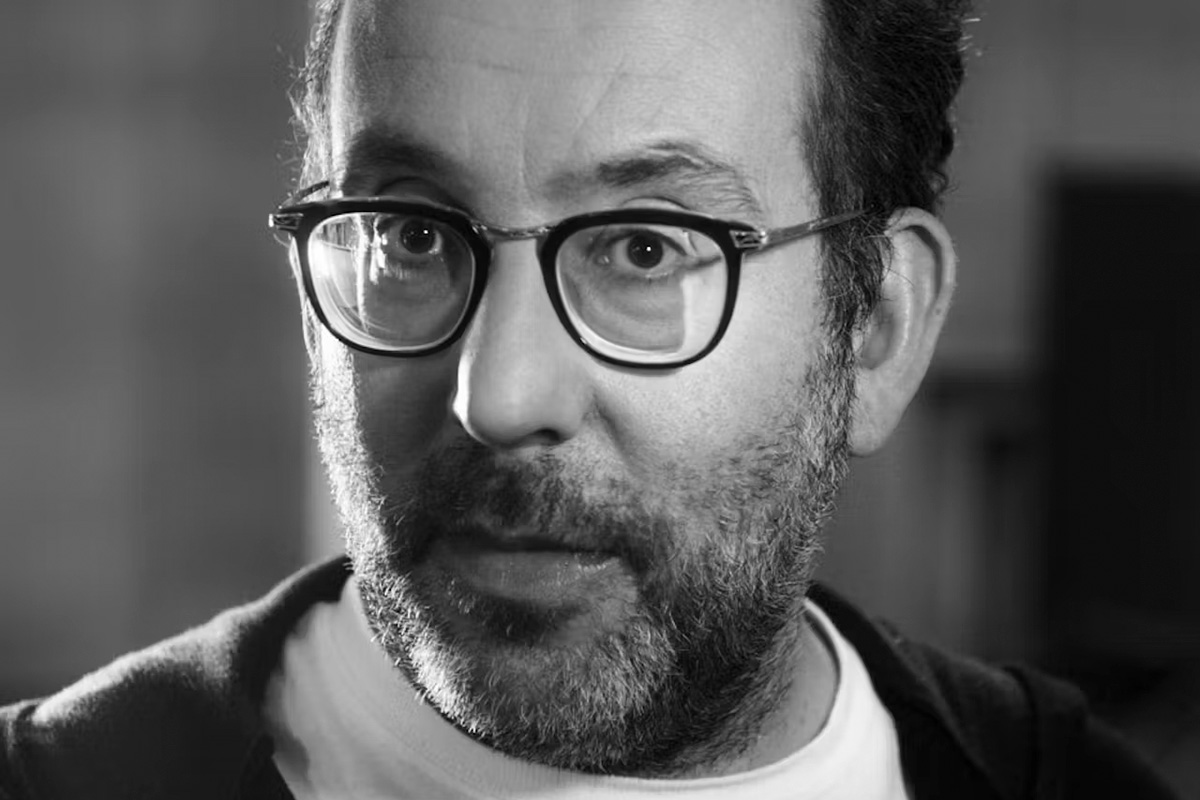 Barrie Kosky (© 2023 ROH)
Der Ring des Nibelungen derives its famously compelling hold on audiences from more than Richard Wagner’s music; it can be interpreted in almost any way, and we have long moved on from literal representations (think horny helmets) of Germanic-Nordic myth, even from those great productions of the past invoking Greek tragedy. It is now nearly half a century since Patrice Chéreau’s epoch-making interpretation (Bayreuth, 1976) of the Ring as an allegory of nineteenth-century capitalism. Many directors today show increasing interest in staging the cycle as an anticipation of contemporary problems, including exploitation of the environment – nuclear immolation and ecological catastrophe are seldom far away. This seems to be where Kosky is turning his attention, making it a different sort of Ring from any that Covent Garden has witnessed before.
Designed by Rufus Didwiszus, Kosky’s first vision is a bare stage with all its machinery exposed and dust sheets covering the set. The design’s main feature is a burnt-out, ossified World Ash Tree, which, rather than oozing sap, dribbles out liquid gold. There is no living nature in this post-apocalyptic vision. It’s not entirely bleak, however, nor without some Koskyesque showbiz – most eye-catchingly the rainbow glitter that falls during the final scene, in place of a more traditional rainbow bridge. The child slaves in Nibelheim, with their huge distorted heads, swarm in formation like the multiple noses in Kosky’s production of Shostakovich’s The Nose. And in a clever play on the disputed gold that lies at the heart of Wagner’s story, Kosky’s lighting designer (Alessandro Carletti) illuminates the gilded proscenium arch between each of the scenes, helping to distract from the decision to drop the curtain in place of the magical transformation scenes one might have expected of Kosky.
Kosky focuses his – and our – attention on two characters: Erda and Loge. The god of fire may be the most enigmatic of all the Ring’s figures, but that doesn’t quite explain his persona here as (in another bit of Kosky showbiz) a master of ceremonies. Sean Panikkar’s Loge is lithe and slippery, played with a trickster’s manic energy and a tenor in keen shape, even if the words and music are sometimes subordinated to his incessant cackling. More thoughtfully, Kosky’s earthy, earth-focused approach revolves around a very exhausted Erda personified in the naked fragility of an elderly woman. Erda’s traditional role, of issuing her dire earth-mother warning to Wotan in a brief scene, is fulfilled by the contralto Wiebke Lehmkuhl, singing offstage with creamy warmth. For perhaps the first time in Ring history, Erda is onstage throughout Das Rheingold, a world-weary figure who has seen it all before and an incarnation of the natural decay that surrounds her. In the Nibelheim scene, Erda is imprisoned under a giant piston pump and sucked dry via steampunk industrial tubes of her golden milk. The eighty-two-year-old actress Rose Knox-Peebles, as graceful as she is brave, is seen slowly spinning as the work reaches its final bars.
Kosky, who first directed a Ring cycle in Hanover between 2009 and 2011, is strong on storytelling. However his own ideas eventually emerge, they will doubtless be a response to the ideas in Wagner’s great work. That is one difference between the currently unfolding London Ring cycles. Over at the English National Opera, Richard Jones sometimes gives the impression of trying to debunk Wagner, one reason perhaps why the Metropolitan Opera returned empty-handed from its proposed co-production with ENO (and is now rumoured to be looking instead at the ROH production).
But alluding perhaps to the pollution of the United Kingdom’s rivers, this production’s symbolism is certainly conceived with a British audience in mind. The gods are dressed in riding boots as if members of a polo club, and we first meet them enjoying a post-match picnic under the watchful eye of Erda (dressed in this scene only, as a maid). Wotan could be a captain of industry, the women are in headscarves, and polo mallets are brandished – to fatal effect when Fafner kills Fasolt.
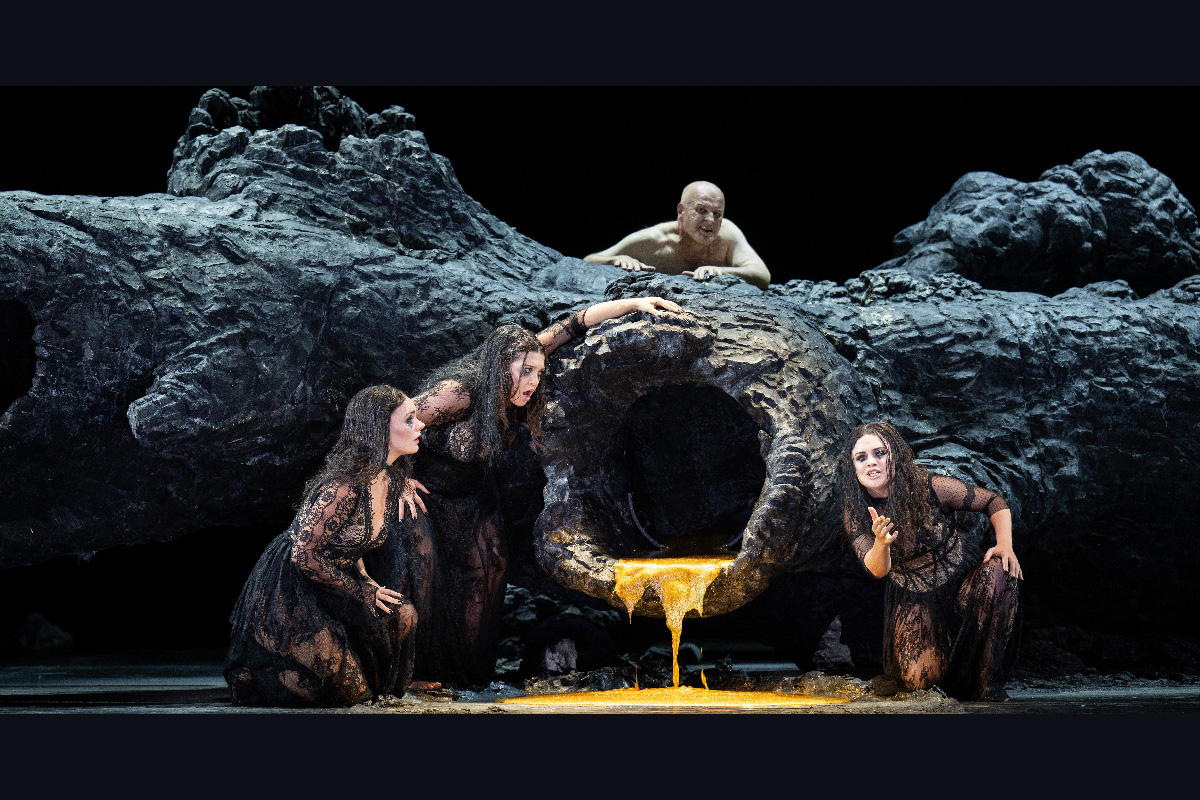 Katharina Konradi as Woglinde, Niamh O’Sullivan as Wellgunde, Marvic Monreal as Flosshilde, and Christopher Purves as Alberich Das Rheingold (© 2023 ROH photograph by Monika Rittershaus).
With impressively detailed acting, Christopher Maltman plays his first Wotan as a ruthless businessman (willing even to cut off Alberich’s finger to obtain the ring). Not exactly lord of the gods, he is more of a mafioso on a picnic, though in a strikingly tender moment he cradles Erda in his arms. Are we in the post-hero era of Ring productions? Perhaps it hardly matters that there’s little nobility in his voice when there is even less nobility in the characterisation given to him by Kosky; Maltman’s bass-baritone is solid and sometimes impressive, but he lacks the amplitude of great Wotans of the past. Another of Kosky’s interesting ideas is to articulate the Licht-Alberich/Schwarz-Alberich notion explored in the riddle scene of Siegfried, the third opera of the cycle, by creating alter egos out of the chief antagonists Wotan and Alberich. Portrayed like bullet-headed blood brothers, they even sound fairly similar – though Christopher Purves’s lively, hyper Alberich sometimes thins down his tone to project Sprechstimme-like lines, making an angry, middle-aged man almost compelling.
Even without reaching the highest Wagnerian standards, the cast is a credible one – and more than that in the case of Soloman Howard’s imposing Fafner and Kiandra Howarth’s warm Freia. Victoria Behr’s costumes don’t make the giants look giant (Fafner’s brother Fasolt is taken by Insung Sim), but the gods are fashionably dressed for the final scene, and Marina Prudenskaya’s dusky-toned Fricka is lively and impatient. Singing never less than adequately are Kostas Smoriginas (Donner), Rodrick Dixon (Froh) and Brenton Ryan (an athletic Mime). As lacey Rhinemaidens, Katharina Konradi (Woglinde), Niamh O’Sullivan (Wellgunde), and Marvic Monreal (Flosshilde) blend beautifully.
Supplying continuity between this and Covent Garden’s previous Ring cycle is Antonio Pappano, the soon-to-depart music director, who will nevertheless conduct the other three operas as they are unveiled. He may not be the most moving Wagnerian – nor does he do overt grandeur – yet he is a detailed one, perhaps a little too much so here at the beginning, where one missed the mysticism of the opening E-flat rumble. But apart from the inexplicable electronic anvils, sounding more like Mahlerian cowbells than tools of the Nibelheim labourers, he draws incandescent playing from the orchestra and delivers expertly paced drama. During earlier performances in the run, the orchestra had been rewarded with curtain calls up on stage, but not here: was it because a sizeable number of players were wearing yellow Musicians’ Union T-shirts, highlighting their ongoing dispute with the Covent Garden management? Some Wagnerians had worried that this big season-opening production would fall victim to the standoff, but for now the winner is Wagner himself.
Das Rheingold (Royal Opera House) continues at Covent Garden until 29 September 2023. Performance attended: 20 September.