


- Free Article: No
- Contents Category: Opera
- Custom Article Title: Biographica
- Review Article: Yes
- Article Title: Biographica
- Article Subtitle: Finsterer and Wright’s opera reaches Melbourne
- Online Only: No
- Custom Highlight Text:
Biographica, an opera in twelve scenes for one actor, five singers, and eleven musicians, was premièred to considerable acclaim by Sydney Chamber Opera at Carriageworks as part of the 2017 Sydney Festival. The creative team of composer Mary Finsterer and librettist Tom Wright subsequently had another success there with Antarctica as part of the Sydney Festival 2023; Finsterer and Wright can now be considered two of the most important creative voices working in Australian opera today.
- Article Hero Image (920px wide):
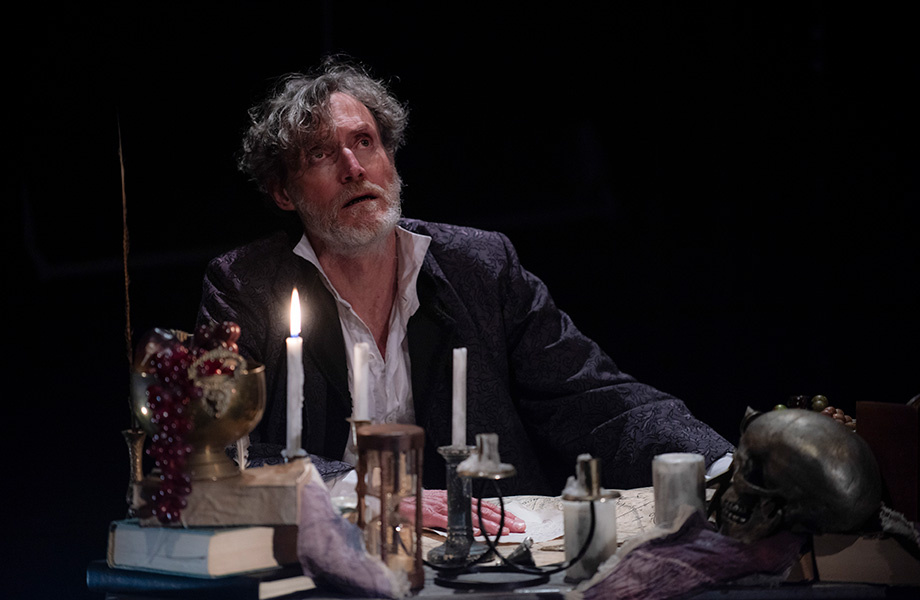
- Article Hero Image Caption: Dion Mills as Cardano (photograph by Jodie Hutchinson).
- Alt Tag (Article Hero Image): Dion Mills as Cardano (photograph by Jodie Hutchinson).
- Production Company: Lyric Opera
While the use of an archaic form of ‘biography’ in the title, with a feminine adjectival ending, might suggest that its subject matter is the life of a woman, we are in fact presented with an exploration of the life of an archetypal dead white European male, the Italian renaissance polymath Gerolamo Cardano (1501–76). Cardano is perhaps best remembered today for his pioneering work in mathematics; he helped to establish both negative and imaginary numbers as part of modern algebra. Towards the end of his life, he also penned an autobiography that is remarkable even by today’s standards for the depth and frankness of his self-analysis. E.M. Forster is one of many later writers who were drawn to explore this enigmatic, complex character; there is a chapter on him in Forster’s volume of non-fiction essays, Abinger Harvest (1936).
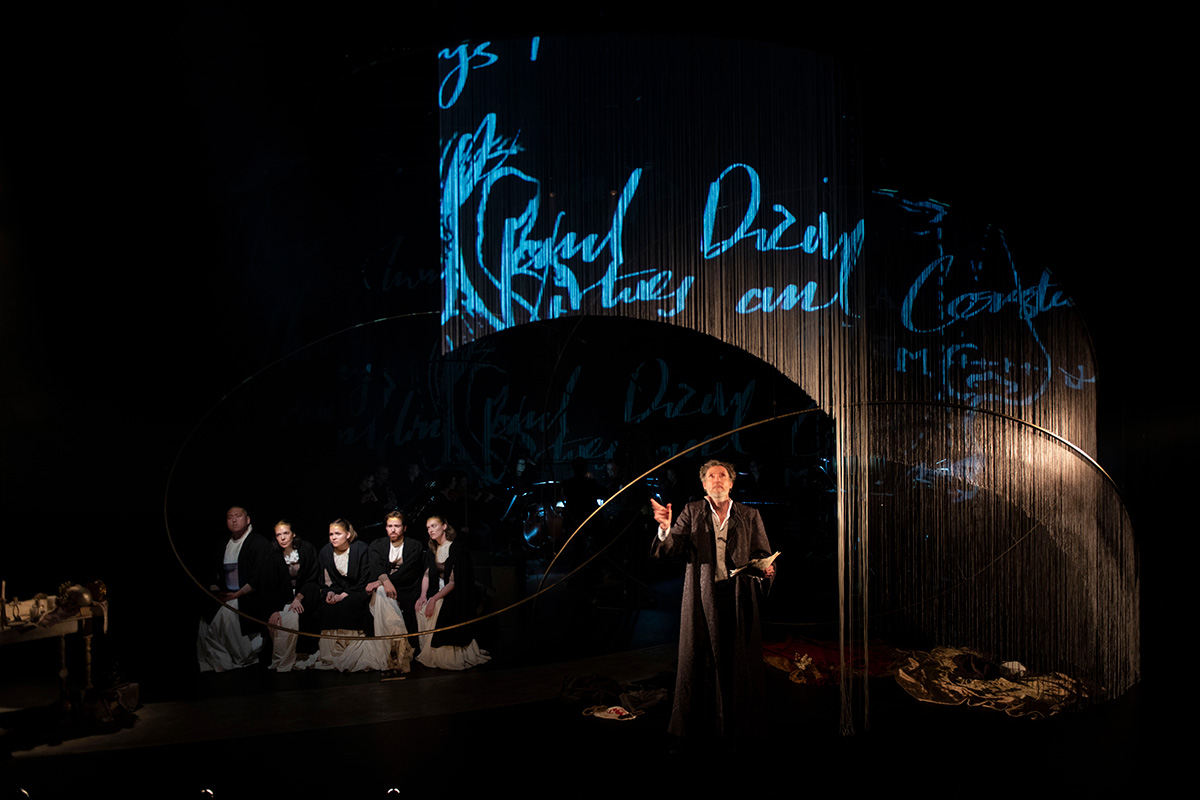 Raphael Wong, Juell Riggall, Rachael Joyce, Douglas Kelly, Belinda Dalton and Dion Mills in Biographica (photograph by Jodie Hutchinson).
Finsterer’s interest was sparked by a chance encounter she had in a university library with a copy of Cardano’s Liber de ludo aleae (Book on Games of Chance). More than just a book about probability, it includes musings on both the practice and ethics of cheating at the gambling table.
Cardano also made substantial contributions to engineering, optics, and especially medicine and astrology. The last two were not an unusual confluence of interests. Given the widespread belief that the position of celestial bodies could have a direct impact on the progression of diseases, astrology was seen as a servant to medicine.
This wresting of observation and logical supposition from the cloak of superstition, however, is perhaps the singular triumph of the Renaissance (if not Western civilisation writ-large), and the human impact of this transformation makes for great drama. (I note that later this year Victorian Opera will première Richard Mills’s take on the life of Galileo Galilei, which no doubt will traverse similar thematic material).
We come to this topic, however, with much less confidence than we might have done even just a few years ago. In the years between Biographica’s first performance and today, we have seen the accepted pre-eminence of scientific reason come under sustained attack on the back of vaccine hesitancy and climate-change denialism, among other things. It would have been interesting to explore whether Cardano’s life story proffered any lessons for us today.
Here, however, director Heather Fairburn presents the work squarely as a historical piece in and of the time of Cardano himself. While her program note states that the opera is ‘unconstrained by a linear narrative’, the twelve scenes (more like vignettes) nevertheless trace out a roughly chronological journey from his birth to death, prefaced by an opening scene in which Cardano consults an astrological chart in order to predict the day he will die.
We are given quite a lot of detail about Cardano’s life in the performance, because he is the only character on stage who does not sing. This conceit enables him to provide lengthy monologues that describe the context for each scene that subsequently unfolds in song. It also places him as an observer of his own life story, a narrative framing device that hearkens back to some of the biographical Lehrstücke of the Weimar era such as Paul Hindemith, Kurt Weill, and Bertolt Brecht’s Der Lindberghflug, or Darius Milhaud and Paul Claudel’s Christophe Columb.
Although delivered here with surety by actor Dion Mills, Cardano’s extended passages of dialogue were often acoustically smothered by both the orchestra and the chorus of female voices. Indeed, balance issues were a singular issue for this production. Principal characters sang in English or Latin, but it was quite hard at times to be sure what language was being sung at all. Clearly, surtitles would have been a valuable addition.
What seemed like general amplification did not provide a satisfactory solution to the acoustic challenges of the space. Conductor Patrick Burns and band delivered a taut ensemble, but, as is so often the case in the presence of general amplification, the orchestra’s dynamic range tended towards a near-constant mezzo-forte by the time it reached the audience. The artificially enhanced spread of sound also reduced the capacity of the audience to identify a particular voice when they were singing in ensemble.
Finsterer’s score has a gentle, minimalist quality, reminiscent of the film scores of Brian Eno or Michael Nyman, while also evoking Renaissance scalar modes and ground bass patterns. It is attractive and accessible, thought it did at times feel a little unvarying. Niklas Pjanti’s lighting was similarly singular in conception, dominated by dark backgrounds that also suggested the painterly effects of a Caravaggio. Together with Savanna Wegman’s smart, efficient set and costumes, it made good use of what I suspect is a difficult space (as well as acoustic) in which to stage opera. But was there, both literally and figuratively, more light and shade to be found in the representation of this fascinating subject?
I was also unsure why the chorus were, regardless of gender, universally dressed in, well, dresses. If this was a signal to the audience that, of course, we now know that all gender is fluid, it nevertheless seemed to play against a plot in which representations of gender-based violence are unavoidable.
As in Lyric Opera’s production of Elena Kats-Chernin’s Iphis last year, tenor Douglas Kelly (Aldo Cardano, Cassante, Examiner) – among a generally excellent young cast – was a stand-out for his clear diction, strong vocal delivery, and unaffected dramatic characterisations. Belinda Dalton (Cardano’s Mother, Doctor, Examiner), Rachael Joyce (Chiara Cardano), Juel Rigall (Catterina, Doctor, Examiner), and Raphael Wong –standing in for an indisposed Bailey Montgomerie (as Giambattista, Archbishop John Hamilton, Examiner) – all delivered their roles with confidence and conviction.
Technical challenges and other criticisms aside, it is laudable that Lyric Opera has given Melbourne audiences a chance to see Biographica for themselves, especially given that Melbourne no longer has an equivalent vehicle to the Sydney Festival that might commission or remount such a work. Next stop, Antarctica?
Biographica continues at Theatre Works in St Kilda until 1 October 2023. Performance attended: 23 September.