


- Free Article: No
- Custom Article Title: La Chimera
- Review Article: Yes
- Article Title: La Chimera
- Article Subtitle: Alice Rohrwacher completes her trilogy
- Online Only: No
- Custom Highlight Text:
La Chimera is the fourth feature film from Italian director and screenwriter Alice Rohrwacher, who made her feature film début in 2011 with Corpo Celeste (Heavenly Body). It is the final piece of a triptych – including Le Meraviglie (The Wonders) (2014) and Lazzaro Felice (Happy as Lazzaro) (2018) – which poses, in Rohrwacher’s own words, the central question of what to do with the past.
- Article Hero Image (920px wide):
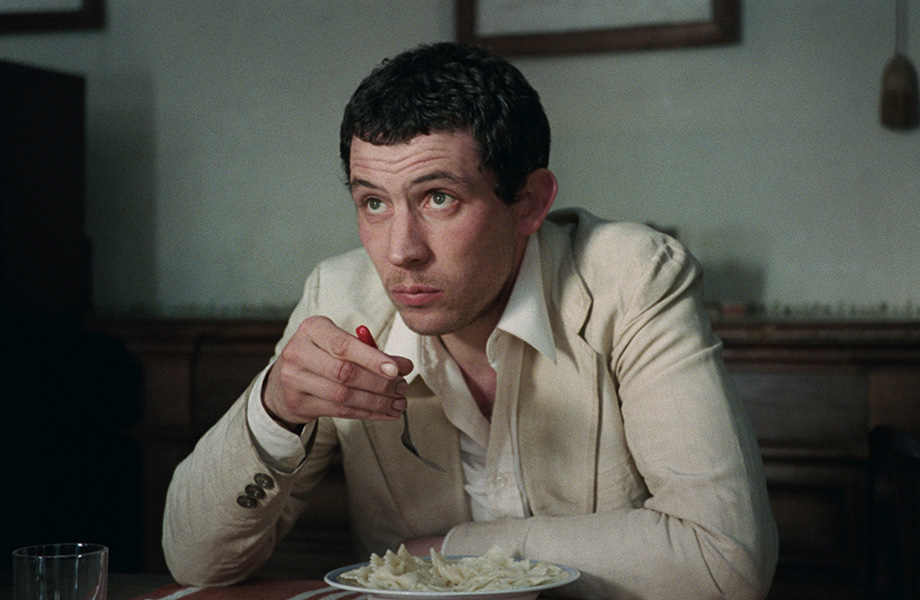
- Article Hero Image Caption: Josh O'Connor as Arthur (courtesy of Palace Films).
- Alt Tag (Article Hero Image): Josh O'Connor as Arthur (courtesy of Palace Films).
- Production Company: Italian Film Festival
The film’s title and central metaphor refers to that which each pursues without ever attaining it; the thing which is more than illusion and less than reality. For the tombaroli, it is a dream of easy money; for Arthur, it is Beniamina. A chimera is also a composite figure. In this sense, it is Rohrwacher’s film itself: not only for its use of three distinct film formats – 35mm for iconographic elements, Super 16mm for the main action, and regular 16mm, shot on an amateur camera for dreamlike sequences – but also for its disparate forms of storytelling. The story progresses by way of storybook illustrations, details from frescoes, gypsy songs, the slowing and speeding up of time, and flashbacks. The paratextual also forms part of Rohrwacher’s cinematographic chimera: the film’s official poster, a reworking of the Hanged Man tarot card, depicts Arthur hanging upside down from a red thread. This suggests fatalism, unconcern with earthly matters, mysticism, and looking at the world from a different perspective. At times, this perspective materialises onscreen via Rohrwacher’s camera, which is literally turned upside down. Indeed, the film is structured around a series of inversions: above-ground/subterranean, sacred/profane, past/present, ancient/modern, nocturnal/diurnal, life/death, possession/loss.
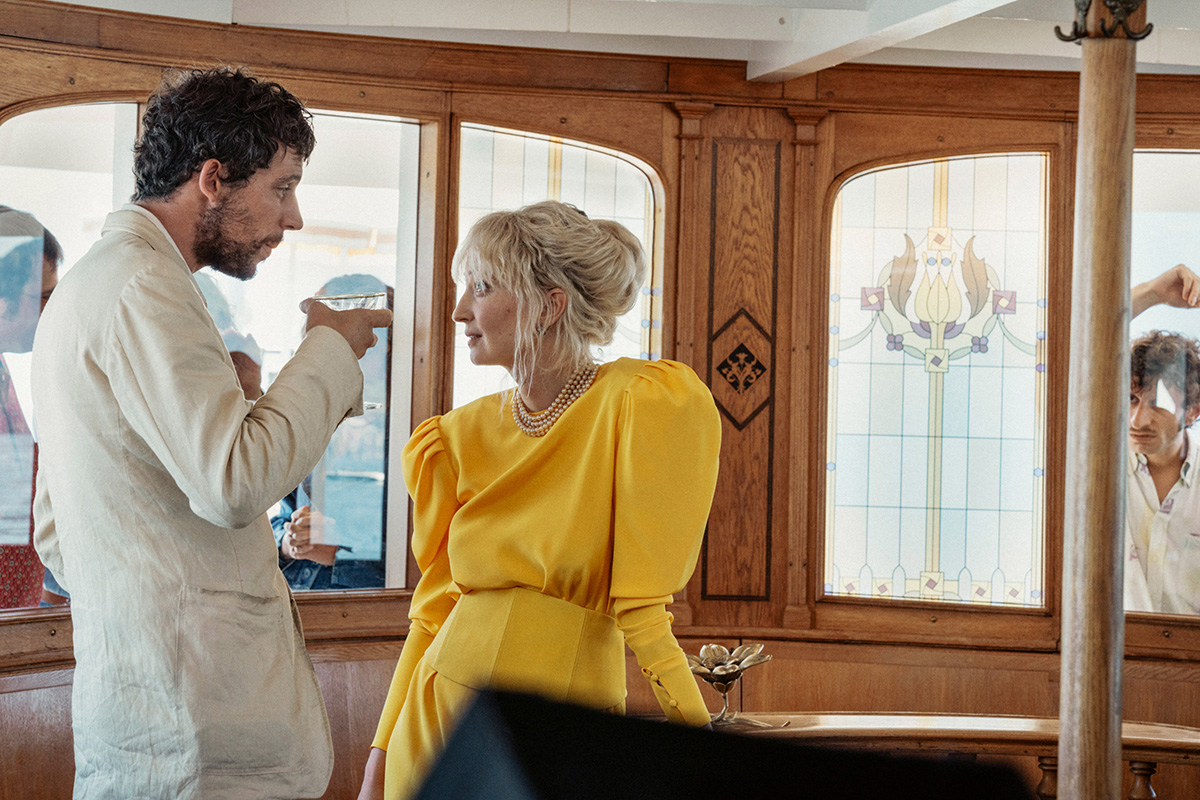 Josh O’Connor as Arthur and Alba Rohrwacher as Frida (courtesy of Palace Films).
Rohrwacher’s approach to filmmaking, her playfulness, and her use of iconography mark her out as a kind of Italian Agnès Varda; indeed, the form, aesthetic, and storytelling of La Chimera owe a debt to Varda. There are also echoes of Fellini, in the film’s dreamy and at times carnivalesque atmosphere, including direct citations such as the fading frescoes in Roma and a recreation of the famous ‘flying statue’ sequence from La Dolce Vita, with Christ replaced by a statue of a headless Etruscan goddess. Emir Kusturica, whose 1995 Palme d’Or-winning Underground is also a reference point for La Chimera, has not only described Rohrwacher as coming out of the best traditions of Italian cinema (Fellini, Antonioni, Rossellini, De Sica) but also as a director who has created some truly ‘good’ characters in the moral sense of the word – heroes of our time – and one whose political engagement and ideas about life are strong and profound.
Typical of a Rohrwacher film is a multigenerational cast of misfits and outsiders played by professional and non-professional actors. O’Connor, best known for playing Charles in The Crown, gives a nuanced performance as Arthur, a man whose gift is a curse and whose quest for artefacts is overshadowed by that for his lost love. O’Connor’s Britishness references D.H. Lawrence, who not only visited Etruscan tombs in the 1920s but who became infatuated with Etruscan culture and wrote a book on the subject (Etruscan Places and Other Italian Essays, 1932). For Lawrence – and also in a way for Rohrwacher – the Etruscans, who lived closer to the earth and more in harmony with its rhythms, offer a foil to the destructive and masculine imperialism of Rome. Thus, in La Chimera, there is an ambiguity around the figure of the tomb raider who pillages and profits but who also brings what was lost to the surface. Isabella Rossellini appears as Flora, a retired opera diva and mother of Beniamina; Alba Rohrwacher, the director’s sister and frequent collaborator, plays, against type, a black-market art dealer who fences the stolen artefacts; and Carol Duarte brings a gauche otherworldliness to the character of Italia, the ‘woman Italy’ who represents what could be and what could have been.
Rohrwacher describes La Chimera as an oriental tapestry into which are woven the disparate threads that structure the film’s universe. The motif of the thread is literalised in the red thread that Arthur, in his reveries, follows in search of Beniamina, the Eurydice to his Orpheus. This thread is also both the narrative thread which pulls us through the film and the common thread, or filo rosso, which runs through all stories and all lives. If a life is a series of events, the filo rosso is what binds them together into what might be called a story or, in this case, a film. Rohrwacher is never heavy-handed about this: the thread is there; it is up to us to find it.
La Chimera is screening nationally as part of the 2023 Italian Film Festival, which runs from 19 September until 28 October 2023.