


- Free Article: No
- Contents Category: Theatre
- Custom Article Title: Lady Day at Emerson’s Bar and Grill
- Review Article: Yes
- Article Title: Lady Day at Emerson’s Bar and Grill
- Article Subtitle: Zahra Newman’s searing portrait of Billie Holiday
- Online Only: No
- Custom Highlight Text:
What makes the physical and mental disintegration of famous performers so compulsively fascinating to so many people? The breakdown of a talented artist, usually female, brought down by her insecurities and the betrayal and abandonment of those close to her, usually male, is a trope that is endlessly trotted out to and repeatedly lapped up by audiences.
- Article Hero Image (920px wide):
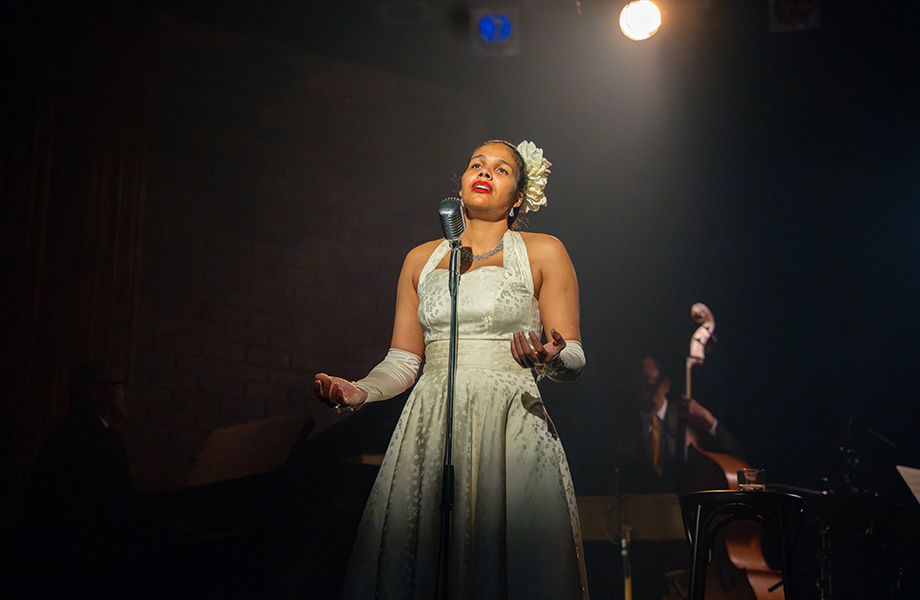
- Article Hero Image Caption: Zahra Newman as Billie Holiday (photograph by Matt Byrne).
- Alt Tag (Article Hero Image): Zahra Newman as Billie Holiday (photograph by Matt Byrne).
- Production Company: Belvoir St Theatre
Robertson doesn’t exactly accentuate the positive in his portrait. The song ‘Gloomy Sunday’, one of Holiday’s staples which doesn’t appear in the show, would have worked perfectly as its theme song.
The play is set in 1959 at the very end of Holiday’s short life (she died aged forty-four). Having been imprisoned for drug possession, her New York cabaret card has been revoked and she can no longer play clubs in New York, so she has been reduced to performing in the seedy club mentioned in the title, in Philadelphia, a city that is definitely not one of her favourites. As she says: ‘When I die I don’t care if I go to heaven or hell, so long as it ain’t in Philly!’
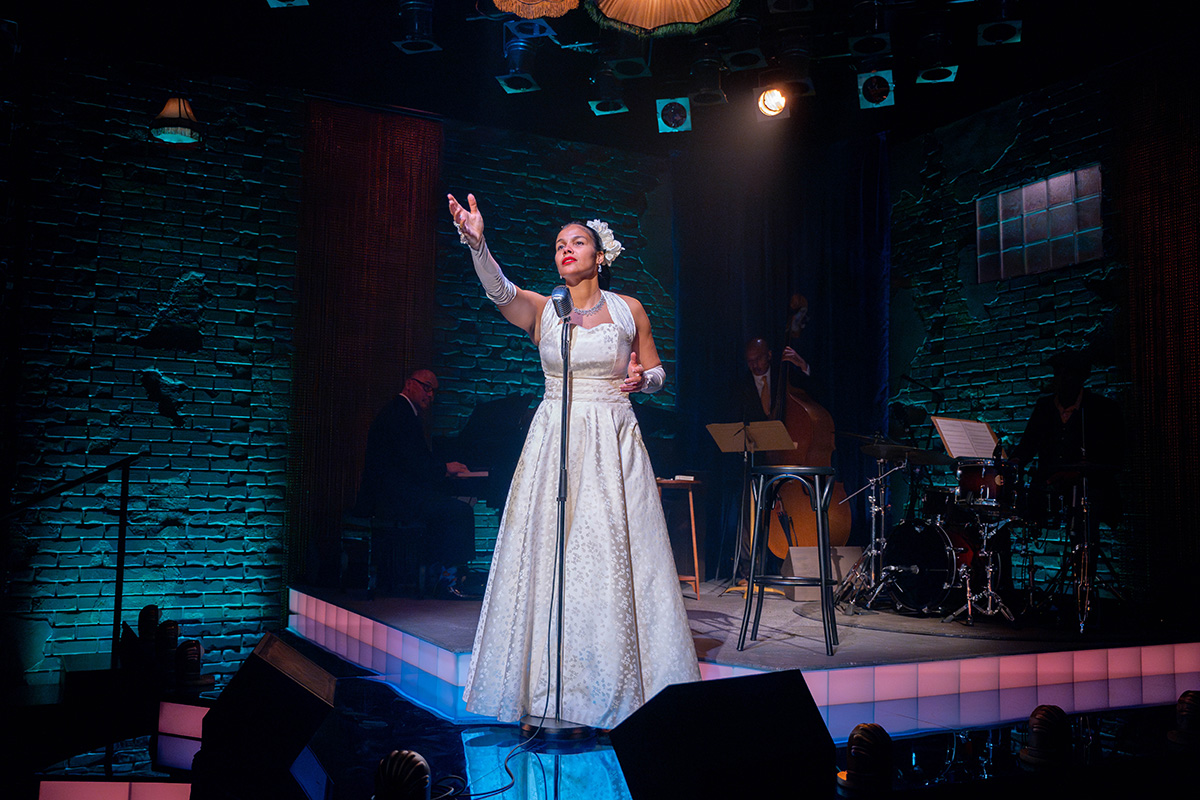 Zahra Newman as Billie Holiday (photograph by Matt Byrne).
Lanie’s play follows a well-trodden path. The performer sings numbers associated with the person she is portraying, while interrupting the songs to fill the audience in with details from her subject’s life. In this case, we have an already high and liquored Holiday becoming more befuddled as the evening wears on, despite the best attempts of her loyal pianist Jimmy Powers at first to keep her on track and later to keep her off stage. At the end, she lapses almost into complete incoherence.
Along the way, the well-known aspects of her life are mentioned: the childhood rape; the under-age jobs at the local sporting house; the complicated relationship with her mother; the abusive men in her life; the challenges and humiliations of touring the south with an all-white band; and the seductive spell of heroin.
So why is this rather by-the-numbers play undoubtedly one of the must-see pieces of theatre this season? The answer lies in the gifted hands of the cast and crew at present at Belvoir, and especially in the hands of the glorious Zahra Newman. Just as Holiday could take the second-rate songs she was often lumbered with in her early days and turn them into art, Newman takes Lanie’s occasionally pedestrian script and creates a searing portrait of a great artist stumbling through the wreckage of her life and career.
Newman, thank goodness, doesn’t attempt to sing as Holiday would have at that stage of her career. Although some ardent Holiday fans claim that the sad, croaky final recordings reveal a lived-in experience that compensates for the vocal wreckage, an evening of late vocal Holiday, combined with Robertson’s moroseness, would be enough to have the audience slashing their wrists en masse. Instead of a vocal impersonation, Newman uses some Holiday quirks – the slight break in the voice, the odd little yelps that arrived in the later recordings, and, above all, the glorious, lazy phrasing that Frank Sinatra, among many others, appreciated and copied – but we have no fear that her power and range will be compromised. One disappointment is that, because the muddled Holiday is gradually forgetting her repertoire, so many favourite songs are merely glanced at as she lurches on. But when she gets a chance to sing a complete number, Newman grabs it. She lets rip on Bessie Smith’s ‘Gimme a Pigfoot’ wandering among the tables that have been set up in front of the stage. When she sings the two most classic Holiday numbers, ‘God Bless the Child’ and ‘Strange Fruit’, she knocks them out of the park. Her final note on the latter is a wail that echoes Holiday and sums up the essence of that devastating song.
When Robertson allows it, Newman is raunchy and funny, but she is at her most moving when she reaches out to her ‘friends’, the only ones she feels she has left – her audience. She makes it clear that the only things that really console her are heroin and music. As Billie herself said, ‘Anything I do sing is part of my life.’
Over the last few years, Newman has given us some extraordinary performances, but this one has to be a highlight of her career, as the Sydney opening night audience acknowledged with a standing ovation.
Kym Purling’s Jimmy Powers is less a support for Billie and more of an increasingly distraught partner. His musical hints fail to curb Holiday’s loquaciousness, and his attempts to create an interval in which efforts could be made to bring Holiday back to earth are also doomed. Musically, however, Purling, Victor Rounds on double bass, and Calvin Welch on drums make a luxurious backing group.
Even though Robertson’s play concentrates on the sad tail-end of her career, director Mitchell Butel and his talented team have treated one of the great song stylists of the last century with compassion and respect.
Lady Day at Emerson’s Bar and Grill continues at the Belvoir St Theatre until 15 October 2023. Performance attended: 16 September.