


- Free Article: No
- Contents Category: Opera
- Custom Article Title: Maria Stuarda
- Review Article: Yes
- Article Title: Maria Stuarda
- Article Subtitle: Donizetti’s wonderfully impure opera
- Online Only: No
- Custom Highlight Text:
The fecundity of Gaetano Donizetti in the 1830s – when he was in his thirties – was exceptional, even during those rampant years for Italian opera. His successes were frequent: Anna Bolena (1830), L’elisir d’amore (1832), Lucrezia Borgia (1833), Maria Stuarda (1834), and Lucia di Lammermoor (1835), perhaps his finest achievement. Donizetti, who wrote about seventy operas in all before his mental collapse in 1846, was the nimblest of composers. Between L’elisir and Lucrezia, for instance, came four operas, all rarities today.
- Article Hero Image (920px wide):
- Alt Tag (Article Hero Image): Maria Stuarda
- Production Company: Melbourne Opera
Donizetti persevered, and Maria Stuarda was performed at La Scala on 30 December 1835, by which time he had added an overture and revised the title role for Maria Malibran, a mezzo, said to be in poor voice on the night. Even the Milanese were scandalised by the frank portrayal of royalty. The censors intervened after the first act of the sixth performance, and the opera disappeared. Not until 1958 was it performed again – in Bergamo, birthplace of Donizetti.
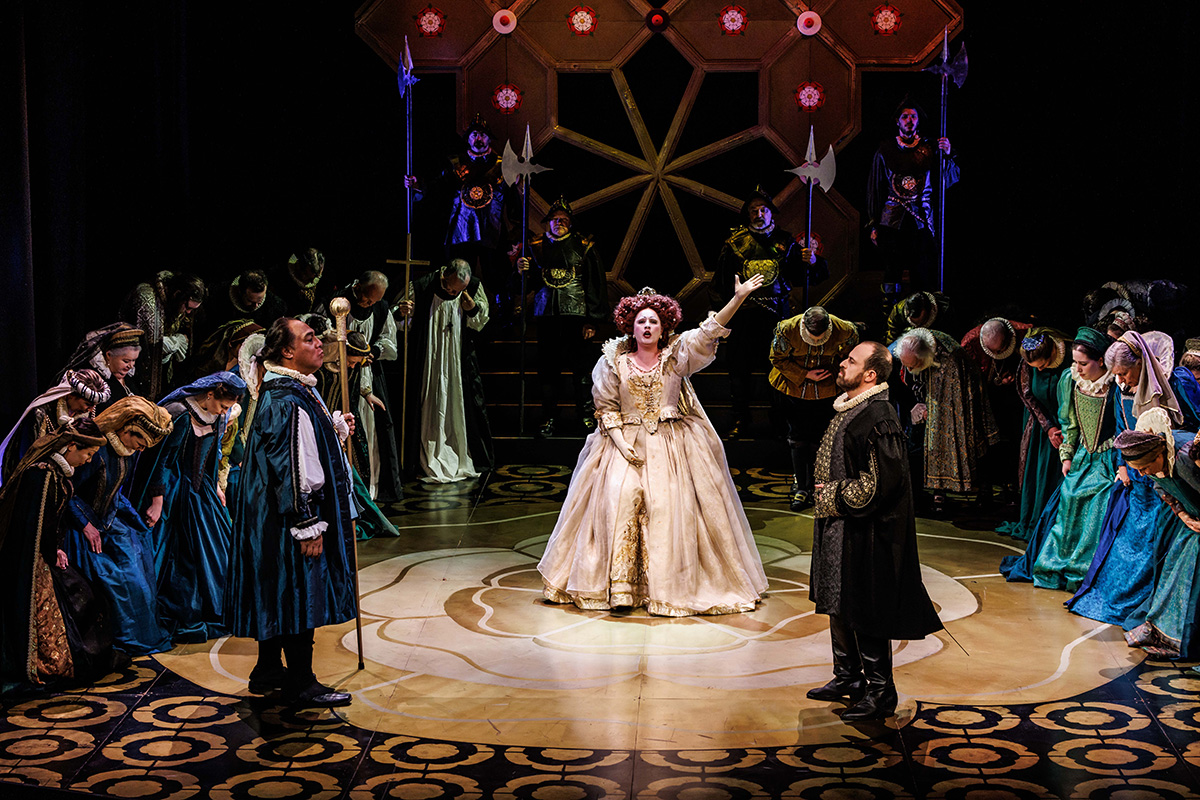 Eddie Muliaumaseali'I as Cecil, Eleanor Greenwood as Elizabeth, Christopher Hillier as Talbot, and Ensemble (photograph by Robin Halls).
We know, of course, that Elizabeth I – the other queen in the opera – never met Mary Stuart, her cousin once removed and a major claimant to her throne because of Mary’s Catholicism and Elizabeth’s putative illegitimacy. Following Mary’s flight from Scotland, Elizabeth imprisoned her notorious rival for eighteen years. She refused to meet her cousin, possibly intimidated by Mary’s famous beauty and several marriages.
Schiller knew better – or knew what makes good theatre. Improbably, he has Leicester, Elizabeth’s favourite, falling in love with Mary. He also has the two queens meeting in the grounds of Fotheringay Castle. Leicester beseeches Mary to flatter Elizabeth, but this goes badly and Mary ends up calling her captor the ‘figlia impure di Belona’ (the unchaste daughter of Anne Boleyn) and a ‘vil bastarda’ (no translation needed). All hell breaks loose, and Mary’s fate is virtually sealed. Elizabeth prevaricates for half an act (the historical Elizabeth balked at executing her conniving cousin, and later denied having intended to sign her death warrant), but then the execution proceeds after the other great scene in this highly camp and entertaining opera, which sopranos such as Joan Sutherland, Beverley Sills, and Montserrat Caballé restored to the repertory in the 1970s.
Melbourne Opera, after its Wagnerian heroics in Bendigo, returns to its bel canto roots with this revival of Maria Stuarda, first seen in 2015, when Rob Holdsworth reviewed it warmly for ABR Arts. How sensible and economical of the company to revive a successful, crowd-pleasing production.
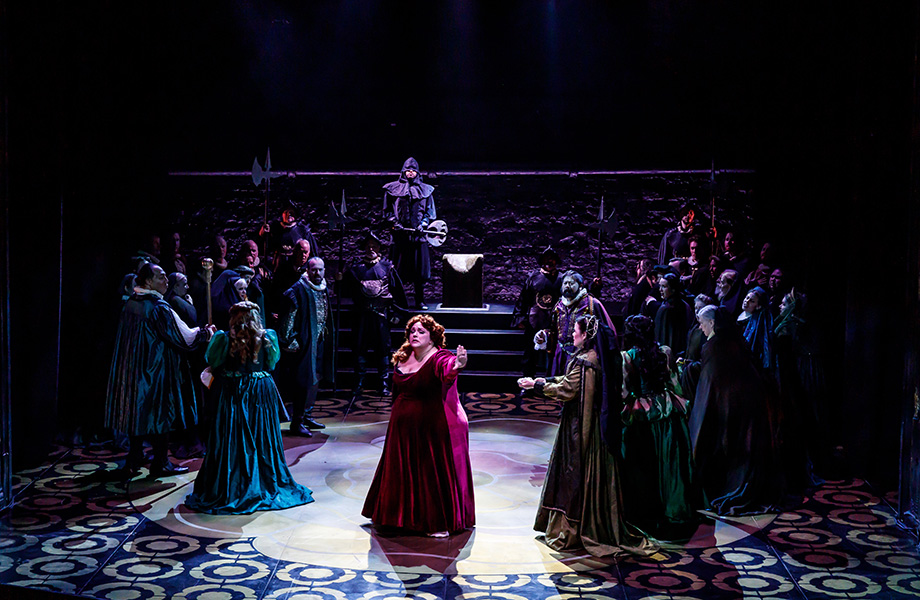
Christine Logan-Bell’s sets are compact and efficient, the scene changes endearingly rapid, the costumes (originally Jenny Tate, ‘refurbished’ by Rose Chong) suitably outlandish and Tudoid (as Barry Humphries would say). Suzanne Chaundy directs with her customary poise and humanity – a singers’ director, it would seem.
In 2015, Elena Xanthoudakis sang Mary; Rosamund Illing was Elizabeth. The opera was presented in English (the Tom Hammond translation). Here it is in Italian, perhaps because Helena Dix – the Mary of the moment – is likely to sing it elsewhere.
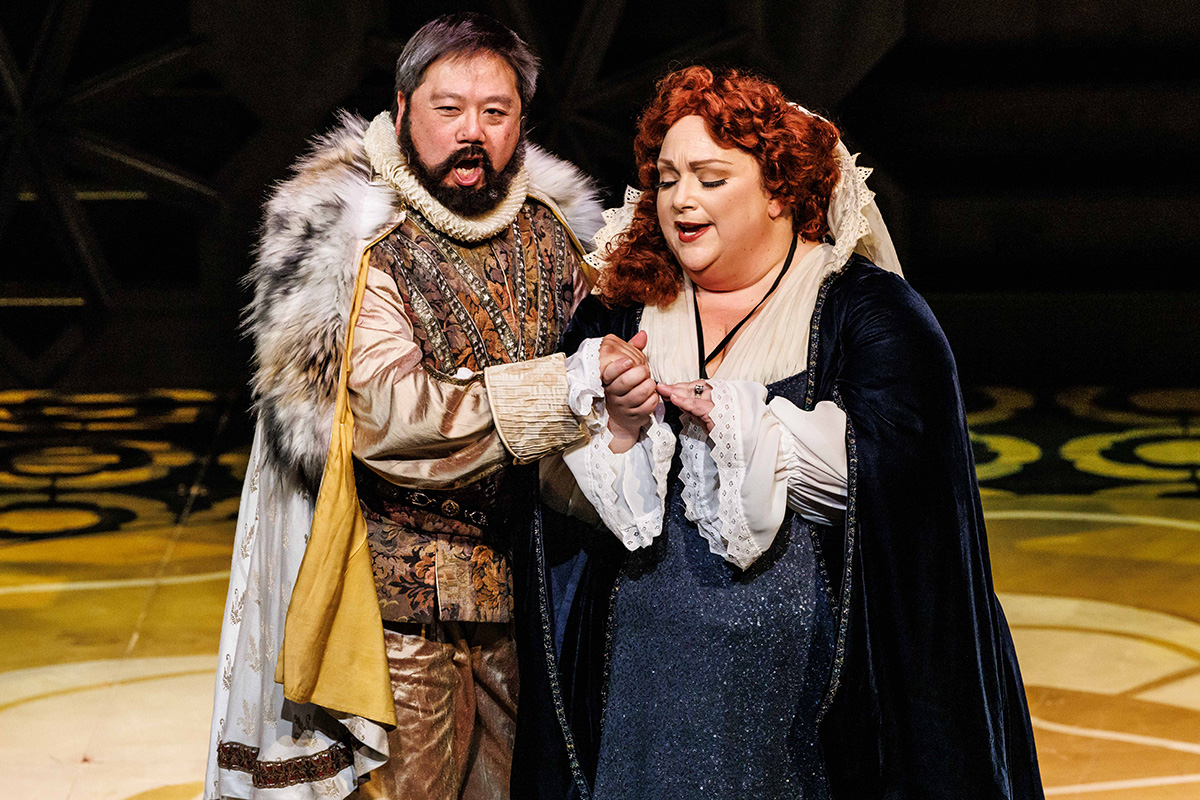 Henry Choo as Roberto and Helena Dix as Mary (photograph by Robin Halls).
Henry Choo and Eddie Muliaumaseali’i, company veterans, return as Leicester and Cecil, respectively. Muliaumaseali’i was a sturdy, engaged bass. Also from 2015, Caroline Vercoe – Mary’s devoted companion – looked the part but was not in good voice.
Choo has rarely sung better. Leicester suits him admirably: he understands the possibilities and perils of bel canto. Choo sang with refinement, discretion, and accuracy. He didn’t falter all night and was at his best in the many duets and ensembles, especially the scene with Talbot and his first duet with Mary, before her confrontation with Elizabeth. How good it would be to hear Choo in I Puritani or La Sonnambula.
Hillier was new as Talbot. He sang powerfully – too loudly at times for this small theatre. He was at his best in the long duet with Mary in Act II, when Talbot informs Mary that Elizabeth has ordered Leicester to witness her decapitation, and reveals himself to be a Catholic sympathiser. This bravura scene was splendidly sung and movingly acted.
Helena Dix – who has just sung Norma for the Metropolitan – is a favourite with Melbourne Opera audiences. Hers is a fascinating voice: delicate at times, with Edita Gruberová-like breaks in the voice as she ascends to pianissimo notes (always accurate); then dramatic and powerful, which is why she is singing Norma and roles like Lucrezia Borgia and Lady Macbeth (which she has sung for Melbourne Opera).
Dix began tentatively, especially in the wonderful ‘Oh nube! che lieve per l’aria ti aggiri’, when Mary recalls her early years in France, of which she was briefly queen. This aria, one of the finest things in the opera, was taken rather slowly. After this cautious start, Dix revealed the full colours and resources of her voice. The coloratura and interpolations (her own perhaps?) grew bolder and more galvanic, especially at the end of the famous confrontation with Elizabeth that ends Act One, when Mary – patience exhausted, deference abandoned – excoriates Elizabeth. How well Dix acts too, always responding to the other singers and to the pathos in this melodrama. Her Mary (hardly regal at all now) is human – defeated and haunted, terrified and accepting.
Best of all in Donizetti’s opera is the prayer scene at the end (‘Deh! Tu di un umile preghiera’). Here, Dix was magnetic – vocally uninhibited and commanding. She capped it with some heroic high notes as she headed to the block.
Eleanor Greenwood, as Elizabeth, threatened to run away with the show until Dix (possibly in response; it’s a competitive art form) went up a notch. Elizabeth (usually sung by a mezzo) opens the opera, and has much testing, florid music throughout. Greenwood, winner of the 2023 Opera Awards in Australia, came to our attention during the recent Ring cycle in Bendigo, where she was a resounding Third Norn (I missed her Sieglinde in the third cycle). Greenwood began as a mezzo but now undertakes major soprano roles, including Leonore and Abigaille for Opera Queensland’s Sopranos. Here, she sang ringingly, at her best in the prize fight with Mary, matching Dix in terms of volume, range, and histrionics. Elizabeth seemed at times to be about to lash Mary with the crop she wielded to hilarious effect.
The chorus in this opera has little to do: a perfunctory tune at the start as the courtiers signal the arrival of Queen Elizabeth, rumoured to be about to marry the Duc d’Anjou; then the long final scene when Mary’s supporters lament her fate and accompany her during the prayer. This was much more vehement and impassioned than usual (some prayer scenes are far too religious), and the chorus was magnificent.
Raymond Lawrence – conductor, head of music, and chorus master – coaxed a memorably subtle and limpid performance from both orchestra and singers.
Maria Stuarda (Melbourne Opera) continues at the Athenaeum Theatre, Melbourne on 15 and 17 September 2023. Performance attended: 13 September.