


- Free Article: No
- Contents Category: Film
- Custom Article Title: A Haunting in Venice
- Review Article: Yes
- Article Title: A Haunting in Venice
- Article Subtitle: Kenneth Branagh’s third Hercule Poirot film
- Online Only: No
- Custom Highlight Text:
In 1920, the figure of Hercule Poirot arrived, fully formed – from the top of his egg-shaped head to the tip of his toes – when Agatha Christie published her first detective novel, The Mysterious Affair at Styles. She introduced her detective in the words of an admiring narrator who was to function as a kind of Dr Watson to her Great Detective. Poirot, we are told ‘was an extraordinary looking little man, hardly more than five feet four inches, but he carried himself with great dignity’.
- Article Hero Image (920px wide):
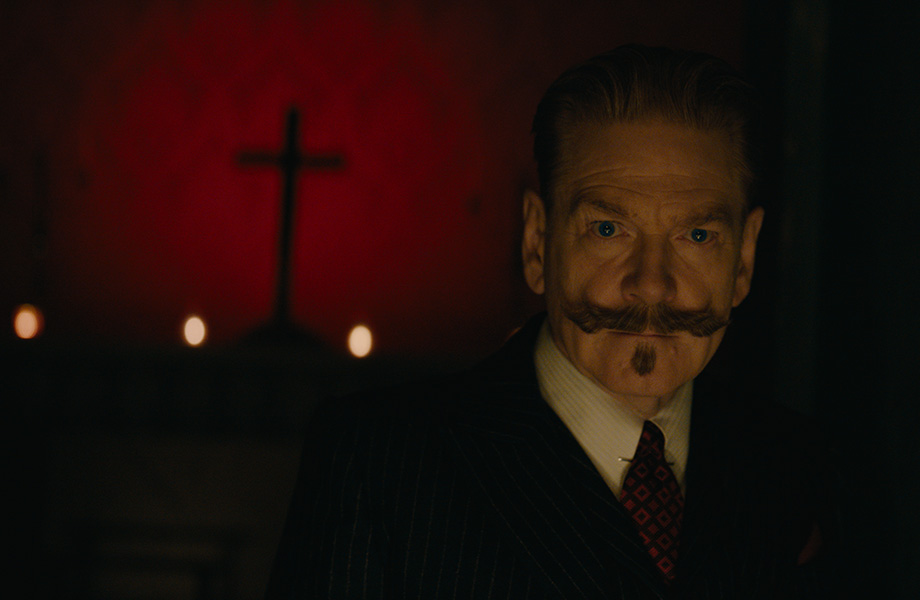
- Article Hero Image Caption: Kenneth Branagh in A Haunting in Venice.
- Alt Tag (Article Hero Image): Kenneth Branagh in A Haunting in Venice.
- Production Company: Twentieth Century
Christie wrote thirty-three novels, two plays, and more than fifty short stories featuring Poirot, before killing him off in 1975 in Curtain. Inevitably, the unprecedented success of her books led to adaptations in other mediums. Poirot has been played by the likes of Charles Laughton, Orson Welles, John Malkovich, Peter Ustinov, and Albert Finney. In a long-running television series that began in 1989, David Suchet played the role seventy times, and published a memoir, Poirot and Me (2013).
Kenneth Branagh, as both director and actor, is the most recent performer to explore the idiosyncrasies and limitations of this sharply defined character. A Haunting in Venice is his third Poirot outing, and it marks something of a shift for Branagh and screenwriter Michael Green. Their previous collaborations, Murder on the Orient Express (2017) and Death on the Nile (2022) were reasonably faithful adaptations of Christies that took place in lavish or unconventional settings.
In A Haunting in Venice, they have once again opted for a spectacular location, but they have taken a late Christie that was set in an English village on the outskirts of London and transformed it. The film is very loosely based on Hallowe’en Party, a 1969 Poirot that has been filmed on a couple of occasions. The Suchet version of the same name (2011), set in the 1930s, tidied up some potential loose ends, but followed the original fairly closely; a French television series, Les Petits Meurtres d’Agatha Christie – which specialises in adapting Poirot mysteries, while dispensing with the figure of Poirot – has an episode, Death at a Country Fair (2014), which adheres to the essence of the story, even if the characters and tone are very different.
As it happens, Branagh had flagged this particular book on screen already. In Belfast (2021), a drama based on his childhood in Northern Ireland set in 1969. There’s a scene at the family Christmas party where gifts are being distributed: they include a hardback copy, seen in close-up, of Hallowe’en Party, which just happened to have been published that year. Christie, it turns out, was a favourite author of Branagh’s mother.
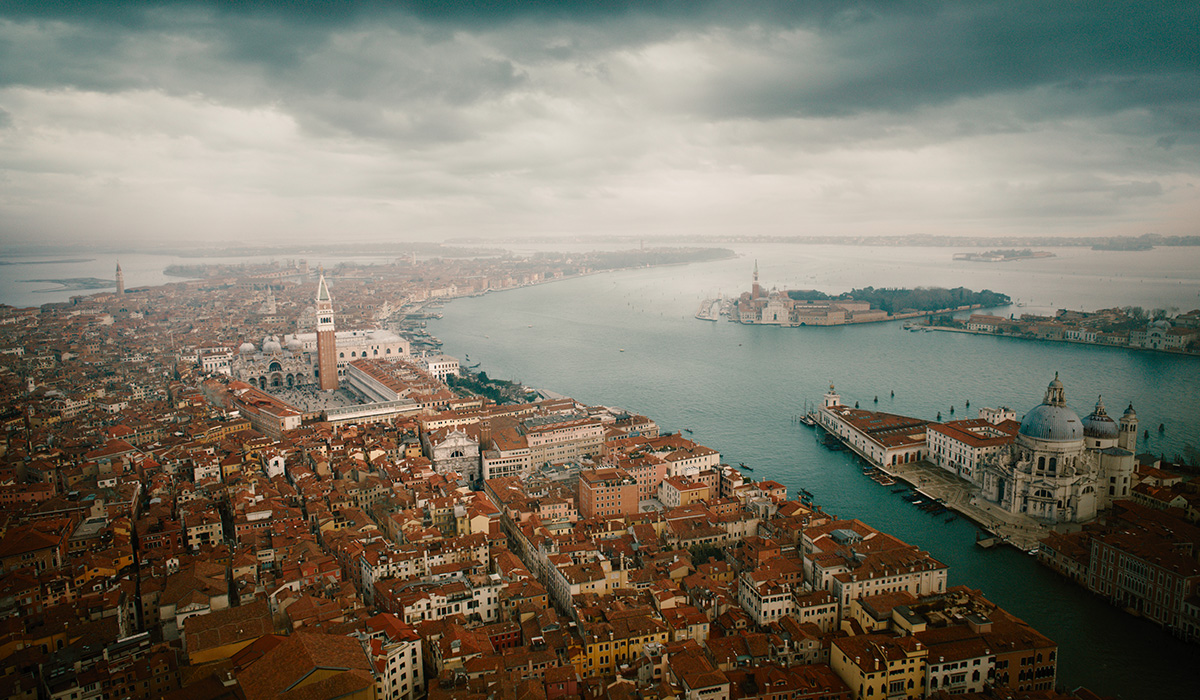 A Haunting in Venice.
Whatever it was about this book that appealed to Branagh, he has played fast and loose with its ingredients. A Haunting in Venice contains trace elements of the Christie novel: character names, small incidents, the Halloween setting, and the traditional game of apple-bobbing. But it is set in 1947, in Venice, where Hercule Poirot is living, retired from the detective business and keeping the world at bay. He is still being bombarded with requests for his services, but a bodyguard (Riccardo Scamarcio) repels all comers. Poirot’s solitude is breached, however, by the arrival of an old friend, detective-story writer Ariadne Oliver (Tina Fey), who wants to jolt him out of his isolation; she is seeking his help to expose the work of a medium, Joyce Reynolds (Michelle Yeoh), who has been engaged by a Venetian resident to communicate with her late daughter. Ariadne Oliver believes she is a fraud, and wants to write a book that will unmask her.
The séance is being held for Rowena Drake (Kelly Reilly), a celebrated opera singer whose beloved daughter, Alicia, jilted by her fiancé, has drowned under mysterious circumstances. The palazzo where they lived is already haunted, it seems; it had once been the site of an orphanage, centuries earlier, where the children in residence were abandoned by doctors and nurses.
The cast of characters is assembled. Some are on site, some arrive for the séance. There is also a family doctor (Jamie Dornan) and his precocious son (Jude Hill). Camille Cottin, a vivid comic presence in the French series Call My Agent!, brings a fierce melancholy to the role of a housekeeper with a strong religious faith. Joyce Reynolds has a couple of young assistants with her (Emma Laird and Ali Khan). And Alicia’s jilting fiance (Kyle Allen) turns up unexpectedly, summoned to the event via an anonymous message.
Once the establishing shots of canals, bridges, and churches have set the scene, A Haunting in Venice goes dark and plays very much like a supernatural thriller. The weather turns stormy and the action shifts to the interior of the palazzo, to a succession of inexplicable events and unsettling shocks. What unfolds is in part a ghost story, but it’s also a murder attempt followed by a killing, plus a locked-room mystery and a protracted test of Poirot’s equanimity, sense of reality, and faith in what he knows.
Yeoh makes the medium, Joyce Reynolds, an enigmatic, self-aware, perceptive figure, an intriguing challenge to Poirot’s scepticism. Overall, though, this is not a subtle exploration of the uncanny. Branagh’s Hollywood directorial début, Dead Again (1991), a tale of past lives and present traumas, was a heightened, over-the-top exploration of supernatural possibilities. He has always loved the Dutch angle, the tilted camera shot that presents the frame askew; here we are constantly presented with slanting lines and perspectives, with images that show rain seemingly falling at a 45-degree angle, with oblique shots from above and below.
As well as his embrace of the angle, Branagh has made certain choices about the character he is playing for the third time. He sees Poirot as a figure who stands both inside and outside the mysteries, and who treats his revelations like a film director shooting a scene. His detective has been more robust than the usual Poirot, although this is less evident in A Haunting in Venice, where he is more unsettled and discombobulated.
Branagh has foregrounded the detective’s obsessive side: his insistence, for example, on his boiled eggs of an identical size was a comic action sequence in Death on the Nile, and it is referenced here once again.
Most of all, Branagh’s Poirot has been, in his own way, a haunted man, from the very beginning. A lost love, Katherine, is referenced in Murder on the Orient Express. In Death on the Nile, the circumstances of her death are clarified, as well as the reason why Poirot feels responsible for it. Death on the Nile also explains the origins of the famous moustache, connected to wounds and trauma. You would almost expect this aspect of Branagh’s Poirot to be heightened here, in a film about guilt, regret, and responsibility. There’s a fleeting reference to Katherine in A Haunting in Venice, but the main thrust of the film seems to be shared postwar trauma or survivor guilt, hastily added to characters’ individual stories. In dispensing with Christie’s plot, Green and Branagh haven’t really brought anything strong or surprising to the narrative. It’s all ambiance and angle. If they are planning another Poirot, they need to rethink their approach.
A Haunting in Venice (Twentieth Century) is released nationally on 14 September 2023.