


- Free Article: No
- Contents Category: Opera
- Custom Article Title: Macbeth
- Review Article: Yes
- Article Title: Macbeth
- Article Subtitle: Stuart Maunder tackles Verdi
- Online Only: No
- Custom Highlight Text:
During his five years as artistic director of State Opera South Australia, Stuart Maunder steered the company out of bleak times to some moments of genuine glory with a number of theatrically strong if mostly smaller productions. Among them, Sweeney Todd and Turn of the Screw stood out for their psychological realism, but he will also be remembered for having revived Richard Meale’s Voss in a highly successful semi-staged version in 2022.
- Article Hero Image (920px wide):
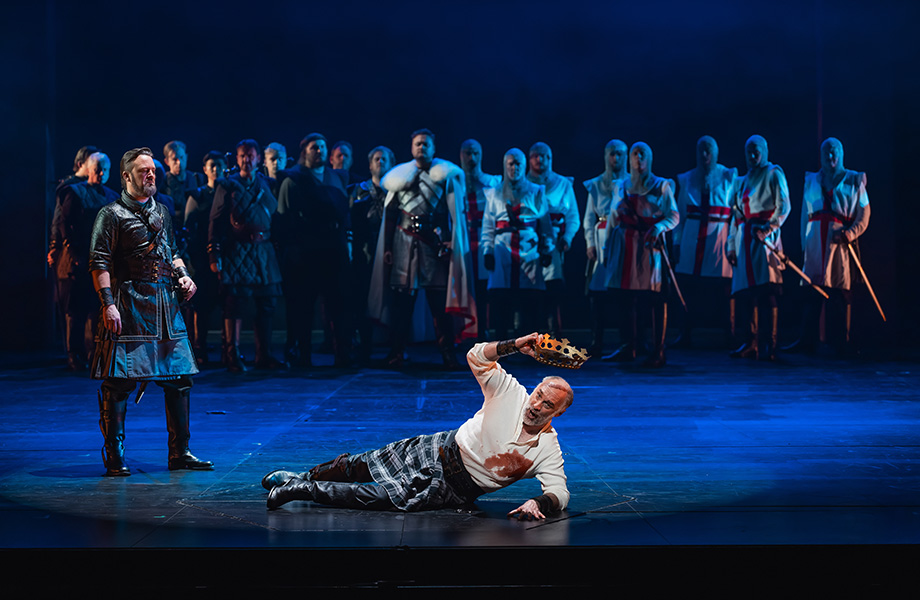
- Article Hero Image Caption: Macbeth (photograph by Tyr Liang).
- Alt Tag (Article Hero Image): Macbeth (photograph by Tyr Liang).
- Production Company: State Opera South Australia
One was to have been Macbeth in a co-production with West Australian Opera in 2020, but Covid put a miserable end to that. It had a success in Perth in 2019, but Adelaide has had to wait until now to see what insights Maunder could bring to Verdi’s first Shakespearean tragedy.
Not as brilliant as one would have hoped, the production is nevertheless something that all who hanker after Verdi should see. It is a Macbeth of breadth and vision, if not fully realised potential. Generally it feels slow to gather itself, which is less than ideal for an opera that depends on a potent start. Yet the singing takes off and it comes into focus theatrically in Acts Three and Four. It sounds and feels like true Verdi after intermission when the cast – headed by José Carbό as Macbeth and Kate Ladner as Lady Macbeth – gathers its strength, lets emotion take hold, and allows vocal cords to rip.
 Macbeth (photograph by Tyr Liang).
Orchestrally, it is all neatness and precision in the pit. Again, this is sadly not full-blooded Verdi, but it comes close. One admires the finesse of the Adelaide Symphony Orchestra under visiting British conductor Finnegan Downie Dear. The pacing he brings is finely judged, allowing all the speed, flight, and delicacy of Verdi’s scoring to come through. The only question is how unaccountably restrained the ASO sounds, given the sheer firepower of this opera. Adelaide’s Her Majesty’s Theatre, recently and superbly refurbished, is nicely sized for Verdi, but maybe its acoustics need sorting out.
The first two acts put all the basic elements in place without setting up the tensions as well as they might. Black-cloaked witches huddle around to prophesy Macbeth’s rise to kinghood, but they need more venomous snarl: they sing more like nuns than witches. But when a tartan-kilted Macbeth blithely strides in, they encircle him like a noose. A degree of grim menace sets in.
Carbό is an inoffensive, affable Macbeth at this point, perhaps lacking avarice. Ladner, reclining in bed to read his letter, is a nonchalant Lady Macbeth to begin with, but she gains a shrill wilfulness with the words, ‘Come! Hurry! I wish to light a fire in your cold heart!’ Seduction takes the place of subjugation when she kisses Macbeth caressingly: where we might expect a dominatrix to loom, instead we encounter a seductress. An interesting and different dynamic emerges between this couple as they set out on their brutal path to seize the Scottish crown.
When Macbeth asks ‘Is this a dagger I see before me?’ and the murders ensue, their singing hits the right spots, but the air is strangely unthreatening. Deep into the second act, Carbό unleashes genuine passion as he beholds the spectre of a dead Banquo. His final scene is great Verdi: emotionally tortured and blood-curdling.
It is in Act Three that the stage fully ignites. Partly it is simply because Verdi saves his best music in Macbeth for when superstition totally takes hold and the witches open up their fiery cauldron to toads, vipers, and all their other vile ingredients. Here, the orchestral ride carries full force, and State Opera Chorus’s female voices open up in full throttle. Something equally momentous needed to happen right at the beginning in the witches’ first chorus. Dear’s conducting holds all the intricate layers with consummate skill, and each soloist ramps up their contribution. This is most strikingly so when Carbό illustrates how Macbeth, consumed by his own nightmares, descends into pure psychopathy.
This is early Verdi, with all its abrupt stops and starts. Macbeth can hardly be compared with the sophisticated integration of Otello or Falstaff – his much later Shakespeare operas. Nevertheless, it remains one of his most theatrically forceful operas. One is reminded in Carbó’s portrayal of the main character just how fallible is any human being, whatever the circumstances. Likewise, we see in Ladner’s characterisation a fully believable person who is overtaken by ambition.
Vocally, Carbó is a pure Verdian and carries off the title role with aplomb and stamina. Ladner has a higher voice than the deeper, threatening mezzo that Lady Macbeth is known for; but she has agility and an upper-register power that makes her performance compelling to the bitter end, when she kills herself.
Pelham Andrews supplies fine acting skills and vocal depth as Banquo. Paul O’Neill adds a wonderfully powerful, almost self-contained vignette as Macduff in the last act. Another fine tenor, Tomas Dalton, is excellent as Malcolm, heir to the Scottish throne. There are no shortfalls in this cast. Teresa LaRocca and Nicholas Todorovic convincingly fill the minor roles of the Lady in Waiting and Duncan.
The choruses are pungently delivered. State Opera SA’s chorus master Anthony Hunt has trained his singers well.
Creative lighting touches by Trudy Dalgleish make up for times when the sets look a little threadbare. Roger Kirk’s medieval-inspired costumes are elaborate and eye-catching, lending an intriguing Game of Thrones look to this production.
Maunder himself did not appear on stage during opening night’s repeated curtain calls. Perhaps he did not have as much directorial involvement in this production as usually happens. If so, this might explain why some elements felt undeveloped.
Verdi’s Macbeth (a State Opera SA co-production with West Australian Opera) at Her Majesty’s Theatre, Adelaide until 16 September 2023. Performance attended: 7 September.