


- Free Article: No
- Contents Category: Theatre
- Custom Article Title: Death of a Salesman
- Review Article: Yes
- Article Title: Death of a Salesman
- Article Subtitle: A magnetic production of Arthur Miller’s classic
- Online Only: No
- Custom Highlight Text:
In his survey of the notebook Arthur Miller kept while writing Death of a Salesman, John Lahr, in Arthur Miller: American witness (2022), relates that early in its composition Miller considered calling the play ‘The Inside of His Head’. Correspondingly, Miller envisioned the stage ‘designed in the shape of a head, with the action taking place inside it’.
- Article Hero Image (920px wide):
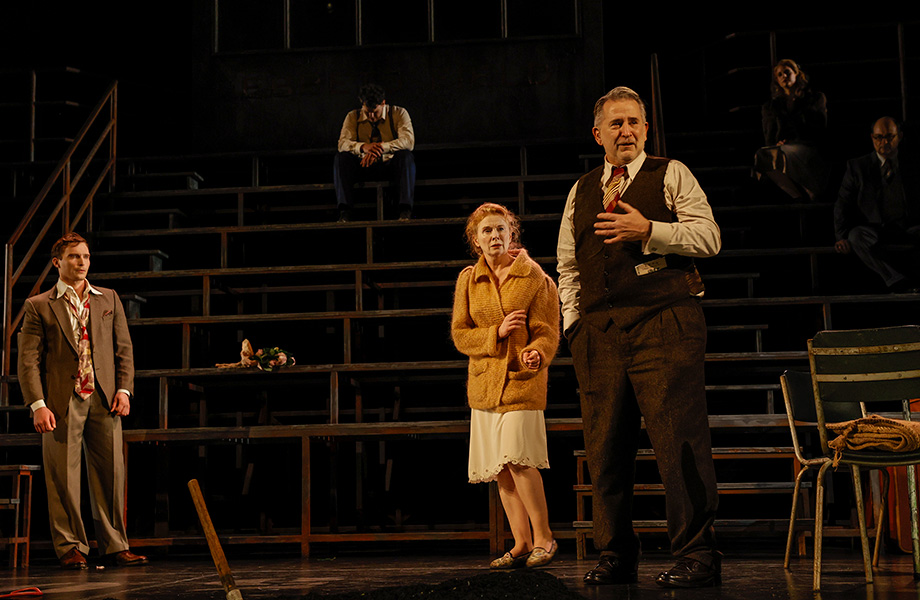
- Article Hero Image Caption: Sean Keenan as Happy Loman, Alison Whyte as Linda Loman and Anthony LaPaglia as Willy Loman (photograph by Jeff Busby).
- Alt Tag (Article Hero Image): Sean Keenan as Happy Loman, Alison Whyte as Linda Loman and Anthony LaPaglia as Willy Loman (photograph by Jeff Busby).
- Production Company: Her Majesty’s Theatre
Death of a Salesman was moving into production when, under the creative team of director Elia Kazan and designer Jo Mielziner, a solution was found to how the play might best be staged. The design encompassed ‘a series of platforms, with Willy’s house as a haunting omnipresent background’, a set rendered by Miller in his stage directions for the subsequently published text of the play as a place of ‘towering angular shapes … a solid vault of apartment buildings around a small fragile-seeming home’.
In his new production of Death of a Salesman at Melbourne’s Her Majesty’s Theatre, director Neil Armfield transfers the action from Willy’s house to a set of steeply raked bleachers looking out over Ebbets field, the high-school stadium where Willy Loman’s elder son Biff shone as captain of the football team (design by Dale Ferguson). As we will soon learn, Biff’s glory days are short-lived: ‘His life ended after that Ebbets Field game. From the age of seventeen nothing good ever happened to him.’
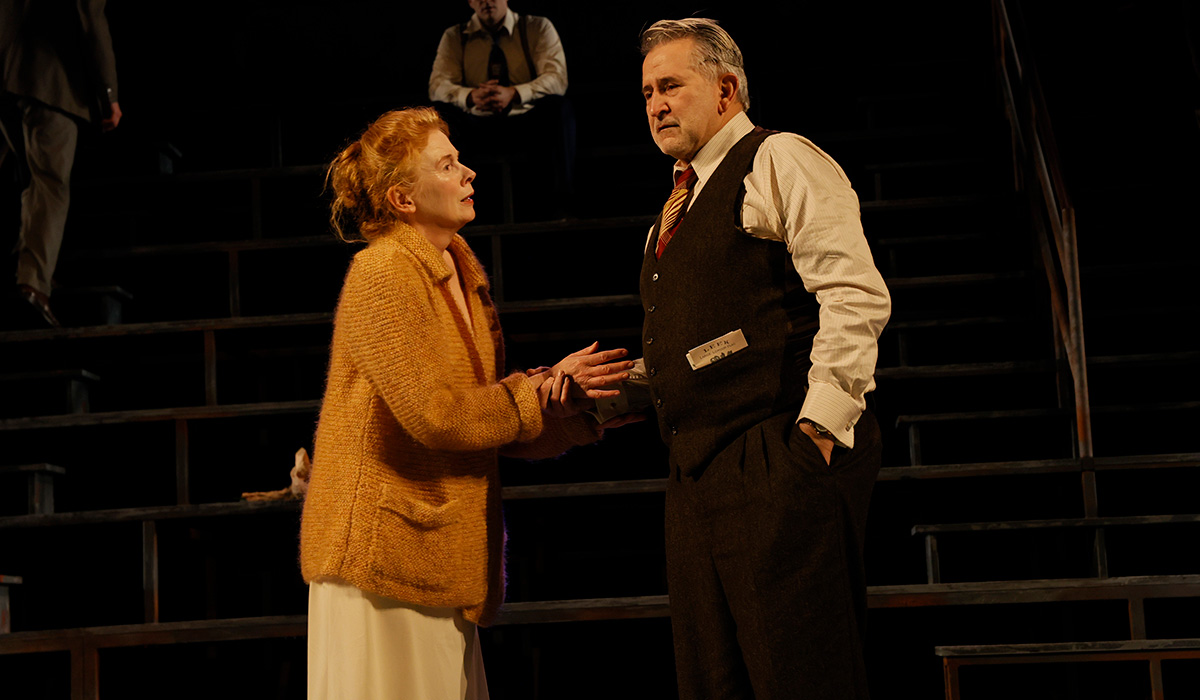 Alison Whyte as Linda Loman and Anthony LaPaglia as Willy Loman (photograph by Jeff Busby).
Armfield’s decision to stage the play not in a version of the Loman home but in the more emblematic space of Ebbets Field has its advantages. Miller’s intention for the play – to, as his notebooks tell us, dramatise that ‘we’re thinking on several planes at the same time … [t]hat life is formless – its interconnections are cancelled by lapses of time, by events occurring in separate places, by the hiatus of memory’ – is heightened by the presence on the bleachers of those friends and acquaintances who people Willy’s memory, a relentless reminder of his own failures. They watch Willy as he struggles to drag himself out of the chasm between his dreams and his reality. They are spectators, looking down on him, judging him. In Anthony LaPaglia’s Willy – in his gait, his breathlessness, his irritability – we feel the burden of their presence.
The advantages are, however, outweighed by the disadvantages. The staging runs counter to one of the central calamities of Willy’s life – that he is a man who passes through the world unnoticed. It distances us from Willy’s reality and robs us of its depth, an effect heightened by a soundscape (Alan John and David Greasley) whose tone, at times, seems at odds with the play’s mood.
A card table and a few chairs on the edge of the stage are unable to ground us in the sense of a present moment, in the daily reality with which Willy’s memories, his regressions into the past, are in constant conflict. We see none of the material accumulations of his life, the appliances that break down just as they are finally paid off, the house that is getting devoured by the ravenous city around it. When, at the beginning of the play, Willy says to his wife, Linda (Alison Whyte), ‘It’s alright. I came back’ – lines which, according to Miller, encapsulate the entire tragedy of the play – it is not clear to what Willy is returning. Nor does it indicate anything of that other place – literal and metaphorical – at which he has failed to arrive.
As Willy, LaPaglia lumbers about the stage, seeming at times to shrink inside himself. When he says he is a man ‘tired to the death’, the exhaustion is there in the way he carries himself, the hand that touches constantly at his chest, unconsciously recognising the pain he carries within himself, a sorrow to which he can’t, or won’t, give expression. This is a man who knows he has nothing left to sell, yet there is a bullishness within him that will not abandon his determination that ‘the greatest things can happen’, and that he and his sons – Biff and Happy – will be the root and branch of those ‘greatest things’.
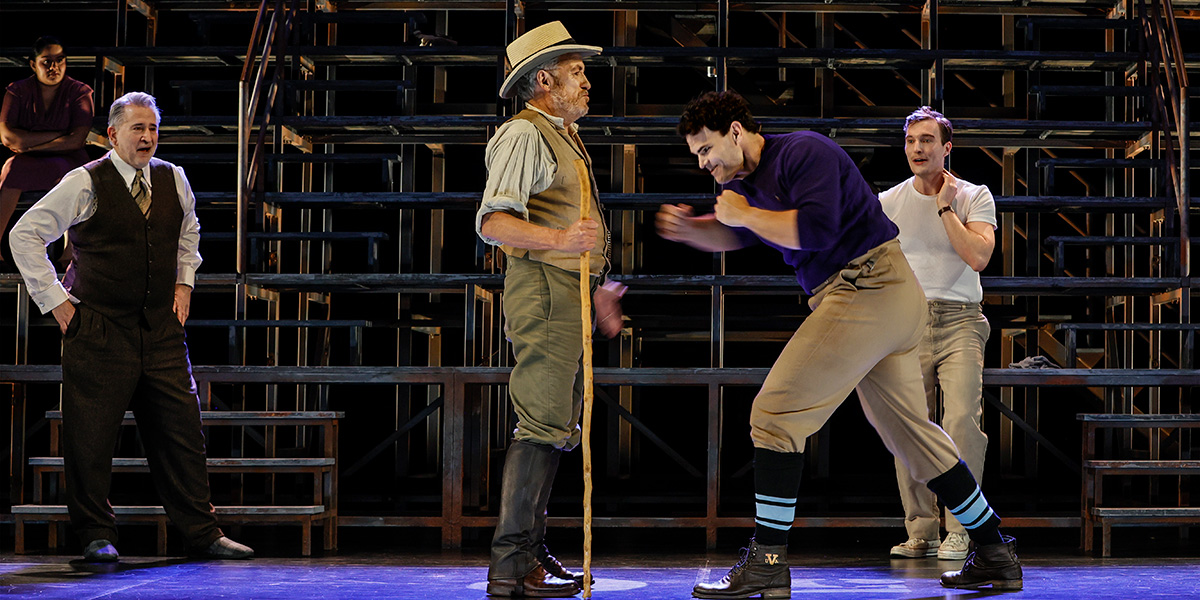 Death of a Salesman (photograph by Jeff Busby).
Crammed with the belief that his own life might yet be salvaged by his sons’ triumphs – Happy’s future work prospects, his promise that he’s getting married; a sporting goods company financed by one of Biff’s former bosses – LaPaglia’s Willy seems to grow taller, struts about and slaps his hands together as though, at last, his time has come. When the stark reality hits – that Happy is, as Linda stresses, ‘a philandering bum’ and any potential greatness Biff possessed has been long ago wrung from him – LaPaglia roars, defying to the last his own realisation that he is a man who has not been, and never will be, noticed. For an actor to find the balance necessary for the role, one that embodies Willy’s invisibility to the world while also saturating Willy’s life with an ambition so blighted we cannot look away from him, is not an easy thing. La Paglia triumphs. It’s a magnetic and moving performance.
LaPaglia is finely supported by the rest of the cast. Josh Helman as Biff reminds us that this is as much Biff’s tragedy as Willy’s. In those scenes where the boy-Biff readies himself for his big game, for the college scholarships that will be his if he gets through high school, there is in Helman’s face and in his bearing a frightening uncertainty, as though Biff knows, even as a boy, that Willy’s assertion that he will, one day, be magnificent – that magnificence is no less than Biff deserves – is a delusion. In his final battle with Willy, there are in the slump and weariness of his body hints of the same burdens, the same unrealised dreams, that have oppressed Willy. This is a man who knows that his entire life has been sacrificed to Willy’s impossible aspirations and to the future of never-ending failure that accompanies such aspirations. Even so, Biff cannot tear the love he has for his father from his heart.
Alison Whyte is terrific as Linda, the wife who has enabled her husband’s self-deception and his aggrandising visions of their sons’ futures. Her harsh doses of the truth – telling her sons they are ‘a pair of animals’ – cut through like a knife. Despite the straight-backed strength with which Whyte imbues her, Linda recognises both the tragedy that is unfolding before her eyes and her own inability to stop it.
As Happy, Sean Keenan has the matinee-idol innocence of a man who can blithely sleep with his colleagues’ fiancées without arousing anyone’s suspicions. Keenan is all good looks and superficiality, prepared to say whatever is necessary to avoid a confrontation. Tom Stokes as Bernard is a revelation, pivoting with ease from the nerdy teenager who idolised Biff to a dignified lawyer about to argue a case before the Supreme Court.
Perhaps the only false note is Richard Piper as Willy’s hyper-successful brother Ben who, at the age of seventeen, walked into the African jungle, discovered diamond mines, and walked out four years later a wealthy man. Piper’s characterisation pushes too hard at Miller’s stage direction that Ben should have ‘an aura of far places about him’, an effect not helped by a costume that makes him look more like a plantation owner from the pre-Civil War south than a business tycoon.
Italo Calvino defined a classic as a text that ‘has never finished saying what it has to say’. Despite speaking very much to its times – an America that, in 1949, had come through the Great Depression and then, according to Lahr, ‘fought a world war to keep the nation’s democratic dream alive; that dream was, broadly speaking, a dream of self-realisation’ – the play resonates keenly with our own times. Like Miller’s other great classic The Crucible (1953), Death of a Salesman now tells both a historical story and a contemporary one.
In the decades after World War II, American aspiration morphed into, Lahr contends, a culture of envy, ‘a process of invidious comparison that drives society forward but also drives it crazy’. As Miller himself noted of the times, individuals fight and compete against each other ‘not because it’s flowing from me but because it’s flowing against him … You’re living in a mirror. It’s a life of reflections. Emptiness. Emptiness. Emptiness.’
This urgency to get ahead at the expense of others, to sell yourself to attain some impossible dream, to feed the agitation and anger emanating from the sense of a world conspiring against you – a world that refuses to notice you on your own terms – is perhaps the defining affliction of our own times. From the politicians who govern against the opposition rather than for the people, to the social media self-promoters who sell themselves in exchange for a nanosecond of notice, all are grasping at this same emptiness.
When, in the play’s final scene, Linda laments over Willy’s grave, telling him that their mortgage is finally paid and that ‘We’re free … We’re free … We’re free’, the irony is palpable. Biff and Happy might now have access to an insurance pay-out, but we sense the ‘greatest things’ are unlikely to ensue from it.
In the end, Willy’s suicide is, as Lahr stresses, ‘the ultimate expression of his belief in winning at all costs’, a refusal to recognise that there is no winning when you have, as Miller says of Willy, competed yourself to death.
Death of a Salesman continues at Her Majesty’s Theatre in Melbourne until 15 October 2023. Performance attended: 7 September.