


- Free Article: No
- Contents Category: Music
- Custom Article Title: Steven Osborne
- Review Article: Yes
- Article Title: Steven Osborne
- Article Subtitle: A highly individual pianist at Ukaria
- Online Only: No
- Custom Highlight Text:
To say that Steven Osborne is one of the more uncompromisingly personal artists out there sounds like the kind of praise that is obligatorily handed to any performer who truly belongs to the top tier. But in the case of this Scottish pianist, his playing can be so individual that one has to enquire into the distinctiveness of his art in order to fully appreciate it.
- Article Hero Image (920px wide):
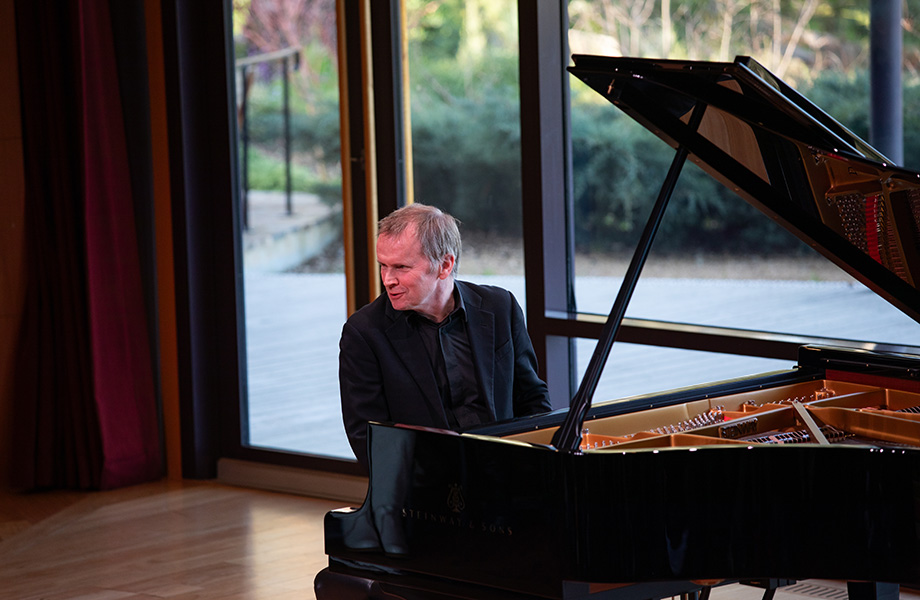
- Article Hero Image Caption: Steven Osborne at Ukaria (photograph by Dylan Henderson).
- Alt Tag (Article Hero Image): Steven Osborne at Ukaria (photograph by Dylan Henderson).
- Production Company: Ukaria
However, there can be times when his playing comes close to being as much Osborne as it is, say, Sergei Rachmaninov.
His recent performance at Ukaria offered illuminating insight into how this happens. Perhaps it was the wonder of this place itself – a rammed-earth architectural delight nestled in the picturesque environs of the Adelaide Hills – or the new Steinway grand; but as soon as he began playing it became obvious that he had entered a more concentrated state of mind than most concert pianists are able to sustain. For the lucky audience, it was a privilege to witness this artist in action.
 Steven Osborne at Ukaria (photograph by Dylan Henderson).
First came a set of children’s pieces by Claude Debussy and Robert Schumann, their full relevance only becoming evident as this recital unfolded. Schumann’s Arabeske in C, Op. 18 tumbled forth in a quick, smoothly connected chain of arpeggios of a quietness that made one hold one’s breath.
Osborne is not one to exaggerate dynamics: rather than following the herd, he generally underplays or avoids contrasts, as though they are a foreign, disruptive element. Little tugs and pulls of timing were all he added. Schumann responds so well to this treatment, especially in a piece of such beguiling directness.
Four pieces from Debussy’s Children’s Corner maintained the tone. Osborne played No. 4, ‘The Snow is Dancing’, with similar delicacy, reaching an even quieter pianissimo. This tiny piece can sound jarringly mechanical if played insensitively, but he reduced its staccato octaves to a misty softness. Nor does Osborne resort to caricature. So in No. 2, ‘Jimbo’s Lullaby’, there was no lumbering elephantine exhibition but rather a study of gentlest affection. It was impossible to not imagine a child at play in either this or No. 3, ‘Serenade for the Doll’. It comes as no surprise to learn that Debussy composed these pieces for his daughter Claude-Emma’s amusement, when she was three years old.
Schumann’s Kinderszenen, Op. 15, presents a different challenge: despite its title, this is not children’s music in quite the same way. Before playing the suite, Osborne explained that an adult’s picture of childhood, typically consisting of sweet untrammelled innocence, bears little resemblance to the chaotic emotion that children themselves experience.
Kinderszenen creates something of a problem, therefore, because Schumann penned its thirteen short pieces as recollections of childhood, or perhaps more correctly as expressions of his persistent inner child, as Clara liked to believe. Osborne, insightfully, went whole-heartedly with the implied fantasy to create a performance of charmingly pared-down simplicity.
His touch was pithily direct but once again delicate, and tempos were on the slightly quicker side. Moving from one to the next with barely a pause, each piece seemed briefer than usual. ‘Träumerei’ (Dreaming) was direct and unromanticised: phrases opened up here and there, but it was all over quickly – like a passing memory. A long, deliberate pause before the last piece, ‘Der Dichter spricht’ (The Poet Speaks), underlined the entire retrospective nature of this suite. It presents a beautiful fiction.
When Osborne plays Rachmaninov, there is just as much to admire but rather more to ponder. It does seem that he becomes a co-creator, moving beyond notions of what the score dictates or what conventions demand. On hearing a selection of the Preludes (Op. 23 No. 4 and Op. 32 No. 5) and Études-Tableau (Op. 33 Nos. 3 and 5), the initial impression is that he has assimilated this music to the point where it emerges in a different way – an Osborne way.
It is then that the artistic logic of his thinking becomes evident. A premium is placed on evenness and subtle gradations of dynamics to preserve an undisrupted flow of thought. Gossamer smoothness takes the place of heavy-handed rhetoric, although when contrast genuinely comes along he pounces on it. This happened at the start of the third movement in Piano Sonata No. 2, Op. 36, making people fairly jump in their seats.
The biggest difference about Osborne’s conception of this sonata concerns the fact that he has actually rewritten it. Rachmaninov himself left two versions, which differ markedly: he excised a full six minutes from the 1913 original work when he republished it in 1931. Osborne explained that his version lies somewhere in between; he borrows ideas from a third version that Vladimir Horowitz produced in 1940 and that won the composer’s approval.
Hearing Osborne play his own version was fascinating. It is completely plausible. Containing the full drama of the first movement’s development, it has satisfying span but retains the concision and power of a composer who loved Chopin. In the program, Osborne talks about ‘the pleasure of decimating the score with a pair of scissors’, and in this supercharged and highly personalised performance one could sense the glee he had in doing this. ‘I think it was partly the joy of returning to childish play; and I suspect it also felt like taking revenge on the never-ending pages of piano music which have dominated my life,’ he explained. Conventional rubato as expressed in teasing around with localised melody was jettisoned in favour of architectural gradations of tempo. Anything sweetly cloying was eliminated to uphold discipline. Suffice to say that while Osborne’s Rachmaninov may be unfamiliar, it is durable.
This Ukaria concert continues a year-round calendar of events of the highest quality at this special venue. It is absolutely worth making the pilgrimage to sample any part of it.
Steven Osborne performed at the Ukaria Cultural Centre on 27 August 2023.