


- Free Article: No
- Contents Category: Theatre
- Custom Article Title: Julius Caesar
- Review Article: Yes
- Article Title: Julius Caesar
- Article Subtitle: A play of mouths and tongues
- Online Only: No
- Custom Highlight Text:
In many ways, William Shakespeare’s Julius Caesar (almost certainly 1599) is a director’s rather than an actor’s play. While there have been brilliant performances associated with it – from Marlon Brando and John Gielgud to Ben Whishaw and our own Robyn Nevin – it is really the directors who make sense of it on stage, and have moulded its politics to suit the times. John Philip Kemble and William Charles Macready defined the play in the nineteenth century, with elaborately realistic sets and massive crowds, emphasising Brutus as a revolutionary figure.
- Article Hero Image (920px wide):
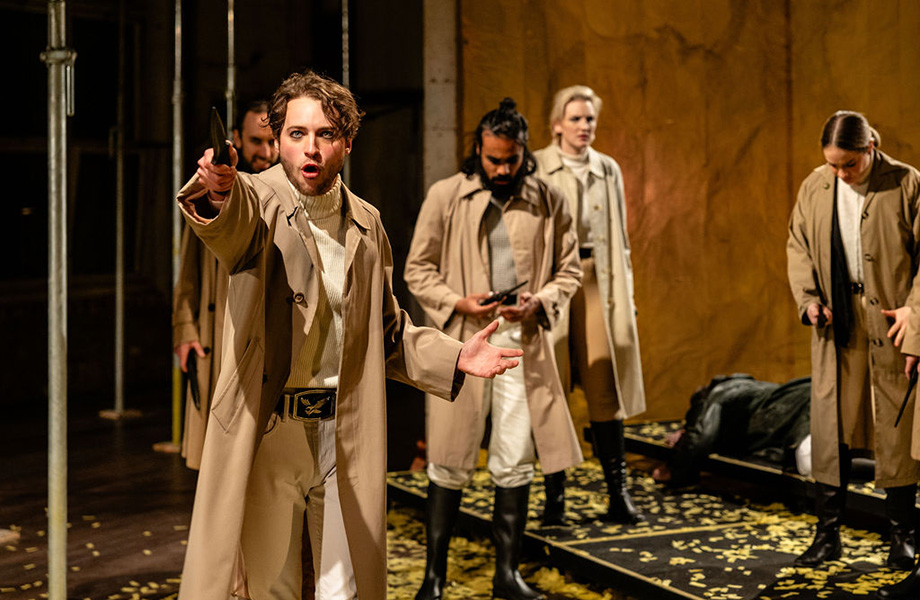
- Article Hero Image Caption: Matthew Connell as Marcus Brutus with cast (photograph by Chelsea Neate).
- Alt Tag (Article Hero Image): Matthew Connell as Marcus Brutus with cast (photograph by Chelsea Neate).
- Production Company: Melbourne Shakespeare Company
Murphet follows precedent by cutting the text – those nineteenth-century productions cut the play to fit in more spectacle, but these days it’s mostly for pacing and clarity – down to a rapid two hours without interval. If we lose most of the work’s preternatural sense of dread, that idea of the assassination as a rift in nature, we gain a terrible momentum, as if the actions of these politicians are careening out of everyone’s control. There is a sickening unravelling of argument and reason, a lurch into chaos the moment those blades penetrate the body politic.
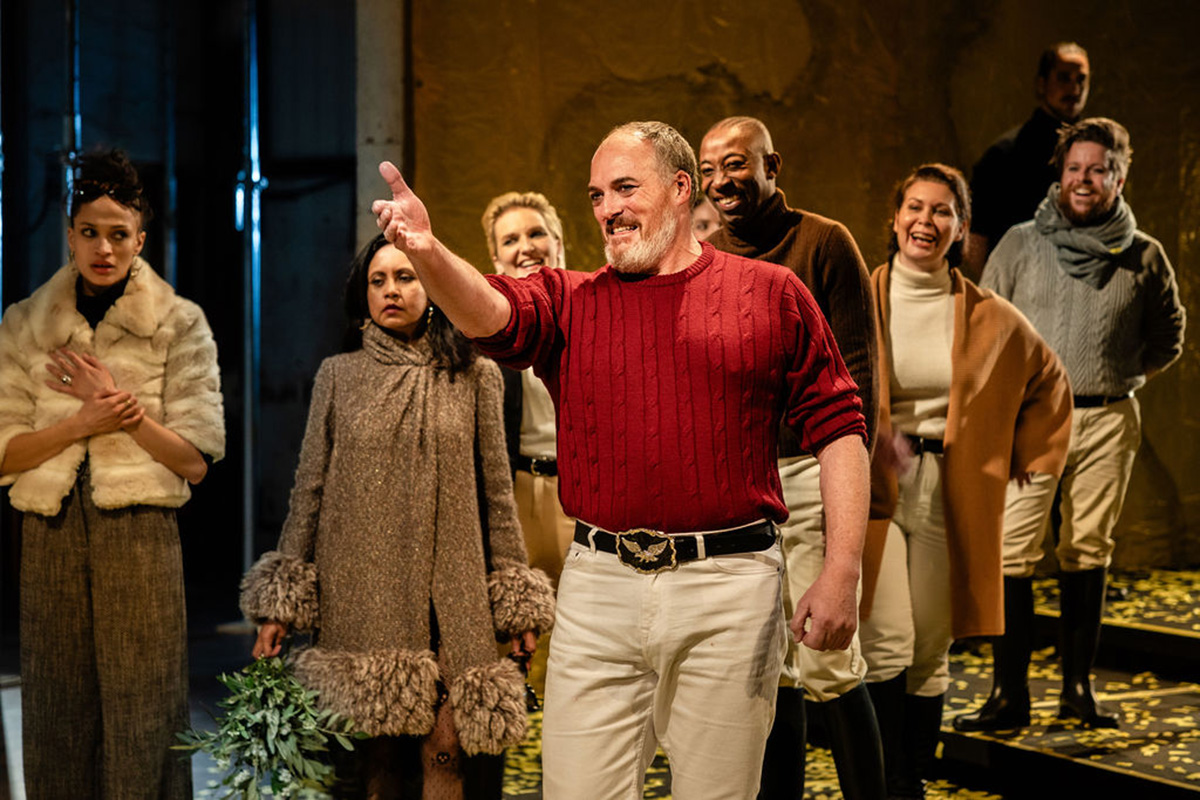 Hunter Perske as Julius Caesar with cast (photograph by Chelsea Neate).
The production opens on Marullus (Malith) and Flavius (Anthea Davis) trying to dissuade the crowds from cheering for Caesar (Hunter Perske), who has just come back from victory over fellow Roman, Pompey the Great. They express disgust at the crowd’s lack of loyalty, its fickleness; and indeed, the inconstancy and dumb power of the mob thrums under the surface of the play throughout. Cassius (Mark Wilson) and Brutus (Matthew Connell) are certainly aware of it as they lay the foundations of their plot. Casca (an excellent, droll Mark Yeates) skewers its gullibility. That Marullus and Flavius are later ‘put to silence’ underlines just how dangerous it can be to find yourself suddenly on the wrong side of history.
Marc Antony (Natasha Herbert) is perhaps the character who best understands the need to swim with the tide, at least until it can be harnessed with the power of words and sent back upstream. Herbert is the actor with the most experience and presence on stage, and she is thrilling to watch. Fear flickers across her face until it morphs into opportunity. As a rhetorician she is consummate but as a tactician she is merciless – a scene late in the play, as she denigrates a politician with whom she intends to share power, feels chillingly familiar. Trump and Putin, in their callousness and choking narcissism, are brought to mind.
Any production that positions Antony as a menacing figure might be expected to lionise Brutus, but Murphet is extremely agile and keeps the audience’s allegiances constantly in sway. Connell is certainly sympathetic, deeply thoughtful and considered, but he is also able to convey a sense of the character’s yawning metaphysical despair. His intellectualism is a kind of refuge in which his baser natures can hide, all while the flood consumes him.
Wilson’s Cassius is delicious, his grinning jaw ready to bite the world. That famous description of the character Caesar delivers at the beginning of the play – not just that he ‘has a lean and hungry look’, but that he ‘is a great observer, and he looks quite through the deeds of men’ – is merely Wilson’s starting point; feverish, choleric, and hateful, he seems unstoppable in his pursuit of the would-be king. That he ushers in the age of the imperator, in one of the great dramatic ironies of the play, seems irrelevant to him.
As the Colossus himself, Perske has the physical stature and gravitas needed, if not quite the dramatic range. His imperviousness at the entreaties of Metellus (Annabelle Tudor) hint at the tyranny of which he is allegedly capable, but there is also something a little dim-witted, about him, malleable. It’s hard to see him ‘bestride the narrow world’. Michelle Perera makes a shrewd Calpurnia and Aisha Aidara is very fine as the jittery, imploring Portia, and there is some truly excellent support from the rest of the cast. The production has a depth of talent that should make Bell Shakespeare sit up and take note.
Dale Ferguson’s production design is ingenious and brilliantly realised, with its forest of steel acrow props and its long-raked stage, which suggests everything from the steps of the Capitol to the hills of Philippi. The costumes are smart and stylish, with the cast in white jodhpurs and black riding boots and flak jackets. It is slightly fetishistic and neatly evokes casual aristocracy, although the beige trench coats for the assassins are a little ‘death-by-Burberry’. Kris Chainey’s powerful lighting is wonderfully atmospheric, and Grace Ferguson’s sound is highly effective when it isn’t overly insistent and distracting.
Julius Caesar is a play of words, of mouths and tongues – even Caesar’s wounds are described as ‘poor dumb mouths’ – and Murphet’s control of emphasis and syntax ensures that we hear everyone. Where most directors of this fine, troubling play force a particular reading or body forth a specific political point, he lets us see the competing visions of governance for what they really are: futile, delusional grabs for power. If that makes us the dumb mob swayed by empty, self-serving rhetoric, then maybe the play’s time has come again.
Julius Caesar (Melbourne Shakespeare Company) continues at fortyfivedownstairs until 3 September 2023. Performance attended: 25 August.