


- Free Article: No
- Contents Category: Film
- Custom Article Title: Godland
- Review Article: Yes
- Article Title: Godland
- Article Subtitle: An Icelandic film that stares down the lens
- Online Only: No
- Custom Highlight Text:
In three films by Icelandic director Hlynur Pálmason, there is a moment of rupture in which the narrative is held up and we see instead a montage of various characters standing still and looking directly at the camera – an example of what has been called a planimetric shot. This particular type of shot, in which the camera is positioned directly perpendicular to its subject, appears to flatten characters against backgrounds on screen, in much the same way that a portrait photograph might.
- Article Hero Image (920px wide):
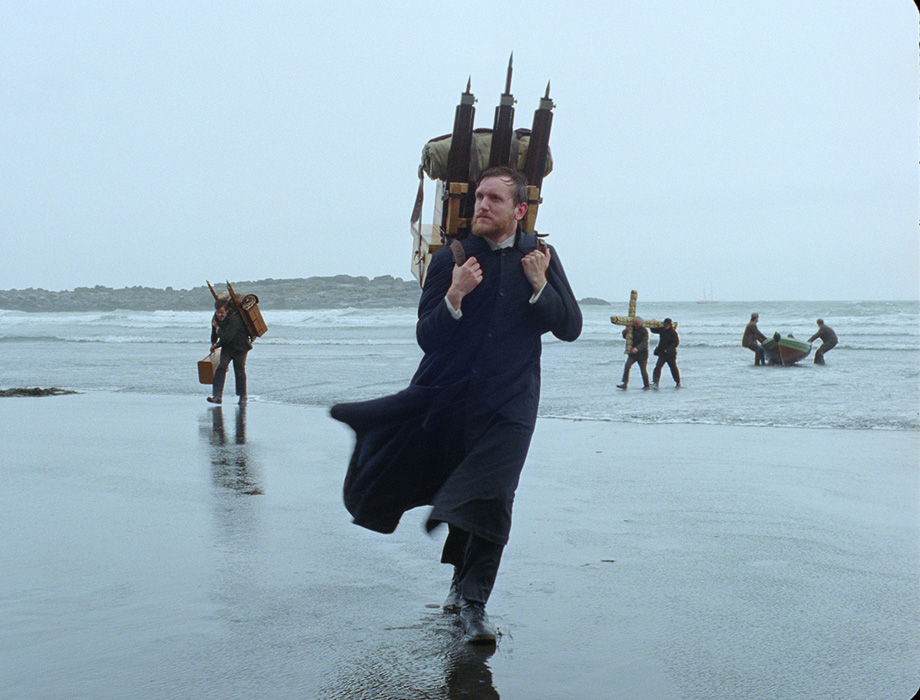
- Article Hero Image Caption: Elliott Crosset Hove as Lucas.
- Alt Tag (Article Hero Image): Elliott Crosset Hove as Lucas.
- Production Company: Palace Films
Hlynur, who started out as a visual artist, deploys this startling technique in his short A Painter (2013), as well as in his second feature A White, White Day (2019), where a series of characters are depicted in frontal poses, looking straight down the lens. In his latest feature, Godland (2022), Hlynur makes use of this signature set piece once again, with the static-image sequence standing in relief against the onward motion of the narrative and rushing waters of the film’s windblown Icelandic setting. While still innovative, in this case such shots are by no means extraneous, and are inspired precisely by the focus on photography in the film itself.
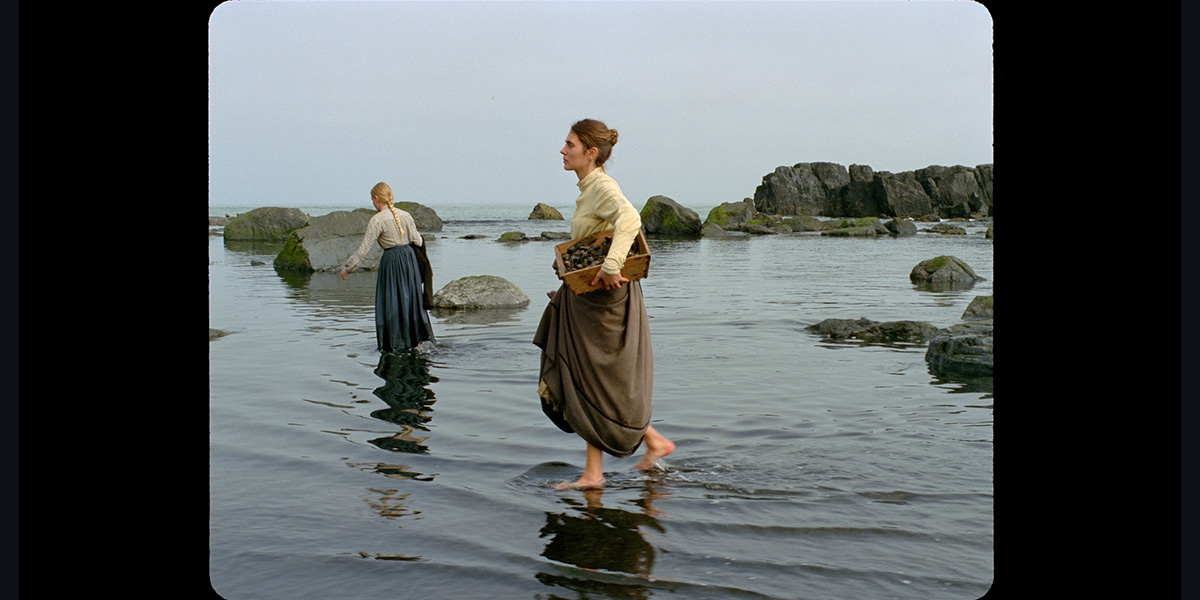 Ída Mekkín Hlynsdóttir as Ida and Vic Carmen Sonne as Anna.
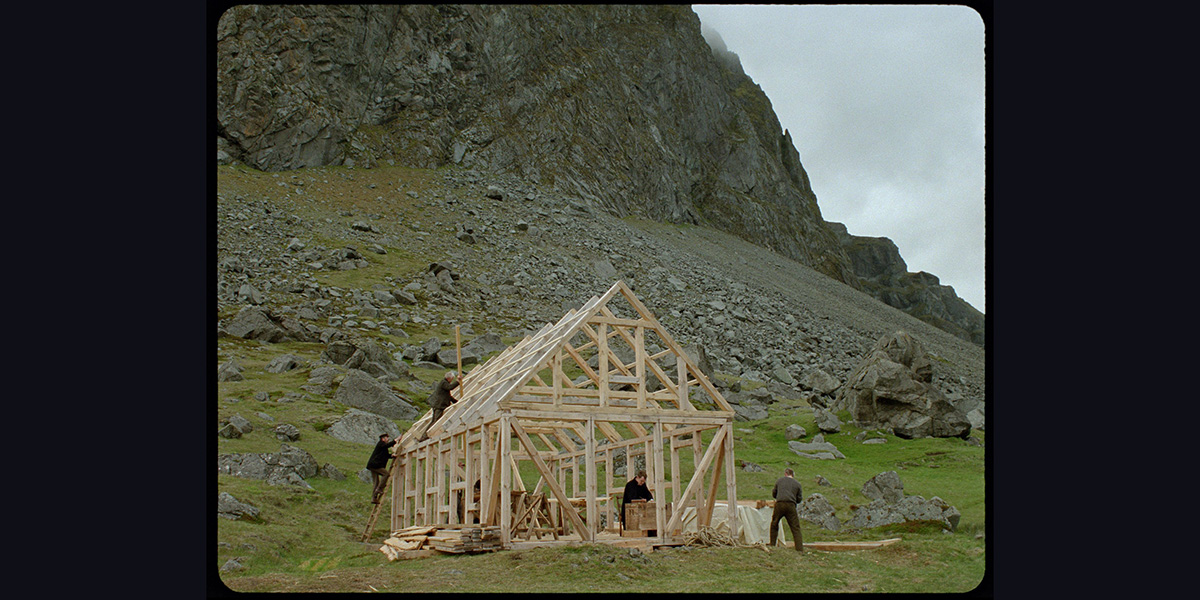
Framed in a rounded 4:3 square and shot on 35mm, Godland follows the story of Lucas (Elliott Crosset Hove), a bookish priest who, in the late nineteenth century, must travel to a remote Danish settlement in Iceland to oversee the construction of a church for his fellow countrymen who have settled there. Traversing rugged terrain and the effects of a volcanic eruption with the help of a translator (Hilmar Guðjónsson) and a rustic Icelandic guide, Ragnar (Ingvar Eggert Sigurðsson), Lucas totes a giant wet plate camera on his back so that he can document the journey. This bulky apparatus, replete with its own darkroom, is a burden on the priest’s ‘pilgrim’s progress’, endearing him to some of the settlement’s inhabitants while also marking him as a strange colonial impostor in a remote outpost. Troubles befall the hapless and obstinate Lucas on the long expedition of the film’s first half, and he endures a dark night of the soul before arriving at his destination. Once there, his incongruous behaviour, and his growing interest in local Anna (Vic Carmen Sonne), arouse the suspicions of her father, Carl (Jacob Lohmann). Will the young missionary ingratiate himself to his new parishioners? Will he allow himself to be shaped by this isolated community, just as their hands shape the new church?
In the midst of all of this, the camera remains, a newfangled foreign object imported into an otherwise parochial environment beset by the elements. Explaining the presence of Lucas’s contraption, a title card at the beginning of the film tells us that what we are about to see was inspired by a box containing ‘the first photographs of the southeast coast’, which were taken by a Danish priest. Importantly, while real wet plate photographs were produced for the film, the historical basis for Godland is a complete fiction concocted by its director. Does this deliberate act of deception at the beginning of the film matter? Perhaps not (and there is no sense within the film that it is a factitious statement), but it does have the effect from the beginning of a historical reality that is not conjured in Hlynur’s other films.
In any case, it is exciting to witness a filmmaker taking what might appear well-trodden material – there are strong hints of Martin Scorsese’s Silence (2016) and Lisandro Alonso’s Jauja (2014), among others – but beating a new path, especially in terms of the film’s formal gambits. The capturing of stillness inspired by photography in Godland is one prominent technique that Hlynur has practised throughout his filmography, but there are others. As elsewhere, the director’s regular DP, Maria von Hausswolff, registers the landscape and its people in two stunning rotational pans, one of which completes 360 degrees as the camera takes in the villagers enjoying a wedding reception in and around the half-finished church. Another hallmark sequence (also used to great effect in the filmmaker’s two recent works, A White, White Day and Nest), involves a lengthy time-lapse montage depicting the same location over the course of several seasons, as spring blooms give way to a firm blanket of snow, and flesh turns to bones.
The fact that such stylistic traits in Godland offer repetitions of shots we have seen elsewhere in his oeuvre might suggest to some a director hewing conservatively to what he knows. Truth be told, were such compositions to be revisited in Hlynur’s next feature, wonder might well turn to predictability. Yet what remains captivating about such shot choices at this point in his career is their continued capacity to defamiliarise. They intrude unexpectedly in the film’s naturalistic world by drawing attention to the camera itself, taking us out of the story, even as they draw us in. Likewise, they also dictate the tempo of the narrative by persisting just a little longer than conventional art cinema editing practices would suggest, and reminding us that the images we see need not be motivated by plot alone.
That said, the performances themselves carry a great deal of weight here. The ongoing linguistic breakdown between the swarthy Icelander Ragnar and effete Dane Lucas (in contradistinction to the film’s clear success as a Nordic coproduction) brings together two of Hlynur’s most exciting returning charges, in Sigurðsson and Hove. The latter, star of the director’s début feature, Winter Brothers (2017), haunts the screen here again with a face that is somehow both half-formed in its youthfulness, yet hangs together with a kind of sunken sallowness that suggests a man at death’s door. Hove’s portrayal of Lucas as a strange interloper depends most obviously on his inability to comport himself with the men and women of the settlement. But it also rides on the ambivalence of the lead actor’s demeanour; his priestly vestments and clerical ruff signify a man of God, but the body underneath betrays more earthly feelings, and perhaps that is enough to convict him in the eyes of his new flock. ‘We don’t need men like him,’ Carl explains to his younger daughter, Ida (Ída Mekkín Hlynsdóttir, also Hlynur’s own daughter). ‘What kind of men do we need?’ she asks. ‘We have enough men,’ her father replies.
For his mission to succeed, Lucas will need to acclimatise to alien surroundings, transforming himself into the kind of man that would be trustworthy and useful to the parish. But as with the photographs that he develops, using traditional materials like egg white and silver, the resulting image may not necessarily align with how he sees himself. Under the cloth cover of the portable darkroom, Lucas and Anna share an intimate moment, watching as the woman’s image emerges from its bath of liquid developer. ‘I look very serious,’ she comments. ‘And older than I thought I looked.’ ‘You look young … and beautiful,’ he assures her. Lucas’s machine, like Hlynur’s own camera, delivers surprising representations of this world that are terribly beautiful; or, as Anna has it, ‘terrible … and beautiful’.
Godland (Palace Films) will be in cinemas nationally from 17 August 2023.