


- Free Article: No
- Contents Category: Theatre
- Custom Article Title: Escaped Alone ★★★★★ and What If If Only ★★★1/2
- Review Article: Yes
- Article Title: Escaped Alone ★★★★★ and What If If Only ★★★1/2
- Article Subtitle: Caryl Churchill – doyenne of the unspoken
- Online Only: No
- Custom Highlight Text:
Voices in Caryl Churchill’s plays swell and ripple and surge, but they are an unquiet river in whose streambed is hidden the unspeakable, the incomprehensible. Like Samuel Beckett and Harold Pinter – the two playwrights with whom she is most often compared – Churchill is a doyenne of the unspoken, silences manifesting as much through their presence as their absence.
- Article Hero Image (920px wide):
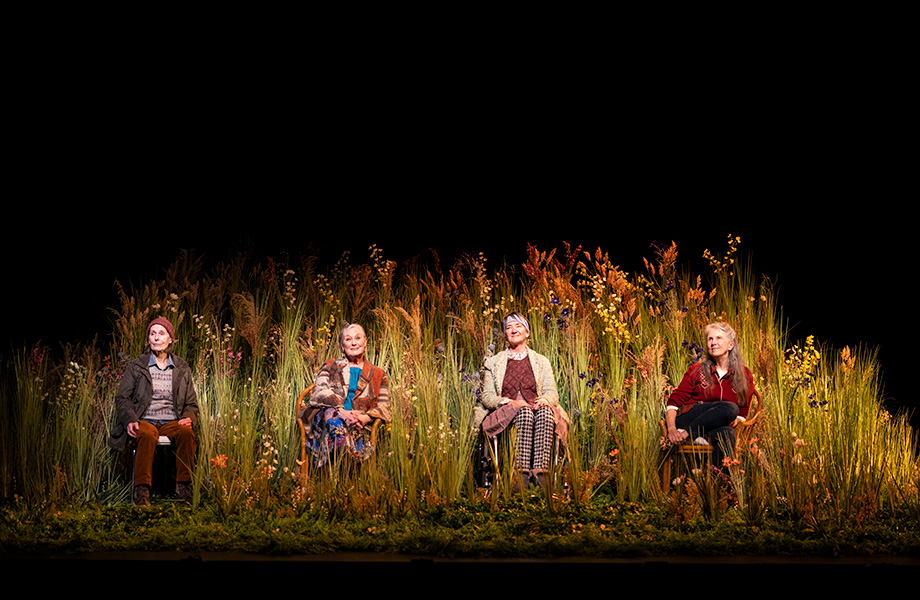
- Article Hero Image Caption: (L-R) Helen Morse as Mrs Jarrett, Deidre Rubenstein as Sally, Kate Hood as Lena, and Debra Lawrance as Vi in Escaped Alone (photograph by Pia Johnson).
- Alt Tag (Article Hero Image): (L-R) Helen Morse as Mrs Jarrett, Deidre Rubenstein as Sally, Kate Hood as Lena, and Debra Lawrance as Vi in Escaped Alone (photograph by Pia Johnson).
- Production Company: Melbourne Theatre Company
This predicament is evident in the Melbourne Theatre Company’s current staging of two of Churchill’s later plays: Escaped Alone (2016) and What If If Only (2021). Churchill’s more abstract writing – of which these plays are seminal examples – tends to be eschewed by mainstream theatres. Director Anne-Louise Sarks’s decision to stage the plays side by side is, therefore, a bold one, but it pays off. This is an inimitable night of theatre, one in which the work of perhaps the most influential English-language playwright of our time is, despite its inherent challenges, unflinchingly realised.
Escaped Alone opens with three older women – Sally, Vi, and Lena (Deidre Rubenstein, Debra Lawrance, and Kate Hood, each of them pitch-perfect) – sitting together in a sunlit garden. Hovering on the other side of the fence is Mrs Jarrett (Helen Morse), who takes a cursory nod of recognition as an invitation to join them. It soon becomes apparent that Sally, Vi, and Lena have known each other for years, their talk a tumble and churn of observations and opinions, the flow of one woman’s thoughts meeting the ebb of another’s. Their conversation is a verbal dance, sometimes clumsy, sometimes delightfully harmonic (a scene where the women drift into song is fabulous). The chatter skips across the surface of their lives: the television shows they are watching, their impatience with physics and mathematics, what it might feel like to fly. But pushing spasmodically through that surface are the jagged eruptions of their secrets and fears (Rubenstein’s performance of Lena’s extraordinary monologue, wherein she disgorges her relationship with cats, is an unforgettable moment of theatre).
Literally and metaphorically, Mrs Jarrett sits on the edge of this conversation, occasionally dipping her toe into the water, her offerings perfunctorily acknowledged by the other women. In her posture, the way she leans towards the other women, her relaxed even dreamy attitude as she listens to their talk, Morse imbues Mrs Jarrett with the air of a woman who, if she does notice the social awkwardness of her presence, doesn’t care.
Escaped Alone’s coup de théâtre comes in interleaved scenes where Mrs Jarrett seems to step out of the world of the play – the garden, the women, their friendly banter – and occupies instead a dark, solitary space. She may be lost in memories, she may be somewhere inside her own head, she may be in that space engendered by everything that the other women are not saying – Churchill gives us few clues – but what Mrs Jarrett perceives within this space is a vision of pestilence and plague, fire and famine. Rendered in syntax that is almost paraphasic in nature, the import of these visions is conveyed not so much through the literality of Mrs Jarrett’s words but through the sounds and patterns those words create. They are perplexing monologues, ostensibly nonsensical, but nevertheless making, in some counter-intuitive way, perfect sense.
Mrs Jarrett’s speeches stretch between the garden scenes like tightropes, demanding the actor trust completely in the playwright’s vision. Morse never wavers, the weight of her words settling heavily on the audience, a performance that is both subtle and striking. Morse delicately orchestrates the tonal shifts between what initially feel like lumbering and darkly comic intrusions into the women’s conversation and the seething intensity of Mrs Jarrett’s culminating ‘terrible rage’ speech. The repetition of that single phrase – ‘terrible rage’ – not only anchors the play, but it also provides the hinge connecting the play’s two worlds, that of a cosy back garden on an otherwise idyllic sunny afternoon (a gorgeous design by Marg Horwell encompassing a wildflower meadow that rises behind the women, a patch of order in the world that is fast disappearing) and Mrs Jarrett’s dystopia.
Churchill has a perennial fascination with other worlds and multiverses. In Escaped Alone, she gives us two worlds existing in an uneasy parallel, their situations in time and space veering ever closer (an interpretation underlined by the subtle transitions in Paul Jackson’s lighting design, the borders between the two worlds becoming less perceptible). Shrewdly, Churchill contextualises the women’s angst without trivialising it, prompting us to question the extent to which their irritations are being unconsciously fed by fugitive irruptions, at the edge of their awareness, of an unfathomable and existential horror.
What is remarkable about Escaped Alone – as was noted by several critics in response to the recent Patalog Theatre Company’s production of Churchill’s Far Away (2000) – is its prescience. In the years since its first production, speeches that bore all the hallmarks of prophecy now convey a chilling immediacy, the biblically apocalyptic having become unsettlingly rooted in our own reality:
Waves engulfed ferris wheels and drowned bodies were piled up on back doors. Then the walls of water came from the sea. Villages vanished and cities relocated to their rooftops … Fires broke out in ten places at once …The blackened area was declared a separate country with zero population, zero growth and zero politics.
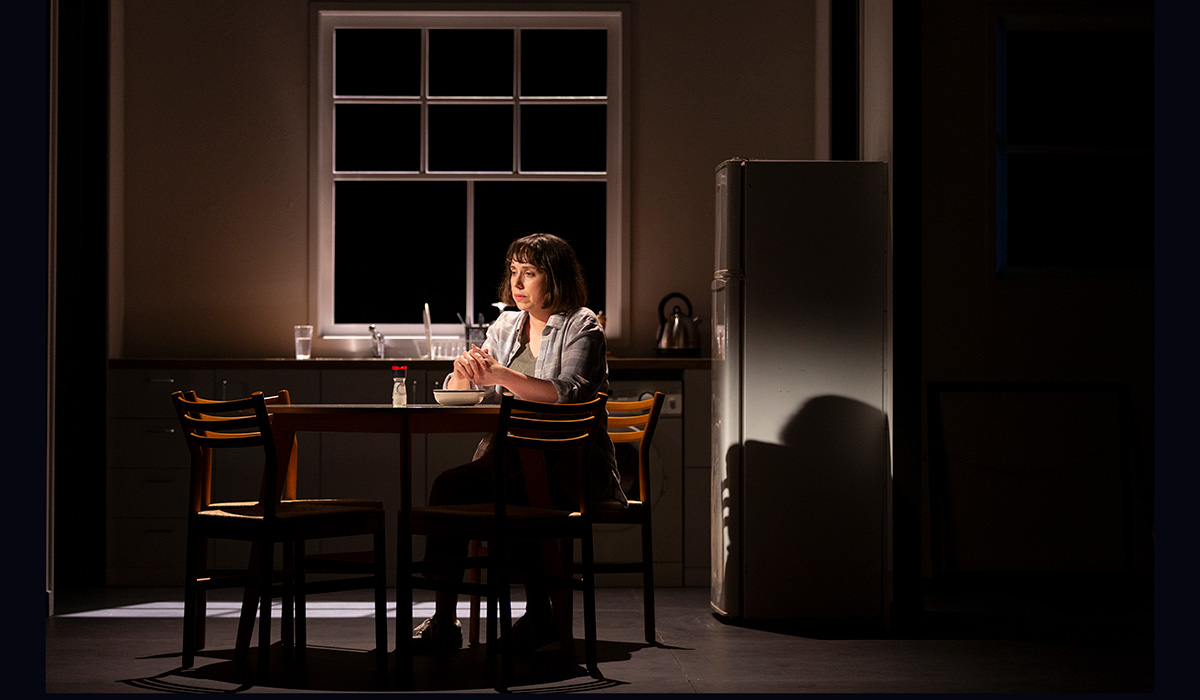 Alison Bell in What If If Only (photograph by Pia Johnson).
If Escaped Alone suggests a world on the brink of imminent collapse, with only superficial distractions keeping the chaos at bay, What If If Only offers something of a counterpoint, Sarks finding in Churchill’s exploration of loss and possibility a buoyant sense of hope.
A woman (Alison Bell) is alone in a house. She eats a meagre meal as the days pass (a brilliant utilisation of light and sound effects – designed by Paul Jackson and Jethro Woodward – to delineate the progress of time), and she talks to her absent partner, who has recently killed himself.
Presented in concert with Escaped Alone, there is the temptation to read the dead partner as a metaphor for the planet itself, a reading that becomes more palpable when the woman’s house, over the course of the play, is peopled by unrealised futures, each of them begging to be actualised. But it is dangerous to pin Churchill’s work – particularly work as abstract and conceptual as What If If Only – to a single reading.
The arrhythmic patterns of Churchill’s dialogue, and the semantic games she plays, inhibit our intellectual engagement with the text. Churchill actively steers us towards meaning that is derived via emotions and instinct. In this, What If If Only operates more like a poem than a dramatic work, inviting the audience to gaze into the spaces between the lines of the play and to find reflected there their own distinct experience of grief; their own sense of futures crushed, of futures that might yet be possible.
Eugène Ionesco noted that there are few new themes, only new languages by which those themes might be expressed. The concept of unwritten and unconsummated futures that Churchill explores here is far from new. What is new is her enactment of these themes, her embodiment of possibility, an approach that underscores the delicate, even fragile nature of the abstraction with which she is experimenting.
Sarks’s decision to situate the action within a naturalistic setting – a solid, three-room house – is perhaps her only misstep. Within this setting, silence is papered over. Concepts become characters tethered to a concrete and deadening reality, and the flatter elements of Churchill’s dialogue – ‘you’re the one living, you’re the one who can make things happen. I’m dead, I’m lucky to be a ghost’ – verge on the banal. Only Alison Bell, in a painfully raw performance, comes close to dragging the play back towards the poetic.
There is no denying that What If If Only, as a dramatic experiment, is no more than moderately successful, and this production only serves to emphasise its flaws. Nonetheless, the play informs our understanding of Churchill’s oeuvre and places her major works – such as, I would argue, Escaped Alone – in sharper relief.
Ultimately, the effectiveness of any production of Churchill’s later work is determined by how well it negotiates the silence that pervades her writing. This production of What If If Only resists Churchill’s silence and thereby falters. Escaped Alone embraces it, and triumphs.
Escaped Alone and What If If Only (Melbourne Theatre Company) continue at the Southbank Theatre until 9 September 2023. Performance attended: August 11.