


- Free Article: No
- Contents Category: Film
- Custom Article Title: Asteroid City
- Review Article: Yes
- Article Title: Asteroid City
- Article Subtitle: Wes Anderson’s new feature
- Online Only: No
- Custom Highlight Text:
Wes Anderson’s films divide audiences; not so much because of their content (rarely does he openly court controversy) but because of their style. When the trailer for Anderson’s latest film, Asteroid City, first appeared online, those eager to dismiss it on social media wrote: ‘Wes Anderson has made his film again.’ It is a comment that cuts both ways.
- Article Hero Image (920px wide):
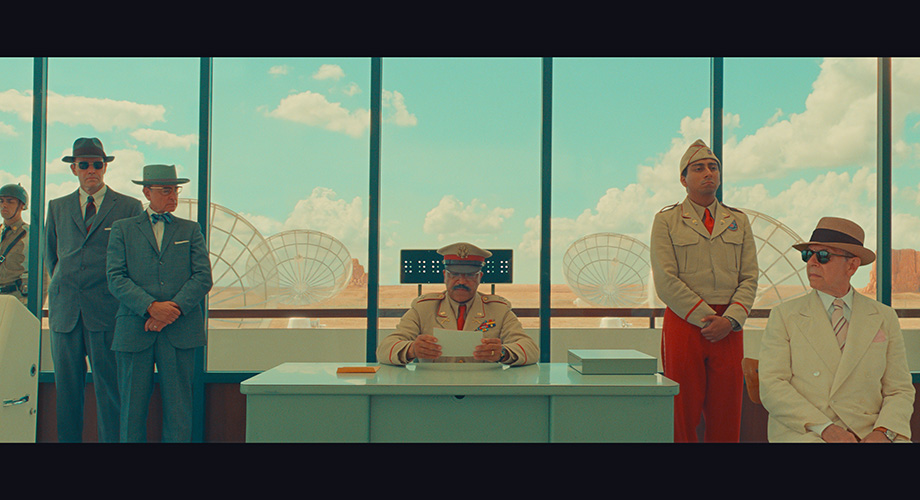
- Article Hero Image Caption: (L to R) Fisher Stevens, Jeffrey Wright, Tony Revolori, and Bob Balaban (courtesy of Pop. 87 Productions/Focus Features)
- Alt Tag (Article Hero Image): (L to R) Fisher Stevens, Jeffrey Wright, Tony Revolori, and Bob Balaban (courtesy of Pop. 87 Productions/Focus Features)
- Production Company: Universal Pictures Australia
In other ways, Asteroid City is not a typical Anderson film. For one thing, its complex plot layering and nexus of references and citations outstrip anything else he has done, including The French Dispatch (2021), his hitherto most complicated and layered film. For another, Asteroid City explores themes of death, grief, trauma, broken families (in a way that the Tenenbaums weren’t), uncertainty, hope, and despair, delving deeper beneath the surface of the whimsical mise en scène to reveal a poetry and profundity not always evident in his other films, in spite of their often melancholic undertones.
 (L to R) Grace Edwards as Dinah, Scarlett Johansson as Midge and Damien Bonnaro as Bodyguard/Driver (courtesy of Pop. 87 Productions/Focus Features)
The film is ostensibly a 1950s television broadcast about the production of a play which exists only for the purpose of a television broadcast about the production of a play. The television presenter (Bryan Cranston) informs us that the play ‘Asteroid City’ does not exist but is only a device for exploring how a typical American play is produced. The film Asteroid City is thus divided into the imagined world of the play as it might be staged, and the world of the television broadcast about the inner machinations of a play; the former in spectacular widescreen and glorious Andersonian colour, the latter in stark black-and-white and a boxy 4:3 Academy aspect ratio reminiscent of 1950s television. It is a film about theatre and Hollywood, particularly the New York theatre scene which swept through Hollywood in the postwar period. The list of citations is long, some more direct than others, and includes films like Bus Stop, The Misfits, and Bad Day at Black Rock; period figures including Marilyn Monroe, Elia Kazan, Tennessee Williams, and Lee Salzburg and his Actors Studio; and socio-cultural touches like the rise of country music, Roswell, and atomic testing.
The imagined or envisaged play ‘Asteroid City’, which occupies the bulk of screen time, is a retro-futuristic vision of the 1950s, set somewhere in the south-western American desert. The town, set against pastel-blue desert skies and washed-out yellow plains dotted with orange-brown ochre-hued rock formations, consists of a diner, a gas station, a motel with ten bungalows, a telephone booth (all with their attendant nostalgic 1950s primary-coloured aesthetic), and, outside the city, a gigantic crater and an observatory. War photographer and recent widower Augie Steenbeck (Schwartzman) and his four children arrive in Asteroid City so that his genius son can attend the annual Junior Stargazer Convention, which recognises the achievements of junior scientists from around the country. There he meets glamorous Monroe-inspired movie star and divorcée Midge Campbell (Johansson). The two connect over their damaged pasts and find common ground in their pessimistic sense of doom. During a star-gazing exercise held in the crater a spaceship appears and from it descends a mysterious alien (Goldblum), sending the town and the US government into panic mode. In the television broadcast narrative, meanwhile, playwright Conrad Earp (Norton), director Schubert Greene (Brody), and actors Jones Hall and Mercedes Ford (also played by Schwartzman and Johansson, respectively) are caught up in their own personal dramas, which both hinder and advance the writing and production of the play.
After the frantic agitation and nervous energy of The French Dispatch and The Grand Budapest Hotel (2014), Asteroid City gives the sense of time suspended; a cosmic stillness as if the world, even the universe, is holding its breath. Over the sun-drenched plains and kitsch buildings of Asteroid City hangs the threat of nuclear war and the spectre of PTSD from America’s involvement in World War II. The lockdown into which the town is plunged after the appearance of the alien evokes our collective experience during the pandemic. The emotional centre of the film lies in the desert with Midge and Augie; but Anderson’s framing affords a greater reflection on the art–life nexus and more importantly on life itself, especially through Schwartzman’s dual roles as Augie and Jones, caught somewhere between stage and backstage, searching for meaning.
Anderson has said in an interview that he did not intend the film – which can be described as a Brechtian romantic comedy sci-fi western, and which employs at times a triple mise en abyme in which actors play actors preparing for a role – to be so complex in terms of its layering. This was simply the result of him following an instinct through to its end. It is the play’s director, Schubert Green, who sums it up best when the actor Jones Hall claims not to understand the play: ‘It doesn’t matter. Just keep telling the story.’ This is what T.S. Eliot once called ‘vision’.
Asteroid City (Universal Pictures) is on national release from 10 August 2023.