


- Free Article: No
- Contents Category: Music
- Custom Article Title: Midsummer Dreams: Mendelssohn Scottish and Beethoven Eight
- Review Article: Yes
- Article Title: Midsummer Dreams: Mendelssohn Scottish and Beethoven Eight
- Article Subtitle: ARCO at Albert Hall
- Online Only: No
- Custom Highlight Text:
A century ago, as Australia’s nascent capital planned its performing-arts future, it opted for a ‘commodious’ assembly hall, serving conference and recreational purposes, and doubling as a municipal theatre. Completed in 1928, Albert Hall was to be the ‘centre from which will radiate all those aspirations that are truly national’, as then Prime Minister Stanley Melbourne Bruce pompously intoned at its opening. Since then, the Hall’s record has been less illustrious, often housing carpet or shoe sales, community fairs or eisteddfods. With its peeling ceiling, drooping curtains, winter draughts, and cramped, overly elevated stage, it has proven a challenge to several generations of concert entrepreneurs.
- Article Hero Image (920px wide):
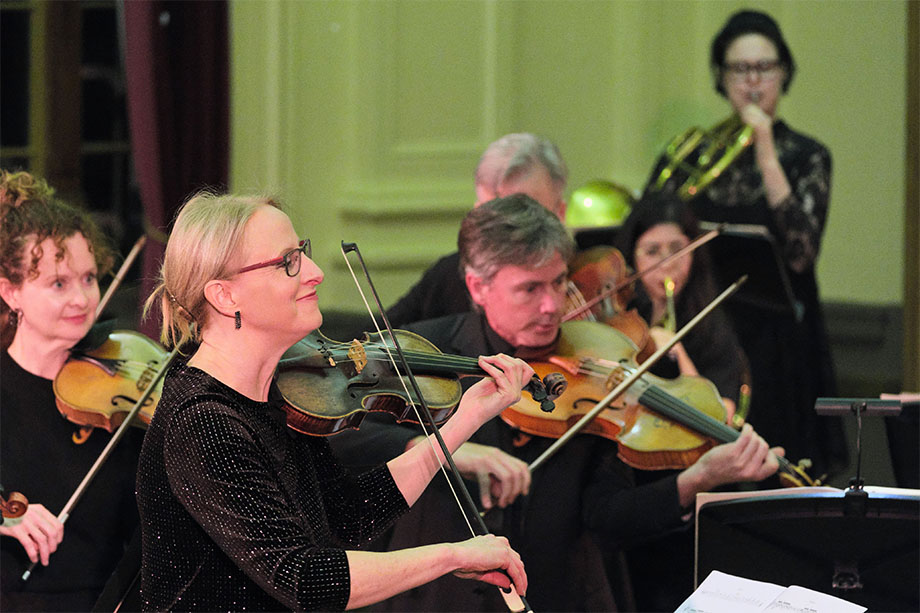
- Article Hero Image Caption: Australian Romantic & Classical Orchestra conducted by Rachael Beesley (photograph by Peter Hislop)
- Alt Tag (Article Hero Image): Australian Romantic & Classical Orchestra conducted by Rachael Beesley (photograph by Peter Hislop)
- Production Company: Australian Romantic & Classical Orchestra
The program was an unexpectedly gutsy Beethoven–Mendelssohn affair, in which two war-themed symphonies were prefaced by Mendelssohn’s early Overture to Shakespeare’s A Midsummer Night’s Dream (1826). This short overture, with its colourful depictions of the play’s main characters – dancing fairies, lovers, a braying ass, and so on – was an excellent introduction to the Orchestra’s disciplined approach to the playing styles of a very narrow, but busy, period in musical history: 1810–30. In particular, the opener showcased the strings’ interpretative tools: extensive use of portamento, tightly coordinated fast bowings (at the tip), and well-calculated tempo variations reflecting rhythmic or phrasing articulations.
In Beethoven’s own view, his Eighth Symphony (1812) was the best crafted of the three orchestral works, Opp. 91–93, all inspired by recent military victories over the French emperor, Napoleon: the Battle Symphony (Wellingtons Sieg), and his Seventh and Eighth Symphonies. Mendelssohn’s Third Symphony, composed between 1829 and 1842, also has its martial inspiration couched in a subtle digestion of Scottish influences betraying his fascination with the Scots’ valiant struggles for independence, led by such now semi-legendary figures as Robert the Bruce, William Wallace, and Rob Roy MacGregor. Mendelssohn’s warlike intent is most explicit in his last movement, Finale guerriero.
These two symphonies, then, called upon ARCO to produce sustained stretches of forte to fortissimo dynamics, which the players did with strength, style, and nuance. The two composers’ approaches were different, with Beethoven overall featuring the non-stringed players more soloistically. This was especially true, for instance, in the respite of his stately Minuet and Trio, with its glorious duet on crooked horns in the Trio, ably rendered by Bart Aerbeydt and Dorée Dixon, against a busy cello counterpart. This performance maintained the sense of balance between strings and wind-brass of Beethoven’s intention.
In Mendelssohn’s symphony, the concerted playing of the wind-brass chorus, underscored by the beat of the calf-skinned kettledrums (Brian Nixon) gave a more strident, nasal, sometimes even braying sound that overwhelmed the twenty-three string players in some tutti sections. The introduction of two additional horns and the prominent role of trumpets further upped the voltage.
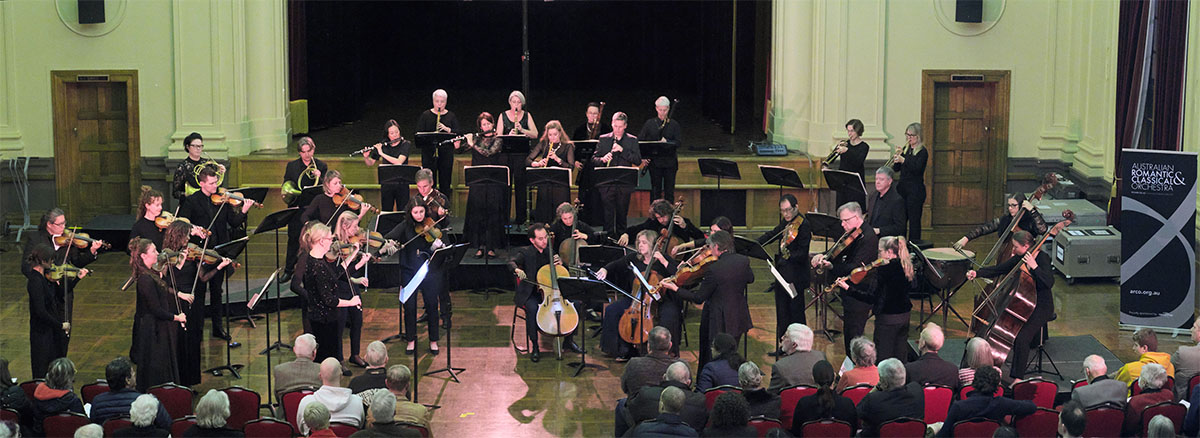 Australian Romantic & Classical Orchestra conducted by Rachael Beesley (photograph by Peter Hislop)
ARCO’s leadership and business models are novel. It has two co-artistic directors – Nicole van Bruggen (clarinets) and Rachael Beesley (violin) – yet no permanent conductor. The latter is appropriate, given the slowly changing roles of orchestral leadership across the classical and romantic eras, from the first violin or keyboard player taking an ensemble’s coordinating role in 1750 to the non-playing, master-interpreter conducting role well established by 1900. On Tuesday, Beesley adopted different roles, according to the different demands of the pieces. In the Beethoven she was more the dutiful concertmaster, leading from the front desk, yet in the Mendelssohn symphony she was more the conductor on the podium.
In both roles Beesley continued to play her violin, except sometimes at climax points or tricky section joins. Yet she is the master of gestures, not just with the hands, but in the swaying of the body, and even the movement of the feet, forwards (at tension points) or backwards (for repose). It made me wonder what the Mendelssohn would have sounded like had she been just a non-playing conductor. ARCO is serious about its research, even down to Beesley’s first-desk companion, Emma Williams, undertaking a Dutch PhD that explores the postures of early nineteenth-century actors and violinists.
Just occasionally everything in a concert comes together: the programming complements itself; the hurried rehearsals pay good dividends; the audience is in a receptive mood; the concert booklet is both informative and artful; and individual players confidently pursue their soloistic and corporate roles. Even the venue itself can generate sympathetic resonances. This ‘Midsummer Dreams’ evening in century-old Albert Hall was one of those rare occasions.
Its achievement was to re-expose the brilliance of Mendelssohn, whose nineteenth-century fame was so denied by the baleful twentieth century. These imaginative, historically informed renditions provided a jolting contrast with mainstream orchestral performances, which so often iron out the distinctions between periods, styles, instruments, or forms. By comparison, even Beethoven’s Eighth sounded rather dull. What a difference a decade or two made two centuries ago in the world of classical, becoming romantic, music.
‘Arco’, of course, means ‘with the bow’ in Italian. In this Canberra concert, it was those instruments that were blown or hit that were very much the evening’s stars. They provided the more martial wallop called for in these sometimes bellicose works, and so well matched the energy and virtuosity of the orchestra’s foundation in those instruments played (mostly) with the bow.
Perhaps Canberra’s founding fathers knew a thing or two when they arranged for an imposing bust by Australian-born sculptor Sir Bertram Mackennal to be placed in front of the new Albert Hall. It was of Bellona, the Roman goddess of War (1906), who might have been pleased at Tuesday night’s soundscape, had she not seven decades ago been given away to the War Memorial.
The Australian Romantic & Classical Orchestra repeats this program in Melbourne (4 August), Newcastle (5 August), Penrith (6 August), and Sydney and live streamed (8 August).