


- Free Article: No
- Contents Category: Film
- Custom Article Title: Oppenheimer
- Review Article: Yes
- Article Title: Oppenheimer
- Article Subtitle: Christopher Nolan’s convoluted breathlessness
- Online Only: No
- Custom Highlight Text:
Writer–director Christopher Nolan is locked in an ongoing, well-documented wrestling match with linear time. With each new film, he attempts to find some unique way of slicing, dicing, and interrogating it. Memento (2000) gave us a crime thriller told entirely out of order; Inception (2010) used an ingenious nesting-doll conceit for its thrilling dream heists; Interstellar (2014) dabbled in relativity; Dunkirk (2017) juggled three parallel timelines.
- Article Hero Image (920px wide):
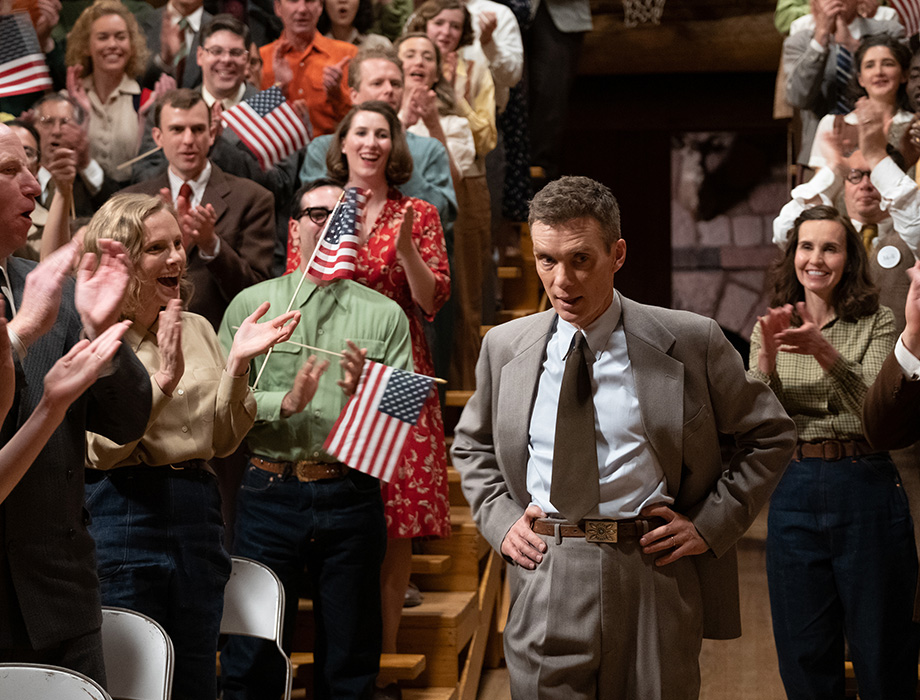
- Article Hero Image Caption: Cillian Murphy as J. Robert Oppenheimer (courtesy of Universal Pictures Australia).
- Alt Tag (Article Hero Image): Cillian Murphy as J. Robert Oppenheimer (courtesy of Universal Pictures Australia).
- Production Company: Universal Pictures Australia
Oppenheimer – ostensibly a historical biopic of J. Robert Oppenheimer (Cillian Murphy), the genius physicist at the head of the Manhattan Project who ultimately enabled the United States to drop atomic bombs on Hiroshima and Nagasaki – compounds many of these techniques and more. It feels like a culmination of both its director’s greatest stylistic instincts and worst storytelling affectations. It is grand yet puzzling, broad but finicky – another intricate cinematic mechanism writ epically large yet wound so tight that there is precious little room for comprehension or connection, let alone empathy. Perhaps for fear of producing a predictable, by-the-numbers, historical Hollywood drama, Nolan has overcompensated and in doing so has created a po-faced period piece that feels more restless and bombastic than any recent blockbuster superhero fare.
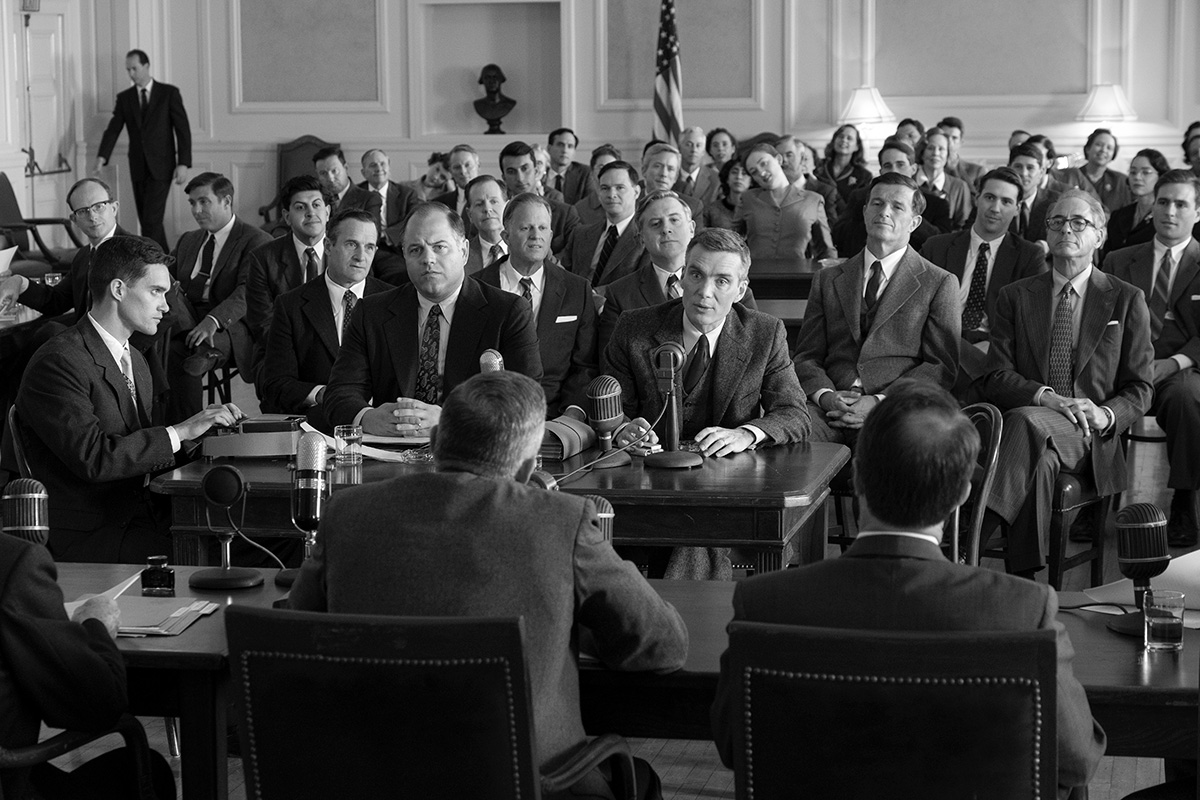 Cillian Murphy as J. Robert Oppenheimer at microphone (courtesy of Universal Pictures Australia).
The film begins with not one but two separate framing devices. The first is Oppenheimer’s controversial security hearings of 1954, when he and a number of his associates were probed by the United States Atomic Energy Commission. The second is Lewis Strauss’s (Robert Downey Jr) contested nomination hearing for the role of secretary of commerce in 1959, during which the ex-AEC chairman’s own dealings with Oppenheimer were dragged into the spotlight. Through a combination of these two hearings, we revisit Oppenheimer’s formative years at Cambridge through to his professorship at Berkeley, his flirtations with communism, his relationship with the young Jean Tatlock (an underused Florence Pugh) and his subsequent marriage to Kitty Puening (an underwritten Emily Blunt), all in the lead-up to his being approached by Lieutenant General Leslie Groves (Matt Damon, ably flexing his comic relief muscles) to head up the Manhattan Project’s secret weapons division at Los Alamos, New Mexico. There the two oversee the construction of a purpose-built village-cum-testing facility, where Oppenheimer’s hand-picked assortment of scientists engage in a blind arms race with the Nazis to create the world’s most powerful bomb – or, as the inhabitants of Los Alamos refer to it, ‘the gadget’. What America does with that gadget – which is to say, how they win (or at least end) the war – understandably becomes the defining moment of our iconoclastic protagonist’s life. Years later, when the poster boy for nuclear weaponry becomes an outspoken critic against the advancement of the even newer, even more terrifying hydrogen bomb, he begins to rub people the wrong way – his ex-colleagues, the AEC, the FBI, Lewis Strauss, even the president – bringing us full circle to the numerous enquiries and public shellackings of the 1950s that left a lasting tarnish on the reputation of one of America’s, and the world’s, greatest scientists.
Somewhere, on some hard-drive or on some cutting room floor, there is a version of Oppenheimer which plays out in the more-or-less linear fashion in which I just described it. There is every chance it’s a more legible and satisfying version of this film. No one’s suggesting that every story should be told through conventional cause and effect, but it’s difficult to overstate the convoluted breathlessness with which Oppenheimer treats even its most straightforward scenes, and how detrimental this feels to any sense of our understanding its characters (surely the raison d’être of any biography). Nolan has brought his most experimental sensibility to his most conservative subject yet; the film’s dual framing devices spawn further framing devices of their own – flashbacks within flash-forwards. Some are depicted in colour, others in black and white. Some are shot in widescreen, others in full-frame IMAX. Scenes then replay multiple times, from different perspectives, in different colour palettes, in different aspect ratios. All this, coupled with the director’s trademark impatience for any sort of emotional legwork (some establishing character moments are drawn in laughable shorthand), and his propensity for constructing scenes through cutting, rather than blocking, creates an overwhelming cognitive experience out of what, in its purest moments, proves a cut-and-dry story about the weight of immeasurable responsibility hanging heavy upon one man’s soul (see also: Batman).
Purest among these moments is a sequence halfway through the film depicting the prelude to and execution of the Trinity test: the first detonation at Los Alamos. On its own merits, this stretch of Oppenheimer stands as the best thirty minutes of cinema this year – beautiful, tense, and (in contrast to the two and a half hours surrounding it) laser-focused. It is the only time when Oppenheimer allows itself some breathing room, giving us room to fully appreciate each of Nolan’s fantastically talented collaborators firing on all cylinders: cinematographer Hoyte van Hoytema, whose stirring evocations of desert-based doom feel like a neat extension of his masterful work in Jordan Peele’s Nope; composer Ludwig Göransson, with his thrumming score (even if it can sound a little like a Hans Zimmer tribute); and above all else, Oppenheimer’s sound design team (including Richard King and Randy Torres), who might as well start dusting off their evening wear ahead of next year’s awards season. The soundscape in the Trinity sequence takes one of the year’s most over-saturated trailer moments and manages to do something completely surreal and unexpected with it; it’s an inversion of almost every other movie explosion to come before it, and establishes a truly haunting aural mechanism, which then recurs throughout the film. You’ll know it when you (don’t) hear it.
Full credit also to one of the deepest benches of supporting actors in recent memory, from Kenneth Branagh and Josh Hartnett to Alden Ehrenreich, Jason Clarke, Macon Blair, David Krumholtz, Benny Safdie, Alex Wolff, Matthew Modine, David Dastmalchian, Dane DeHaan, Casey Affleck, Gary Oldman, and many more. Best Actor Oscar-winner Rami Malek shows up to deliver roughly five lines of dialogue, which makes you wonder again about that cutting-room floor. It’s fantastic to see Robert Downey Jr out from under his Iron Man suit, but the film belongs to Cillian Murphy, as chameleonic and captivating a leading man as ever there was. There may never have been a more fitting use of the world’s largest-format film than to allow us to gaze into Murphy’s piercingly blue eyes and the worlds of information he holds there. We watch him transform from mop-haired wunderkind to stetson-hatted egotist to hollow-eyed pariah – a compelling progression that only feels hindered by Nolan and his editor, Jennifer Lame’s, agitated pacing. Instead of a character arc, we are given a collage. By the time Oppenheimer left me with the lasting image of Murphy’s inscrutable face, projected seven storeys tall, I wished I’d had a better chance of unpacking this fascinating character’s intentions, instead of getting so swept up in his director’s.
Oppenheimer (Universal Pictures Australia) is screening nationally from 20 July 2023.