


- Free Article: No
- Contents Category: Theatre
- Custom Article Title: Far Away
- Review Article: Yes
- Article Title: Far Away
- Article Subtitle: Caryl Churchill’s play about power
- Online Only: No
- Custom Highlight Text:
Now an octogenarian, and with more than thirty plays to her name, Caryl Churchill must be the English-speaking theatre’s nearest equivalent to a rock star of a certain age. It’s no exaggeration to say that without her plays – which, like Samuel Beckett’s, have become increasingly spare and crystalline over time, some running to as little as ten minutes – it would be hard to imagine the existence of whole generations of British playwrights, from Martin Crimp and Mark Ravenhill, to Alistair McDowell and Lucy Kirkwood.
- Article Hero Image (920px wide):
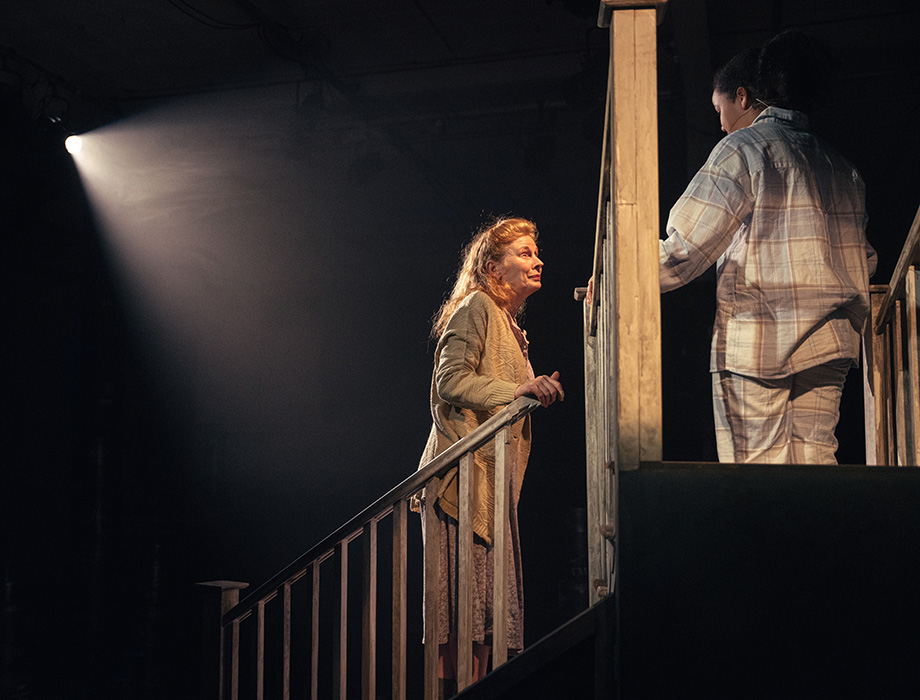
- Article Hero Image Caption: Alison Whyte as Harper and Darcy Sterling-Cox as Young Joan (photograph by Cameron Grant).
- Alt Tag (Article Hero Image): Alison Whyte as Harper and Darcy Sterling-Cox as Young Joan (photograph by Cameron Grant).
- Production Company: Patalog
Far Away is, perhaps, Churchill’s greatest play, distilling in under sixty minutes the essence of her influential but ultimately inimitable style: allusive, non-naturalistic, blackly humorous, and concerned always with the excesses of power. Here, as throughout her body of work, Churchill’s use of language is economical and expansive at the same time, gestural and conjuring, calling up glimpses of what feel like fully imagined worlds from the barest of lexicons.
As with all the best dystopian fictions, the play is less a commentary on its own time – it premièred in 2000 at the Royal Court under the direction of Stephen Daldry – than an anticipation of times to come. Viewed from 2023, Far Away appears strikingly prescient of the early twenty-first century’s geopolitical disturbances. It seems, now, to have foreshadowed both the sinister ‘with us or against us’ binarism of the ‘war on terror’ as well as the paranoid-schizoid divisions of the current socio-political moment. Its depiction of a natural world in revolt, turning on both humanity and itself, feels eerily redolent of the climate crisis. As well, the play’s vivid portrayal of expedient untruths stretched to breaking point seems in some way to have pointed towards Donald Trump, Brexit, and the shameless dissembling characteristic of contemporary politics.
Still, a play as impressionistic and fable-like as this deserves better than to be reduced to such straightforward readings. At every turn, Far Away thwarts easy interpretation, refusing the didacticism common to much politically minded naturalistic theatre. By contrast, Churchill’s late plays illustrate Harold Pinter’s maxim that ‘the more acute the experience, the less articulate its expression’ (a point seemingly forgotten by Pinter himself, whose own mature plays often feel compromised by their heavy-handedness).
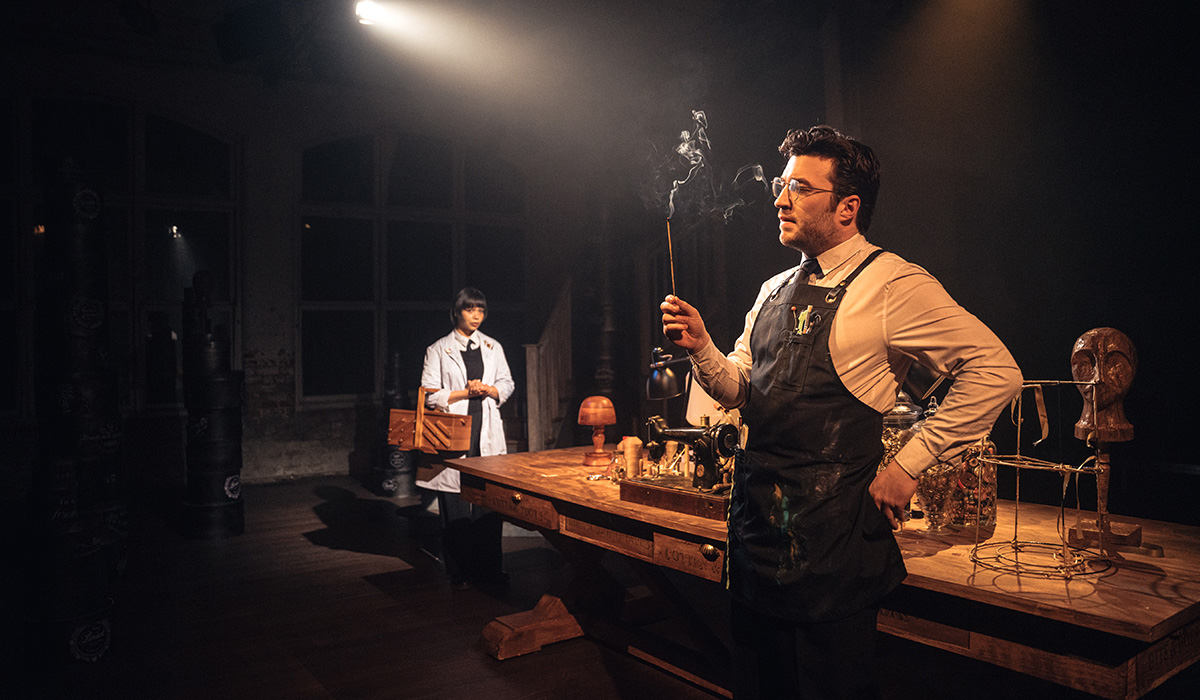 Lucy Ansell as Joan and Darcy Kent as Todd (photograph by Cameron Grant).
The play comprises three brief scenes. In the first, Young Joan (played by Darcy Sterling-Cox on opening night) has recently relocated to the house of her aunt, Harper (Alison Whyte). Unable to sleep, Joan recounts an increasingly disturbing story to Harper whose response is to gaslight her niece into believing that nothing is amiss. The screams of people – children – are merely the screeches of owls. Blood that Joan slipped on after sneaking out of her bedroom window belongs to a run-over dog. Children herded into lorries and sheds are under protection, beaten only when revealed to be traitors of some kind.
In the second scene, Joan, now an adult (Lucy Ansell), undertakes her first day of work at a hat factory opposite fellow milliner (and soon love interest) Todd (Darcy Kent). In a series of brief duologues reminiscent of Mad Forest, Churchill’s 1990 play about the Romanian Revolution, Joan and Todd question the underpinnings of their workplace and their superiors’ power while creating outlandish hats for the parade, an esoteric ceremony culminating in executions and the ritual burning of the hats.
The third act, which follows a surreal glimpse into the parade itself, sees Joan and Todd, now married, sheltering from a global conflict which has broken out between forces both human and non-human. Everything – animal, vegetable, or mineral – has taken a side, the whole of creation seemingly locked in a cascade of sectarian violence. A butterfly can kill as surely as a wasp. A partisan river might drown or spare. Dentists and computer programmers, as capricious as anyone or anything else, have gone over to one side or another, the Chinese or the French or the Canadians.
Combined, the three scenes add up to a deeply unsettling portrait of a world subject to a kind of mass psychological splitting, whereby every object, no matter how apparently insignificant, has been divided between unshaded categories of ‘good’ and ‘bad’. While reviewers of previous productions have singled out Far Away’s abrupt ending for criticism, it seems to me entirely fitting for a play about a conflict that, as with the ‘war on terror’ or Israel’s murderous occupation of Palestine, makes a deliberate virtue of appearing unresolvable.
Cassandra Fumi directs with commendable attention to detail while leaving ample room for the text and performances to fully register. While marginally extending the play’s running time, touches like a sequence in which Todd fussily wreathes the workshop in smoke from an incense stick nevertheless enrich the whole by offering both character development and space for the audience to breathe. The play demands a careful weighing of its dramatic and comedic effects, and for the most part Fumi succeeds in this. The exception is the play’s famous hat parade, which here risks sublimating the spectacle’s uncanny horror into silly Monty Pythonesque choreography.
Special mention must be made of designers Dann Barber (set and costume) and Rachel Lewindon (sound design and composition). Barber’s set, consisting of stacks of black hat boxes, a moveable staircase, and a vintage workbench on castors, is minimal but effective and allows for swift changes. Even more impressive are the hats – flamboyant, comically outsized constructions incorporating everything from flowers, animal skulls, and swords to memento mori-like skeletons and even a gigantic, anatomically accurate-looking heart.
Almost the entirety of the production is scored with washes of eerie synths shot through with animal cries and susurrating voices. While often subtle, Lewindon’s composition soars in moments, such as during the hat parade, to a kind of baroque grandeur. The close-miking of set elements, transforming mundane sounds like the opening and closing of drawers into virtual sonic events, is ingenious and discomforting.
I doubt you could want for a better cast than this. Whyte’s performance is a masterclass in strained control, and you can’t help but wish she had more to do. Ansell and Kent are equally skilful, quickly establishing complementary personas – Todd is stiff-necked, vulnerable, and quietly intense, Joan more of a free spirit – and both striking the right balance between warmth and wariness. Sterling-Cox’s performance, meanwhile, more than justifies the decision to cast a different actor as Young Joan, a part often played by the same performer as the character’s older version.
We are fortunate that Caryl Churchill is not only still with us, but still writing. Fortunate, too, that theatre-makers continue to be drawn to her singular oeuvre, even as its dark auguries increasingly come to pass. A second-rate production of Far Away might convince us of this. A first-rate one leaves us in no doubt.
Far Away (Patalog Theatre Company) is at fortyfivedownstairs until 30 July 2023. Performance attended: 14 July.