


- Free Article: No
- Contents Category: Opera
- Custom Article Title: The Tales of Hoffmann
- Review Article: Yes
- Article Title: The Tales of Hoffmann
- Article Subtitle: A fascinating production of Offenbach’s classic
- Online Only: No
- Custom Highlight Text:
Whether apocryphal or not, this anecdote tells us a lot about Offenbach and how he was perceived as the epitome of French wit and insouciance, reflected in his many popular operettas. Naturally, his story is far more complex than this glib description, and some of the complexity of his life as an outsider, being both German and Jewish, living in Paris, is mirrored in his final, and many would maintain, his greatest opera.
- Article Hero Image (920px wide):
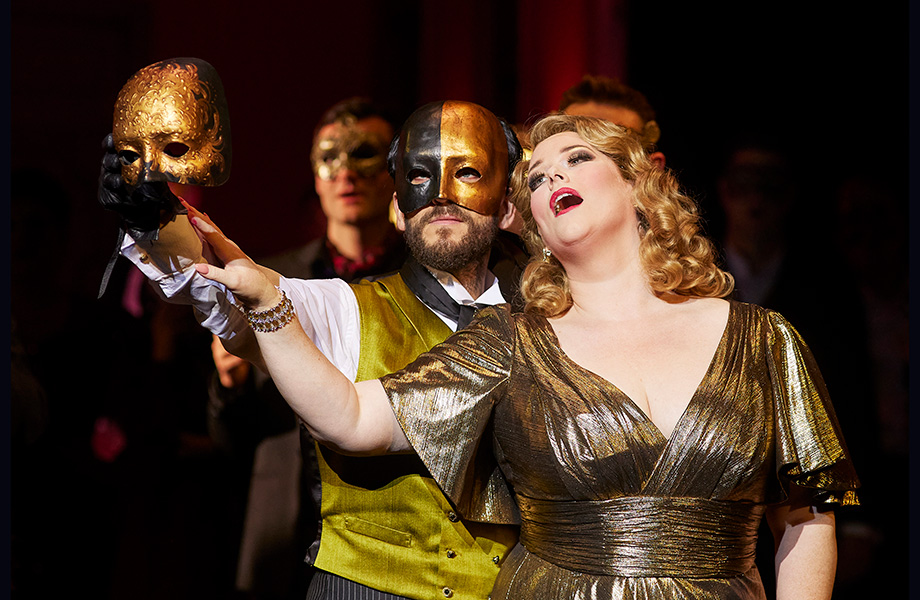
- Article Hero Image Caption: Marko Mimica as Dapertutto, Jessica Pratt as Giulietta and the Opera Australia Chorus (photograph by Keith Saunders).
- Alt Tag (Article Hero Image): Marko Mimica as Dapertutto, Jessica Pratt as Giulietta and the Opera Australia Chorus (photograph by Keith Saunders).
- Production Company: Opera Australia
Les Contes d’Hoffmann is a dark, protean work that has been adapted and staged in a wide range of productions since its première at the Opéra-Comique in Paris on 10 February 1881, four months after Offenbach’s death. One reviewer observed: ‘It is the sad privilege of dead composers to have no enemies at their premières. To be sure, the recent works of Offenbach were performed to sympathetic houses, but none was awarded anything like tonight’s universal acclamation.’ A few months before, Offenbach wrote to the impresario Léon Carvalho: ‘Hurry up and stage my opera. I have not much time left, and my only wish is to attend the opening night.’ The opera was presented over a hundred times that year, but Offenbach was not present to enjoy the success which he so desired for this work.
Part of the reason for Hoffmann’s continuing popularity lies in its ‘adaptability’, a result of the fact that, like Hamlet, there is no one definitive version. It ranks second only to Carmen (1875), and ahead of Faust (1859), as one of the trio of nineteenth-century French operas still central in the current operatic canon. Offenbach, who longed to be taken seriously as an opera composer, rather than a ‘mere’ operetta composer, has finally trumped Faust, the most performed opera of the nineteenth century.
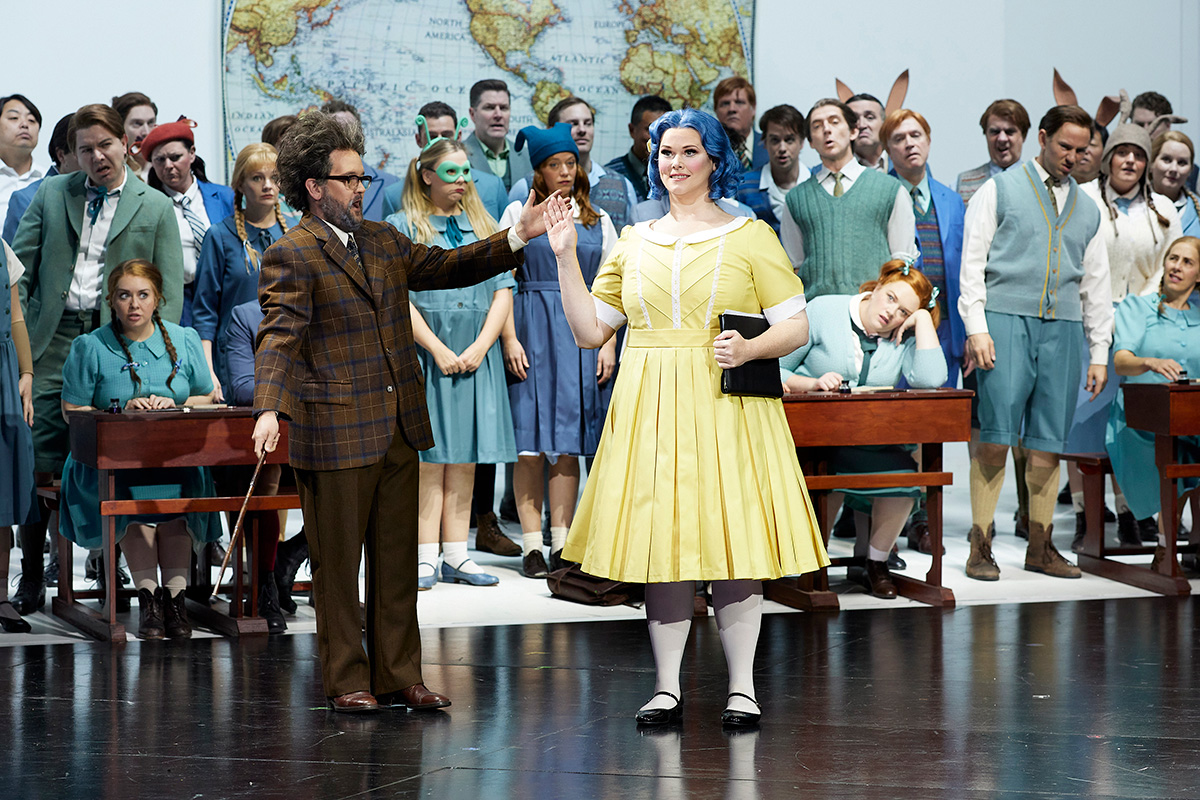 Iain Henderson as Spalanzani, Jessica Pratt as Olympia and the Opera Australia Chorus (photograph by Keith Saunders).
Heather Hadlock suggests that each generation ‘brings its own concerns, obsessions, and desires to the work – which being incomplete, being undead, continues to change in response to our needs’. A series of editions have emerged over the past fifty years, often based on material found in the property of descendants of Offenbach, and the opera resides, in the words of Slavoj Žižek, ‘between two deaths’ in its incompleteness – a truly ‘undead’ work.
Hoffmann is based on a 1851 play by Michel Carré and Jules Barbier, itself based on the tales of E.T.A. Hoffmann, who, Théophile Gautier observed, ‘is more popular in France than in Germany’. The play was a success; Offenbach conducted the music, and observed to the authors that it would make a good opéra-comique. Many of Hoffmann’s characters represent aspects of his own complex personality, which justifies the device of presenting Hoffmann as the principal character in his own stories.
Offenbach was described as ‘the little Mozart of the Champs-Elysée’, while Wagner observed: ‘The French have the secret of these things. I don’t envy them in many respects. Nevertheless, one has to acknowledge this truth that leaps to the eyes: Offenbach could have been like Mozart.’ Don Giovanni haunts Hoffmann. Similarities reside in the mix of farcical elements, pathos, violence, and the supernatural. Parallels between Giovanni’s pursuit of three women – Elivira, Zerlina, and Donna Anna – are matched by Hoffmann’s obsession with Olympia, Antonia, and Giulietta. Nicklausse sings a snatch of Leporello’s opening aria from Giovanni, while the action occurs next door to a theatre where Giovanni is being performed. We do not see or hear this performance, but Hoffmann’s three stories are recounted during its second interval, and his final tale occurs to the sound of applause from the opera house as Stella, singing Donna Anna, appears.
Hoffmann was obsessed by singers, particularly the female voice: this was the century of the inexorable rise of the opera diva. One of the striking features of Hoffmann is how much ‘performance’ is embedded within the actual work itself. There are a variety of different types of song, from drinking songs to serenades, ballads and choruses, even a music lesson scene. Nearly half the opera is composed of music that characters in the action are self-consciously ‘singing’, and which is heard by themselves and other characters on stage as music separate to the sung discourse of the opera.
The première of the opera omitted the Venetian act, with its famous Barcarolle, because the music could not be completed in time. The act is a combination of numbers from other Offenbach compositions; very little music in this act as it stands was composed for Hoffmann. It is standard practice these days to include this act, but where to place it? Some insist it should come second, with the Antonia act serving as the final emotional catharsis of the whole work. However, as in this Opera Australia production, it is more common to have the Venetian act end the opera.
This is a co-production with the Royal Opera House Covent Garden, Opéra National de Lyon, and Fondazione Teatro La Fenice di Venezia. The title role is sung by young Peruvian tenor Iván Ayón Rivas, winner of the prestigious Operalia Competition in 2021 at the age of twenty-eight. It is a marathon of a role – Hoffmann is on stage for lengthy stretches – but Rivas has a voice well suited to the demands, possessing a sweetness and lyric quality as well as the requisite power for the many dramatic moments. Most impressive are his fearlessly ringing high notes. He should, in time, take his place in a celebrated line of great singers in this magnificent but most demanding role. This was a stunning performance.
The three major female roles might be seen as requiring three different types of voices, but they are increasingly frequently sung by the same singer, as is the case in this production. Just as Verdi’s Violetta in La Traviata seems to require a different voice for each act, in Hoffmann we have the mechanical, inhuman coloratura of Olympia in Paris in the first act; the passionately soaring and all-too-human and fragile lyric soprano of Antonia in Munich in the second; and the more dramatic requirements of the pragmatic Giuliettta in Venice in Act Three. All culminates in the tavern in Nuremberg as the silent diva, Stella, briefly appears after her triumph as Donna Anna.
British-born Australian soprano Jessica Pratt sings all three. A much-anticipated performance, she has garnered praise in many of the world’s important opera houses, including in this role. Pratt reveals crystal-clear coloratura facility as the automaton Olympia in Act One. Perhaps Pratt’s ornamentation of the second verse of the famous ‘Doll Song’ is the robot disobeying its master – has AI become too powerful and unruly? It certainly can be seen as a tale for our times.
Diametrically opposed are the vocal demands of Antonia. Here Pratt demonstrates the true quality of her remarkable instrument, with a luscious warmth and gleam to the tone; her vast experience in the bel canto repertoire is very apparent in her effortless ability to spin a beautiful vocal line. As Giulietta, she employs a more dramatic edge to the tone; Pratt’s voice rode majestically over chorus and orchestra in the sextet that ends the act. This is a performance of supreme quality.
 Agnes Sarkis as Nicklausse (photograph by Keith Saunders).
Croatian bass baritone Marko Mimica sings the four ‘villains’: Coppelius, Dr Miracle, Dapertutto and Lindorf. He possesses a voice of impressive power, dark in quality but with an attractive edge to the sound. He was probably most impressive in the insinuatingly evil lyricism of Dr Miracle. Nicklausse was sung by Agnes Sarkis, with a warm mezzo and engaging stage presence; the character is portrayed as a fairy with a talking bird, shades of Papageno. Sometimes doubled with Nicklausse is the Muse, sung with luscious mezzo by Sian Sharp, while Antonia’s mother was Jennifer Black.
Other important character roles are strongly cast from Opera Australia stalwarts: David Parkin, Iain Henderson, Tomas Dalton, Luke Gabbedy, Anthony Mackey, and Richard Anderson. Adam Player delighted the audience with his eccentric ballet master. Frenchman Guillaume Tourniaire, an Opera Australia favourite, conducted this vividly challenging score with finesse and a fine ear for detail and pacing. The chorus were, as always, outstanding, providing a wide range of stage characters while doing justice to the infinite musical variety of the choral moments.
The Italian production team – director Damiano Michieletto, costume designer Carla Teti, set designer Paolo Fantin, and lighting by Alessandro Carletti – creates a version that has strong elements of magic realism, with events occurring in specific situations but potentially slipping off into a world of fantasy. The Olympia act is set in a schoolroom, Hoffmann as schoolboy, while Olympia is controlled by Coppelius’s ultimately malfunctioning radio. We move to a ballet studio for the Antonia act with the arts of ballet and song interchangeable. Antonia is ill, and cannot be saved from Dr Miracle by her father or Hoffmann. The Giulietta act takes place in a rather seedy nightclub.
The evocative set, expertly constructed to allow excellent vocal projection, consists of a series of rooms which suggest access to the mind of Hoffmann. We enter his meandering memory and delve into his past where these love stories are recalled. There are realistic characters interspersed with others who appear as pure fantasy. Of course, these settings are not indicated in the libretto, but the concept for each is clear and coherent, and the execution outstanding. The direction of the characters is meticulous, while the costumes are a visual delight. Michieletto’s imaginative and highly theatrical perspective never flags, creating a production that deeply respects the spirit of the work while taking liberties with the narrative.
After two false starts due to Covid, Opera Australia has presented a fascinating production of this problematic and disturbing work. Seen from a contemporary point of view, Hoffmann perpetuates many of the stereotypes of nineteenth-century opera that challenge contemporary creative teams. The portrayal of female characters is troubling; the male gaze causes the destruction of Olympia; Antonia is another in a long line of operatic women who die; Giulietta perpetuates the Madonna/Whore dichotomy, another persistent trope in opera. Stella seems to be the only woman with agency, but the diva remains silenced. However, Hoffmann is a work of such imagination and musical riches that a new perspective becomes part of its varied and continuing performance history. This fascinating production certainly does the remarkable work proud.
The Tales of Hoffmann (Opera Australia) will be presented at the Sydney Opera House until 20 July 2023. Performance attended: 11 July.