


- Free Article: No
- Contents Category: Opera
- Custom Article Title: Idomeneo
- Review Article: Yes
- Article Title: Idomeneo
- Article Subtitle: A secular Passion from Mozart
- Online Only: No
- Custom Highlight Text:
Inspired by everything he had learned and seen at the Mannheim Court in 1777–78, Mozart, aged twenty-four, was primed when he received a commission to write an opera for the 1781 Munich carnival. His years in Mannheim had been formative, exposed as he was to Elector Carl Theodor’s court, which rivalled that of Frederick II, king of Prussia, in discrimination and cultivation.
- Article Hero Image (920px wide):
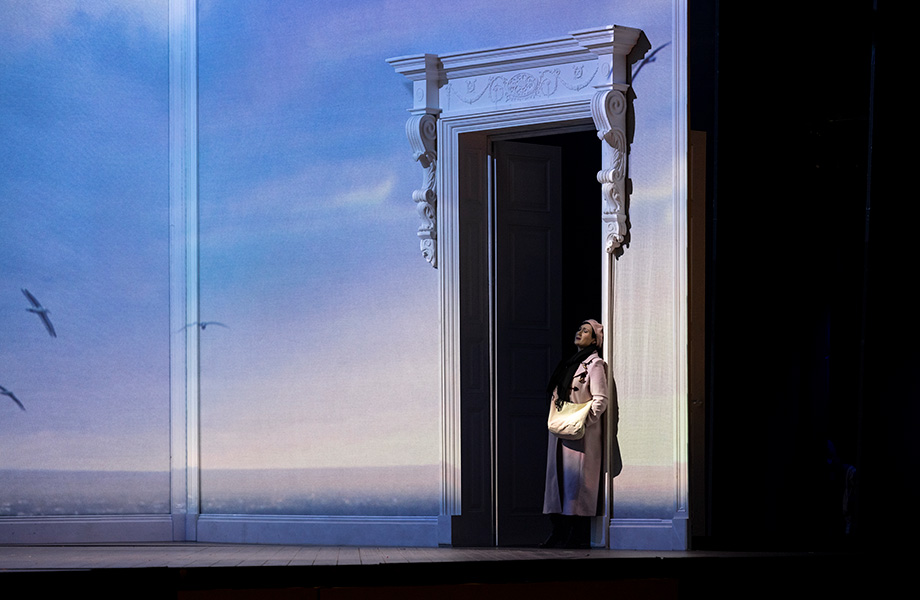
- Article Hero Image Caption: Kathryn Radcliffe as Ilia (photograph by Charlie Kinross).
- Alt Tag (Article Hero Image): Kathryn Radcliffe as Ilia (photograph by Charlie Kinross).
- Production Company: Victorian Opera and Opera Australia
During 1780, when he wrote most of the opera, Mozart was far from buoyant. His mother had died in Paris, his relations with his domineering father, Leopold, were almost at breaking point, and he was unhappily in love with Aloysia Weber, sister of his future wife, Constanze. He left Salzburg in November 1780 and only returned to the city of his birth once more, for a brief visit in 1783. These themes of deracination, amorous woe, and filial estrangement would be played out in the new opera.
Despite his personal circumstances and the putative rigidities of opera seria, Mozart took the outmoded form and did something highly original with it, infusing it with a lyricism and humanity not seen before. From the outset the work is full of motivic subtleties and orchestral colourings that mark Idomeneo as the first of his masterpieces. Only the most impatient Puccinian or Verdian could resist the mellifluous unfoldings of Act One. Perhaps ironically, Idomeneo turns out to be one of Mozart’s most affecting operas.
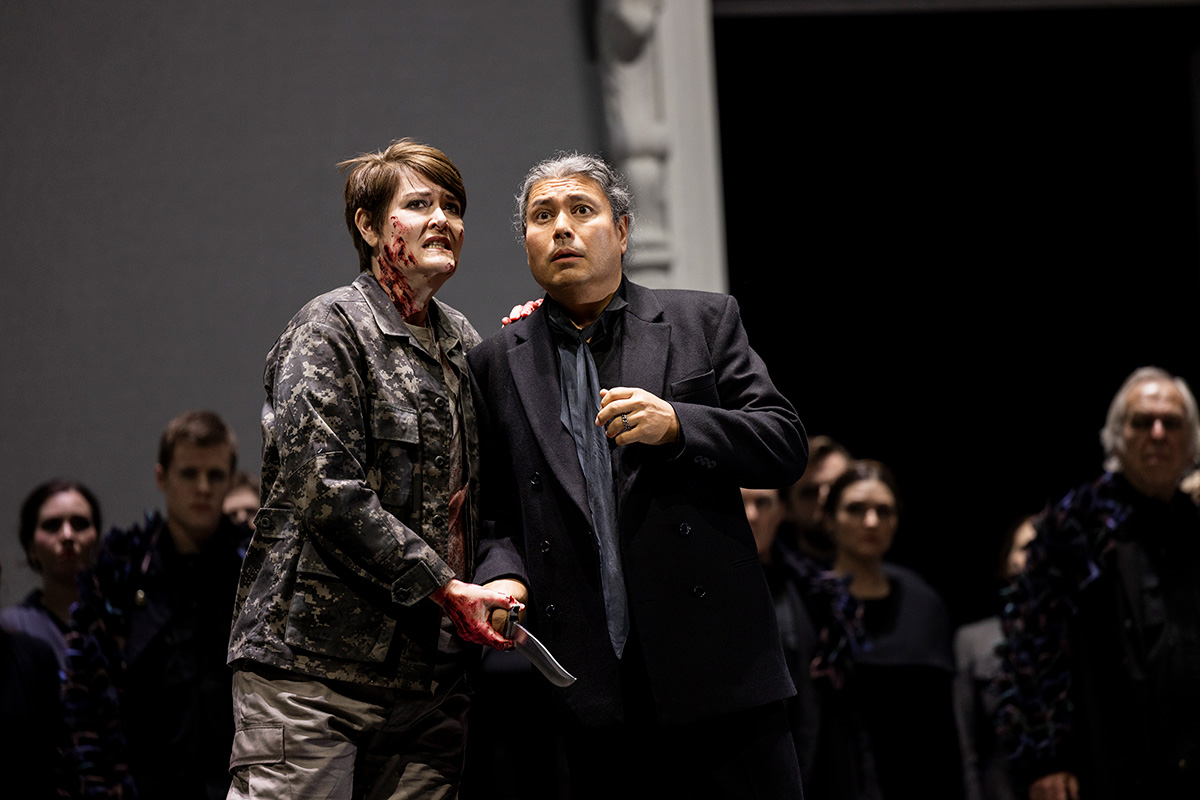 Catherine Carby as Idamante and Steve Davislim as Idomeneo (photograph by Charlie Kinross).
The whole score is rich, right from the Overture, which represents a huge advance – a ‘leap into greatness’, according to Charles Osborne. Mozart had learned much from Gluck’s French operas – the two Iphigénies and the second version of Alceste. He began to use the chorus as an integral part of the drama, not an adjunct. Gone were the oppressive breaks between solos and ensembles. Mozart, not wanting the dramatic tension to be broken, did everything he could to circumvent applause. Continuity was all. Along the way, he created three characters – Ilia, Idomeneo, Elettra – who were more psychologically acute and realised than any that had come before.
Work on the opera did not proceed smoothly. Mozart grew impatient with his prolix librettist, and Leopold was typically profuse with nostrums and criticisms: ‘I advise you when composing to consider not only the musical, but also the unmusical public. You must remember that to every ten real connoisseurs there are a hundred ignoramuses. So do not neglect the so-called popular, which tickles long ears.’ Mozart had a tough time with his Idomeneo, Anton Raaff, an elderly and demanding tenor. He detested his Idamante, the young castrato Vincenzo dal Prato (‘mio molto amato castrato del Prato’), who was said to be a wooden actor and a worse singer.
Ten days before the première, Mozart was still working on the opera, especially the superfluous ballet, which he resented having to compose. In a letter to his father he wrote: ‘My head and my hands are so full of Act 3 that it would be no wonder if I turned into a third act myself. It has cost me more trouble than a whole opera, for there is hardly a scene in it that is not extremely interesting’.
When Carl Theodor attended a rehearsal, he complimented Mozart. ‘Who would believe that such great things could be hidden in so small a head?’
The première of Idomeneo, Rè di Creta took place on 29 January 1781 at the Court Theatre, Munich. It seems to have been well received, but there were only two other performances, well apart, and the opera was never staged again during Mozart’s life, though he did conduct a concert performance in Vienna in 1786, when Idamante was sung by a tenor, requiring much rewriting.
Thereafter, Idomeneo was rarely performed, eclipsed by Mozart’s great operas with Lorenzo Da Ponte: Don Giovanni, Così fan tutte, and Le nozze di Figaro. Richard Strauss prepared a new edition for the sesquicentenary in 1931; Albert Einstein dismissed it as ‘a gross act of mutilation’. The first British production followed in 1934, in Glasgow, but it was the 1951 production at Glyndebourne – with Richard Lewis as Idomeneo, Sena Jurinac as Ilia, and Birgit Nilsson as Elettra – that transformed the opera’s fortunes.
Idomeneo is not unknown in Australia. I have seen it twice in Sydney: back in 1979, a performance that was broadcast on radio and can be heard in its entirety on Youtube; then in 2000, with John Mark Ainsley as Idomeneo, Emma Matthews as Ilia, and Deborah Riedel as Elettra (Christopher Hogwood conducted).
Set soon after the end of the Trojan war, the three-act opera takes place in Crete. Idomeneo, king of Crete, returns home after the Trojan war. Caught in a tempest, he vows that, should he be saved, he will sacrifice the first person he meets on dry land to Poseidon, god of the sea. It will surprise no one to learn that the first person he encounters is his beloved son, Idamante (now frequently sung, as on this occasion, by a mezzo-soprano). There is a beautiful, excruciating recognition scene, when Idomeneo, who has not seen Idamante since infancy, finally recognises his son, only to promptly reject him in order to save his life.
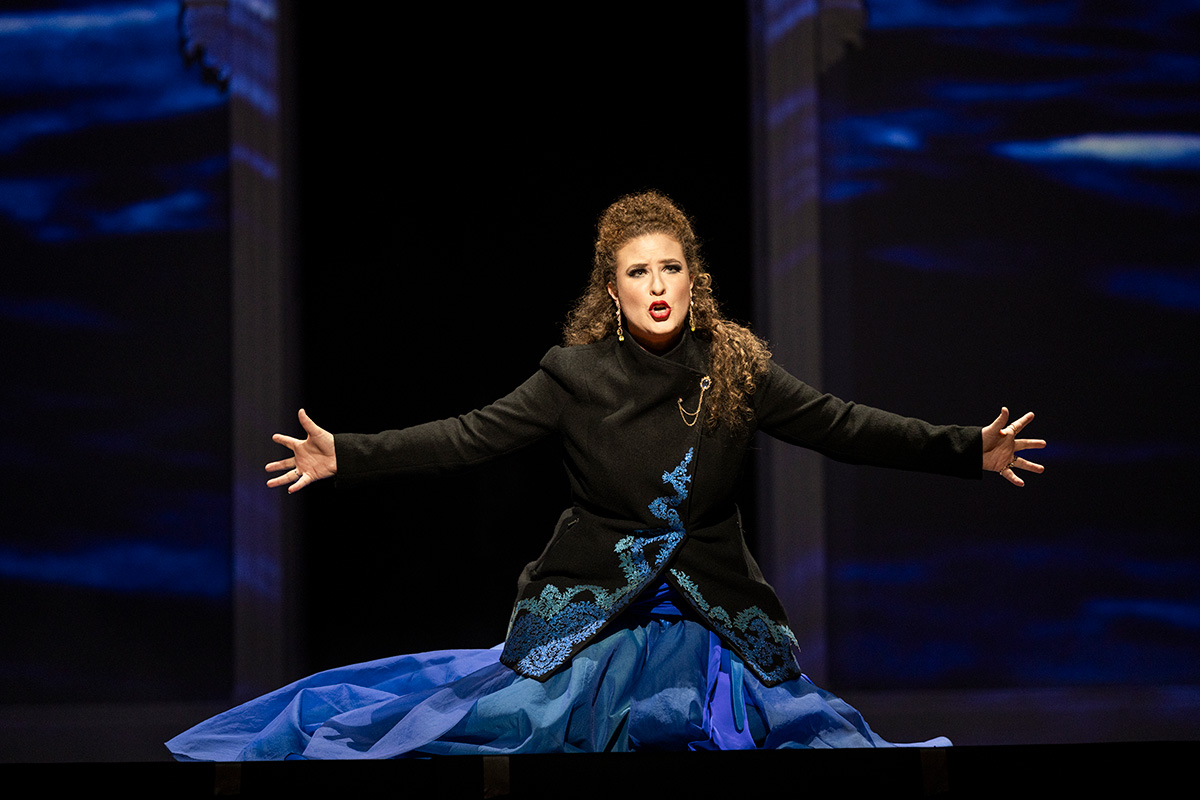 Olivia Cranwell as Elettra (photograph by Charlie Kinross).
This new production is a collaboration between Victorian Opera and Opera Australia. It will be presented (with a different cast) in Sydney next February as part of OA’s summer season, which is being curated by Lindy Hume. At present it feels like something of a work in progress, and a very promising one.
Hume directs Idomeneo with her usual clarity and attentiveness. The set is simple, economical, and accommodating: a three-walled Robert Adam interior with doors on each side. Possibly in readiness for the small Sydney stage, the set looks rather cramped on the big Palais stage. There is a confusion of chairs and the inevitable revolve. In the first scene, the chorus mooches about like backpackers on a tram and generally gets in Ilia’s way as she prepares to relate her hatred of her captors and her conflicting love for Idamante. The lighting (Verity Hampson), video design (David Bergman), and cinematography (Catherine Pettman) are inspired. Wild seas, bright skies, and soaring birds are projected on the walls.
Steve Davislim, an accomplished Straussian, makes a welcome return to Australia as Idomeneo, ahead of his appearance in Das Rheingold with the Sydney Symphony Orchestra later this year. Davislim acted with feeling, and his immensely florid Act Two aria, ‘Fuor del mar’, was a highlight.
Ilia, daughter of King Priam, is a wonderful creation. Captured by Idomeneo, she has been sent back to Crete where she has fallen in love with Idamante. Kathryn Radcliffe, a very twenty-first-century princess, sang with considerable attack, sometimes risking a certain vehemence or squeakiness in the upper register. The cuts throughout were considerable, and Ilia’s long Act Three aria, ‘Zeffiretti lusinghieri’, was one casualty.
Catherine Carby, heard here most recently in Verdi’s Requiem, sang Idamante. Carby has given us many fine performances, notably in Bellini’s I Capuletti e I Montecchi (2009) and Handel’s Partenope (2013). She was not at her best in Act One and may have been indisposed, though there was no announcement. She sang with more volume later on, and the duet in Act Three, when Ilia confesses her love, was well done.
Arbace, the king’s faithful counsellor, is the only stock character in the opera. His long aria in Act Two is often cut, and that was the case here, where he was sung by Michael Dimovski.
Elettra – daughter of Agamemnon and Clytemnestra – is one of the great neurotics in all opera. Mozart gives her three arias and uses her in the famous trio and quartet. Edita Gruberova was Elettra on the excellent 1983 Decca recording, conducted by John Pritchard (Pavarotti sang Idomoneo, one of his finest roles). It’s a shame that Decca couldn’t lure its star soprano to join the cast, for Joan Sutherland had sung it in Sydney four years earlier – the only time she sang Elettra, and a memorable experience for anyone who was present, especially the scintillating ‘D’Oreste, d’Ajace’, a virtuosic aria that was remarkably omitted from the 1781 première.
Elettra’s Act One aria, ‘Tutte nel cor vi sento’, is equally thrilling and very similar in style. Both arias are full of psychotic fury and repulsion. Olivia Cranwell – recently heard in Melbourne Opera’s Ring cycle, and soon to sing Sieglinde for OA in Brisbane – was a suitably mobile and ferocious Elettra. She looked the part too, in the best of Anna Cordingley’s costumes, which were otherwise contemporary and rather anonymous. Elettra often steals the show, and Cranwell was the best of the singers, only fudging the piercing coloratura at the end of ‘D’Oreste, d’Ajace’, exiting with a kind of shriek, to much acclaim from the opening-night audience.
The Melbourne Chamber Orchestra, conducted by Benjamin Bayl, played superbly throughout, with a balanced, clarion sound that filled the theatre and occasionally ran the risk of overwhelming the principals. The Overture was done with panache, and there were memorable passages throughout, notably when the Voice of Neptune is accompanied by solemn chords for horns and trombones, the latter rarely used by Mozart.
The chorus sang and acted with gusto and made the most of Mozart’s many stirring ensembles.
We know from Constanze what this opera meant to Mozart. In 1829, long after his death, she told the English organist and composer Vincent Novello that Mozart was happiest when composing Idomeneo – quite an admission, since he was in love with her sister at the time. She also recalled a time when, singing the great Act Three quartet (‘Andrò ramingo e solo’) with herself, his sister Nannerl, and Leopold, Mozart was so affected that he had to stop. ‘He was so overcome that he burst into tears and quit the chamber, and it was some time before I could console him,’ she said.
It is, after all, a profoundly emotional opera. Done well, as it is here, it can be a most stirring experience.
But David Cairns, that fine Mozartian, should have the final word:
Humanity may need, as never before, the sanity, the life-renewing laughter of Mozart’s comedies, but it needs too that handful of special masterpieces whose qualities of courage, hope, compassion and honesty of vision make them its natural parables and sacred texts. Idomeneo is one of those works. Perhaps [Edward] Dent was right: it should never be taken for granted, but always ‘attended in a spirit of pilgrimage’. It is a secular Passion, with power to chasten and uplift a distracted age.
That wasn’t written yesterday, either – but in 1983.
Idomeneo (Victorian Opera and Opera Australia) continues at the Palais Theatre, Melbourne on 8 July 2023. Performance attended: 4 July.