


- Free Article: No
- Contents Category: Theatre
- Custom Article Title: Romeo and Juliet
- Review Article: Yes
- Article Title: Romeo and Juliet
- Article Subtitle: A production of unrealised tension
- Online Only: No
- Custom Highlight Text:
Bell Shakespeare’s latest production of Shakespeare’s Romeo and Juliet (directed by Peter Evans) is punctuated by stand-out performances: Lucy Bell, as the Nurse to Juliet, steals the show early, with her accounts of Juliet’s birth and growing up; she lends warmth and a sense of time and place that allows this loving and loveable character to shine...
- Article Hero Image (920px wide):
.jpg)
- Article Hero Image Caption: Rose Riley as Juliet and Jacob Warner as Romeo (photograph by Brett Boardman).
- Alt Tag (Article Hero Image): Rose Riley as Juliet and Jacob Warner as Romeo (photograph by Brett Boardman).
- Production Company: Bell Shakespeare
This play marks the first staging of a full Shakespeare play in The Neilson Nutshell, Bell Shakespeare’s new theatre space down at Wharf 2/3, Walsh Bay. The space is roughly twenty metres square, with the audience seated on three sides. Effecting a type of theatre in the round, it is a promising space, as laughter is often infectious and more intense when you can see others laughing. Poignant moments – when you can hear a pin drop – are made more intense. Sadly, such moments were rare: Benvolio’s winking at the audience brought candour, the Nurse’s discovery of Juliet’s body (believed to be dead) brought pathos, Juliet’s discovery that Romeo’s deceased lips are still warm, could have resonated more, and Evans’s commendable inclusion of Paris’s lament at Juliet’s grave – ‘O woe, thy canopy is dust and stones, / Which with sweet water nightly I will dew, / Or wanting that, with tears distilled by moans’ (often cut from the play) – lent poignancy and dynamism to the graveyard scenes. But whether the show was ‘galloping a pace’ because of timing issues, or for some other reason, many crucial moments had not yet fully landed, not enough to draw the audience into the drama.
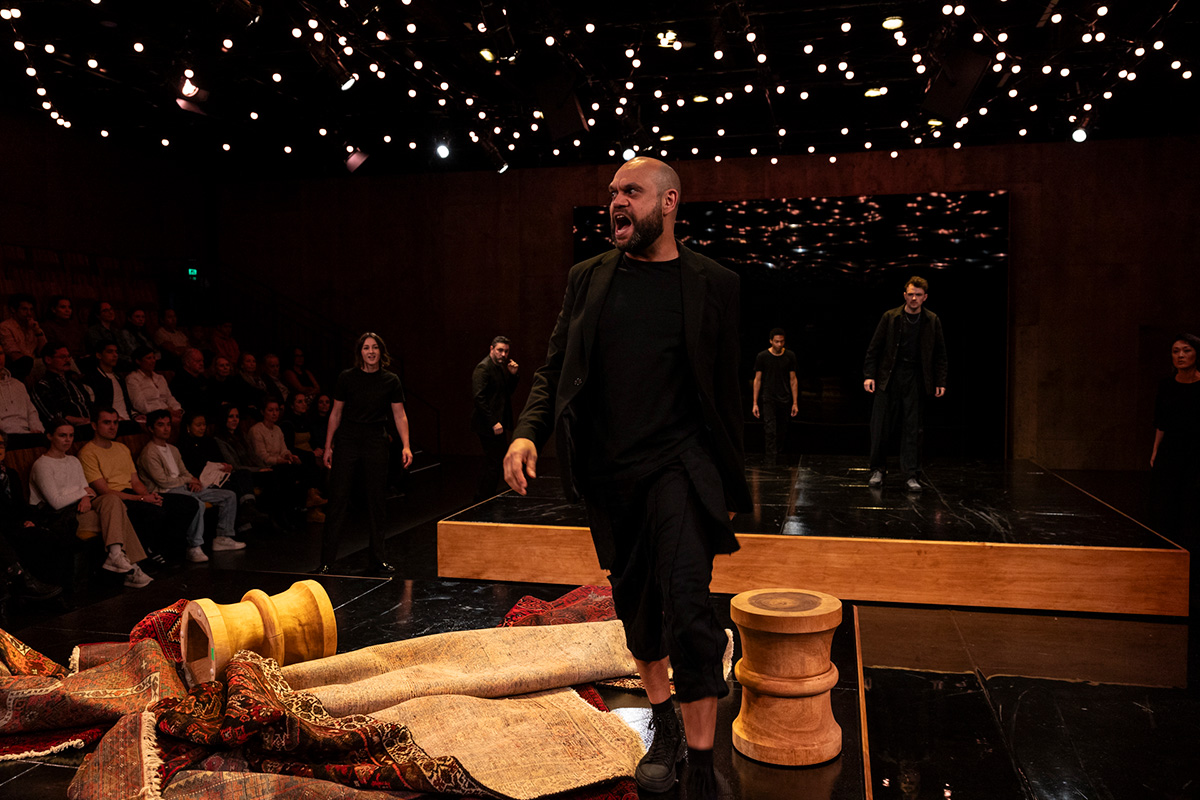 Kyle Morrison as Benvolio (photograph by Brett Boardman).
The play began well, with a brash fight brewing between the Capulets and Montagues on the streets of fair Verona (where we lay our scene) – ‘Do you bite your thumb at us, sir?’ But when it came to the climactic confrontation, with two characters wielding strange wooden poles, something was missing. When Benvolio said, ‘Part fools! / Put up your swords, you know not what you do’, there had been no fight and no swords. The stage directions say, ‘They fight’, so this is an odd omission that undermines the drama, especially when later combats are fully realised with shiny swords, showing off the skills of the fight director (Nigel Poulton). Why brandish these strange wooden poles when swords are available?
The lighting design by Benjamin Cisterne was simple but effective, a hundred globes strung haphazardly above the stage, dimmed or brightened to suggest a starry night or the party lights of the Capulet ball. The costumes (Anna Tregloan) include skater shorts and boots and plain contemporary garb, but they are exclusively charcoal, which tends to flatten the characters. Flashes of colour and harlequin patterns were donned for the Capulet ball but, even then, the characters became homogenised rather than distinguished as individuals. Without sartorial distinctions between the Capulets and Montagues, it would be difficult for first-timers to follow the action. Despite the contemporary dress, the dancing at the ball was slow and processional. When actors selected new partners from the audience, it all seemed rushed and contrived.
Many lines were mouthed by the actors as a kind of rendition, disconnected from the dramatic situation: the pulses of danger, the allure of romance, the compunctions of parenting. Perhaps the interpretative space and the surrounding audience made it difficult to realise these underlying tensions. The scenes between Romeo (Jacob Warner) and Benvolio were a bit mopey and listless, as if the players were kicking the lines along the ground in the hope of finding something to do with them. At the ball, Romeo simply rocks up alongside Juliet and says he loves her (there is no real discovery moment between them). The Montague and Capulet youths rock onto stage and begin hating one another, but there is little more of the brooding swagger and testosterone present in the opening scene. There is little acknowledgment of these characters’ familiarity with one another, though Friar Lawrence and Romeo conveyed the nuanced warmth between a life coach and his trouble-making pupil.
The Queen Mab speech by Mercutio (Blazey Best) is delivered in its full glory, but too quickly for us to follow every word, and it smacks of a set-piece monologue rather than a witty tirade from one friend to another. Best is superbly physical and flighty as a Mercutio fully bent on fighting Tybalt, but Tybalt (Leinad Walker) chooses neither to play a suave nor dangerously psychotic Tybalt, so Mercutio seems more ‘the prince of cats’ – she out-Tybalts Tybalt! Most egregiously, Romeo’s lines in the balcony scene were played for laughs, lines that should make audiences weep. If they are played earnestly, the audience can empathise with the youthful wonderment of Shakespeare’s Romeo, and the laughs will follow (they’re built in). Playing the balcony scene purely for laughs obscures the lovers’ fascination, and a madcap Romeo seems incongruous vis-à-vis Juliet’s yearning affection.
Comments in the program note this play is not an archetypical Shakespeare tragedy, and ‘the first two Acts are like a knockabout comedy,’ but those acts contain a disruptive street fight that prompts the prince to declare death to anyone who breaks the peace, and they also contain the most romantic lines ever written in the Western literary canon. The comic mode should be the mesmerising flower under which the brooding snake of tragedy coils, ready to strike.
Romeo and Juliet (Bell Shakespeare) continues at The Neilson Nutshell, Pier 2/3 in Sydney until 27 August 2023 and will appear at the Arts Centre Melbourne from 13 to 29 July 2023. Performance attended: 28 June.