


- Free Article: No
- Contents Category: Film
- Custom Article Title: Alcarràs
- Review Article: Yes
- Article Title: Alcarràs
- Article Subtitle: A Spanish film close to the sun
- Online Only: No
- Custom Highlight Text:
Given how commonplace it is in today’s economy, where are our great films about solar power? I’m not thinking here of those countless disaster and science fiction films that feature a dying sun or volatile solar winds as catalysts for global catastrophe, but simply movies that would give life to the otherwise unremarkable solar panels tilted skyward on roofs and farms around the world.
- Article Hero Image (920px wide):
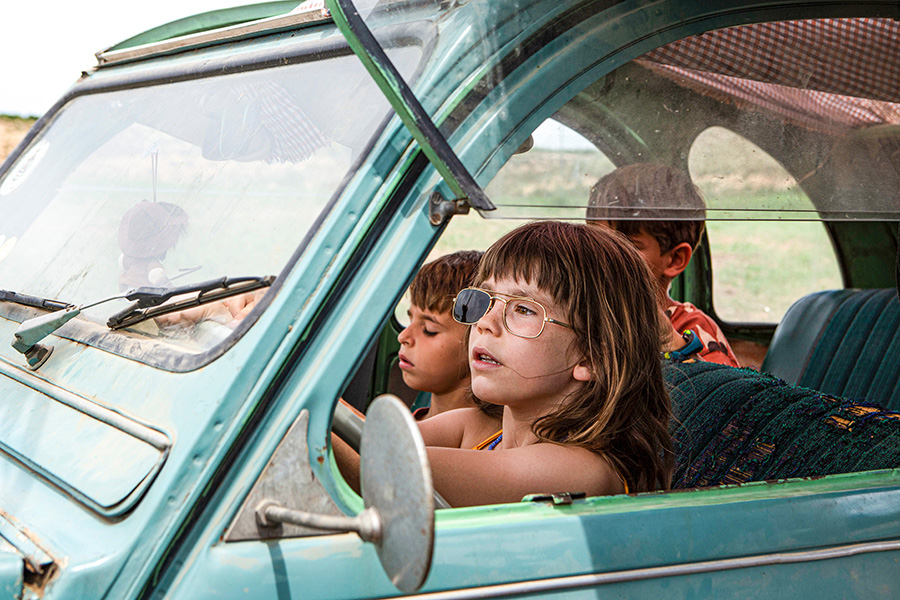
- Article Hero Image Caption: Aine Jounou in Alcarràs (photograph by LluísTudela and courtesy of Palace Films).
- Alt Tag (Article Hero Image): Aine Jounou in Alcarràs (photograph by LluísTudela and courtesy of Palace Films).
- Production Company: Palace Films
Now, in Carla Simón’s sophomore feature, Alcarràs, solar panels form the unlikely bête noire of a family of peach farmers in rural Catalonia. Or, at least, they are but one of a bevy of problems that set the plot in motion, and which mount one on top of the other as we go on. The film foreshadows the coming crisis from the beginning, with the first line spoken by a young girl, Iris (Ainet Jounou): ‘We’re too close to the sun!’ She is behind the wheel of a rusted old VW Beetle in a field, alongside her twin cousins, and the trio are pretending that they are in outer space. But this role-playing is cut short by an offscreen voice; the children are shooed away, and their spaceship is removed by an excavator to break ground for the installation of solar panels. Embracing nominative determinism, the family to which these children belong is given the surname Solé, connecting them fittingly in Catalan with both the ground and the sun. The children are ‘too close to the sun’, but not as they know it.
 Alcarràs (photograph by LluísTudela and courtesy of Palace Films).
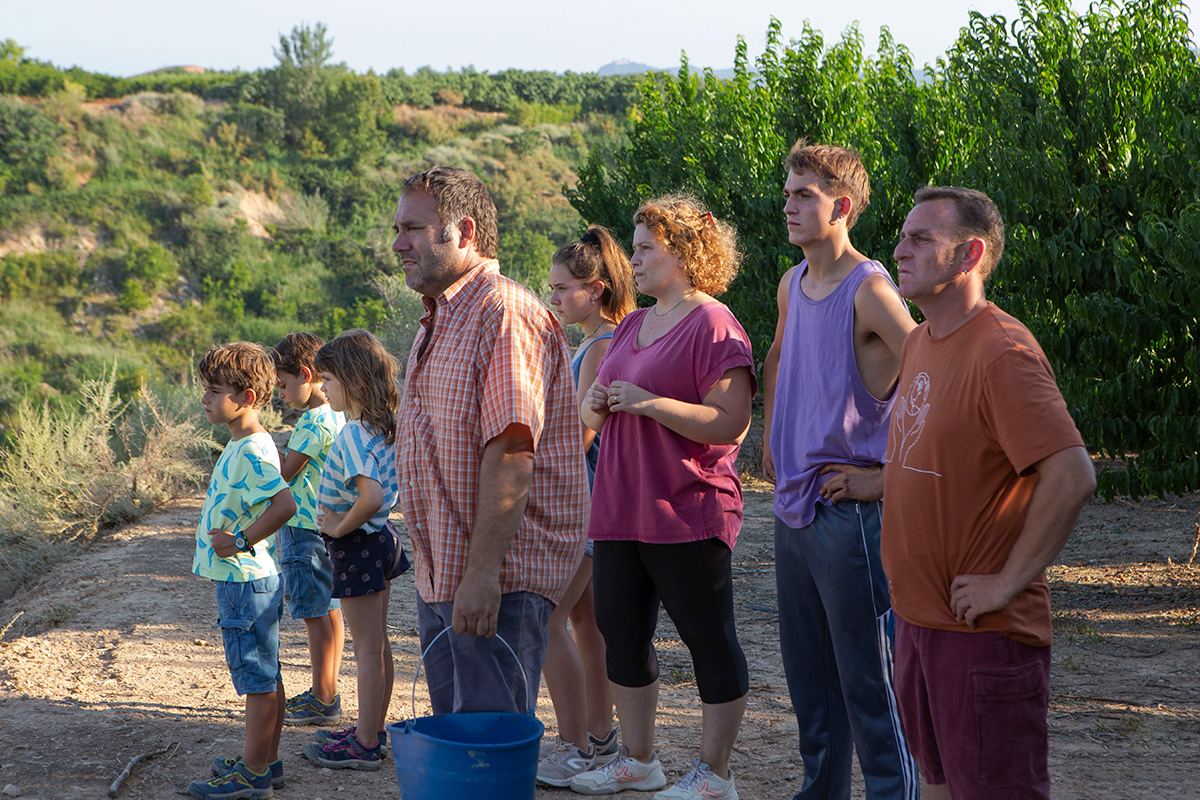
We soon learn that grandfather Rogelio (Josep Abad) has been promised the tract of land upon which he and his family have farmed peaches for decades, in return for hiding the property’s original owners during the expropriations of the Spanish Civil War. But this verbal contract was never put into writing, and now the rightful heir to the land is insisting upon its return at the end of the summer. Rogelio’s son, Quimet (Jordi Pujol Dolcet), resents his father for landing the extended family in this situation, but is determined to lead one final, successful harvest before they all face eviction. Most of the migrant fruit pickers are laid off, and the Solé children and grandchildren must all band together in the orchard against the threats posed by rabbits, flooding mishaps, and the unreasonably tough margins offered by the supermarket chains for their produce.
In these uncharted waters, roles and objects trade places daily. A working tractor can take on new life as a joyride vehicle for the young ones. Wooden pallets can be joined together as a makeshift cubbyhouse, before they are requisitioned by Solé père for peach picking again. Peaches can be used as orange paint to bring colour to that cubbyhouse. Peaches can be thrown as objects of protest at a demonstration. Peaches can be farmed and preserved, just like solar energy – what’s the difference? Some members of the family are more amenable to change than others, but Quimet, who refuses a late offer to remain on the land as a solar farmer, finds his identity in the orchard, even making the luddite’s gesture of dismantling one solitary solar panel on the side of the family barn.
For all of the trials and tribulations faced by the Solé family, we often register their reactions before we see what has prompted them; effects before causes, faces before spaces. While we certainly see the wide-open reaches of the land, there are also many claustrophobic shots of the family in close proximity to one another, sharing beds and rooms, and the narrow confines of the sun-dappled orchard rows. Remarkably, given that the burden is often on gestures and facial expressions (like Rogelio’s smile/grimace for a family photo shoot), almost the entire cast is comprised of non-actors from the area; Dolcet was found at a farmers’ demonstration not unlike the one that was staged for the film. It is truly an achievement for Simón to have coaxed such convincing performances across the board; several cast members have been deservedly nominated for domestic acting awards.
Where her début feature, Summer 1993 (2017), drew on her childhood experiences, Alcarràs reflects something of the lives of Simón’s aunt and uncle, who were peach farmers in the town after which the film was named. Here again, the director proves her ability to integrate child actors of different ages and abilities. Just as she takes seriously the perspectives of the youngest observers in this story, so too does Simón attend to the minor details of the world, which seem to have been captured fortuitously, but at the same time resound with major aspects of the plot. For example, in a touching scene, old Rogelio dozes on the couch while the children jostle for the remote control. The film he half-watches on the family television is Una bala marcada (Juan Bosch, 1972), a Spanish-Italian spaghetti western in which the bounty hunter hero is called upon to defend a group of farmers against a ruthless landowner. Elsewhere, late on in the piece, we see Iris in a T-shirt emblazoned with bright yellow suns, just as she watches the final destruction of the orchard to make way for more solar panels. It is a testament to the film’s commitment to realism that such fleeting moments like these are rendered as incidental, when there is a great deal of calculation behind them.
Carla Simón found backing for her latest work through the Berlin Co-Production Market, and received the coveted Golden Bear at the festival in February last year. And yet the distribution of Alcarràs has been a long time in the making. Considering the ever-narrowing windows between festival exhibition and online or theatrical release for films these days, it is a shock that the film is only now having its second release in this country, as part of the Spanish Film Festival, a full year after its première at the Sydney Film Festival in 2022. But, after all: what is another trip around the sun?
Alcarràs (Palace Films) is screening nationally as part of the Spanish Film Festival until 12 July 2023 and is on national release from July 27.