


- Free Article: No
- Contents Category: Theatre
- Custom Article Title: Exiles
- Review Article: Yes
- Article Title: Exiles
- Article Subtitle: The Victorian première of James Joyce’s play
- Online Only: No
- Custom Highlight Text:
Is it time for Joyce’s Exiles to come in from the cold? Joyce’s only extant play has long been marginal within his oeuvre, scantly loved even by Joyce enthusiasts, and seldom produced for stage. Bloomsday in Melbourne, which has been making live theatrical adaptations of James Joyce’s prose work for some thirty years, has only got round to putting it on now, the first ever production in Victoria.
- Article Hero Image (920px wide):
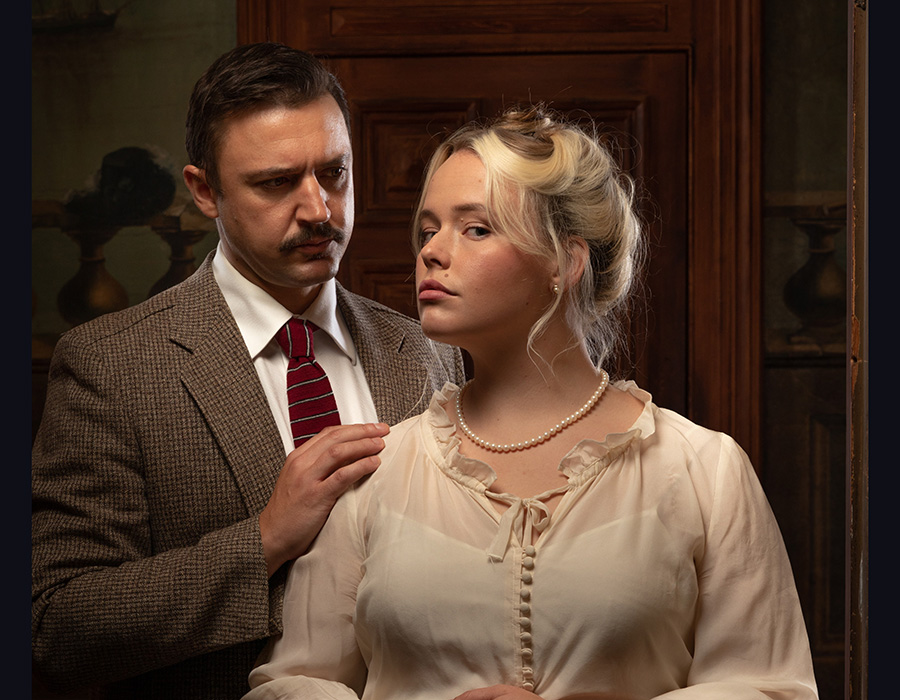
- Article Hero Image Caption: Lucy Payne as Bertha Rowan and Doug Lyons as Richard Rowan (photograph courtesy of Jody Jane Stitt and Mark Harper).
- Alt Tag (Article Hero Image): Lucy Payne as Bertha Rowan and Doug Lyons as Richard Rowan (photograph courtesy of Jody Jane Stitt and Mark Harper).
- Production Company: Bloomsday
Joyce could not find a theatre in the United States or the United Kingdom to put it on (Yeats’s Abbey Theatre was one of those that rejected it) and, an inauspicious fate for a play, it was published before it was ever performed. It was finally premièred in 1918 in Munich to unfavourable reviews, a consensus that endured for decades. That might be that, had Harold Pinter, already a major playwright, not revived it successfully in London’s Mermaid Theatre in 1970. ‘You’re a brave man to take on Exiles,’ Samuel Beckett had written to Pinter, ‘I understand your excitement. I often wondered how it could be done.’
 Soren Jensen as Robert Hand, Lucy Payne as Bertha Rowan, and Doug Lyons as Richard Rowan (photography courtesy of Jody Jane Stitt and Mark Harper).
Perhaps, as so often, society was catching up with Joyce. Changing sexual mores and the loosening of marital bonds in the 1960s may have made Joyce’s exploration of sexual freedom more resonant by 1970. In any case, it seems that Pinter realised the play’s possibilities by a directorial exactitude and by the careful use of pauses and silences that he learned from Beckett and deploys in his own work. Less is more when it comes to a successful Exiles, and Carl Whiteside’s new production has wielded its razor liberally, cutting a third off the playscript and tightening the melodrama considerably. The small basement studio setting of fortyfivedownstairs, with audience seating on both sides of the central action, affords a focus and an intensity well suited to the play’s testing of the borders of monogamy.
Exiles may be ‘minor’ Joyce, but its themes of love, betrayal, secrecy, and desire are central to his wider writing, and it deals with, perhaps, the cardinal trope of his work – that of male–female–male triangle. It explores themes of jealousy, or, more pertinently, cuckoldry, that surface in ‘The Dead’ and in Ulysses. Richard Rowan, a writer and something of a freethinker, returns to Dublin after nine years in Rome with his common-law wife, Bertha. He allows, or perhaps encourages, a liaison between Bertha and his friend, the journalist Robert Hand, so long as Bertha reveals all the details of their encounter. Robert and Bertha have a child, Archie, played by a grown woman in this production (an anti-naturalist innovation which presumably also avoids the extra troubles of engaging a child actor), one of many factors to highlight the gender asymmetry in the politics of sexual freedom. Lucy Payne’s restrained performance as Bertha, shifting adroitly from seduction to exasperation, from self-possession to outraged jealousy, reveals something of the livid gender politics around power and status, the different options for men and women. The child’s nanny, Beatrice Hand – Robert’s cousin, deeply in love with Richard – is played here with an air of wounded innocence. She is an awkward supplement to the triangle, sidelined by a social system with limited options for women, while the men indulge in self-important sexual attitudinising.
The dramatic conflict emerges from the differing agendas and impulses between the characters, but also, crucially, in the conflicting emotions and imperatives felt within them. Jealousy is the flame that burns, but also that which draws in, as Richard’s repeated questioning of his wife – his hunting for details – attests. Like Leopold Bloom, a part of Rowan is intensely excited by his wife’s prospective sexual encounter with his friend: the lure of being a cuckold. This intensity of sharing one love object creates a deep bond as well as deep rivalry, a bond that, following René Girard and Eve Kososky Sedgwick, is underpinned by what we might call ‘homosocial desire’. One interesting aspect of this production, and one reason why the play might resonate today, is its recognition of the implicit homoerotic aspects of same-sex intimacy.
As in Pinter’s 1978 play Betrayal, which owes much to Joyce’s play, it is by no means obvious who betrays whom: the man who tries to seduce the wife of his friend, or the husband who knows all along but does not say. At one point, Richard explains to Archie that if he gives away a toy willingly, he never really loses it, for it has never been taken from him. How does one love without possession? How can you allow the person you love to self-realise? To turn jealousy into what ethical non-monogamists call ‘compersion’?
It’s a rare opportunity to see Joyce’s only play performed, and Bloomsday in Melbourne is to be commended in bringing out its layers and subtleties and some contemporary resonances so adeptly. Yet there are limits, I think, to how much any production can do for this play, which remains wordy and hampered by the characters’ over-earnestness. I know I will never care as much for Richard Rowan’s marital plight as I do for Gabriel Conroy’s or Leopold Bloom’s. But I return to Joyce’s prose as, perhaps he did, with an enhanced sense of its ability to excavate the interior lives of his characters and complexities of the thinking, moving mind.
Exiles (Bloomsday in Melbourne) continues at fortyfivedownstairs until 25 June 2023. Performance attended: 15 June.