


- Free Article: No
- Contents Category: Film
- Custom Article Title: Run Rabbit Run
- Review Article: Yes
- Article Title: Run Rabbit Run
- Article Subtitle: The horrors of generational trauma
- Online Only: No
- Custom Highlight Text:
A sense of dread permeates Australian director Daina Reid’s (The Handmaid’s Tale) début feature film, Run Rabbit Run, which had its première at Sundance earlier this year.
- Article Hero Image (920px wide):
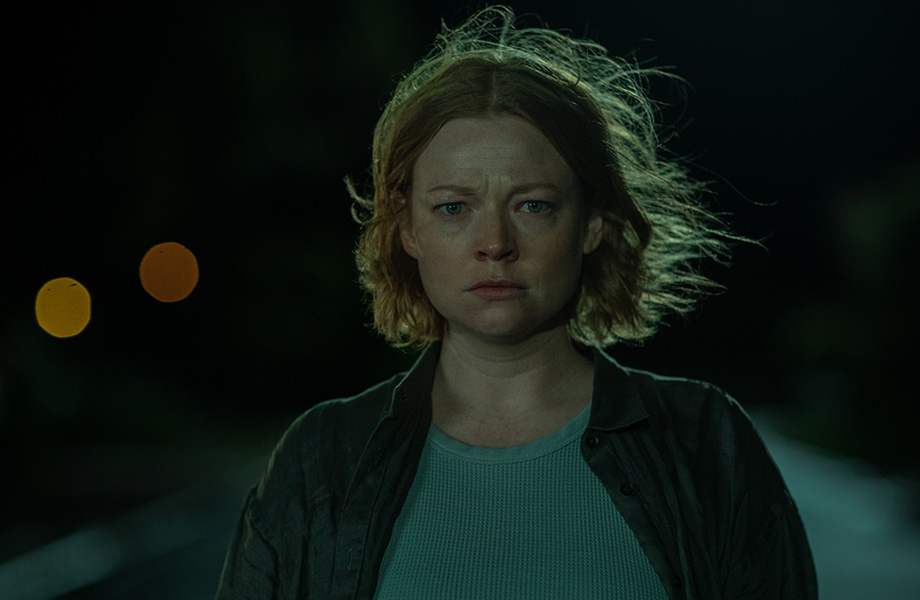
- Article Hero Image Caption: Sarah Snook as Sarah in Run Rabbit Run.
- Alt Tag (Article Hero Image): Sarah Snook as Sarah in Run Rabbit Run.
- Production Company: Netflix
Sarah, herself, is still reeling from mounting emotional trauma. She is still mourning the recent death of her father, to whom she was close, as well as a difficult divorce from her husband Pete (Damon Herriman), who has remarried and is trying for a baby with his new partner. This leaves Sarah feeling betrayed, for when they were together they had agreed not to have more children.
There are also lingering scars from a difficult childhood and a distant and fractured relationship with a mother, who is in aged care and has dementia, and with whom she has no contact. Underlying and somehow linking all these scars is the disappearance of Sarah’s sister, Alice, aged seven at the time, an incident that still haunts Sarah. Sarah’s mother, Joan (Greta Scacchi), has always blamed her for her sister’s mysterious disappearance.
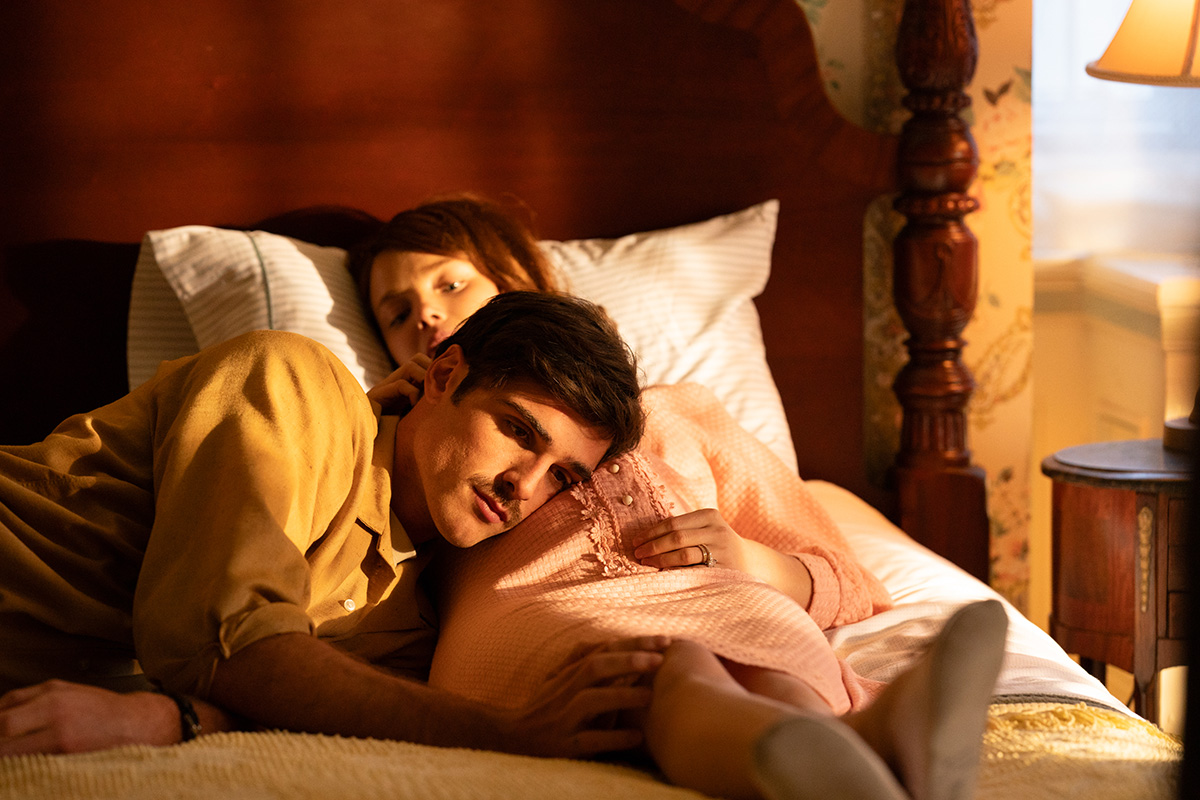 Sarah Snook as Sarah and Lily LaTorre as Mia in Run Rabbit Run.
Reid suggests that Sarah is teetering on the edge, due to her own unprocessed trauma and grief and her increasing concern about Mia’s behaviour. In one scene, after viewing her daughter’s art, she rings Pete and his wife (Naomi Rukavina), accusing them of turning Mia against her and causing her to act in the way she does.
Making Sarah even more agitated, Mia insists that she is Sarah’s missing sister, and calls herself Alice. She demands to meet her grandmother Joan (Greta Scacchi). It is at this point that things begin to unravel.
As Sarah begins to lose her grip on reality, a trip to her childhood home with Mia causes her to tip over the edge. From here on, tormented by the scars of her past and her current anguish, she is no longer able to distinguish between her nightmares and reality. Here, the film enters horror territory.
Initially, Run Rabbit Run seems to be heading in a promising direction. Anchored by the stellar work of its lead cast, particularly the duo of Snook and LaTorre, as well as Herriman, the performances are undoubtedly its strongest component. Snook, in particular, gives a commanding and restrained turn and excels with the material, embodying Sarah’s distress.
Reid and cinematographer Bonnie Elliott cannily utilise the chilly remoteness of the South Australian riverbanks to striking effect, magnifying Sarah’s alienation and the isolation of her situation. This pervasive unease is aided by the eerie, spectral score of Marcus Whale and Mark Bradshaw, which amplifies the anxiety eating away at Sarah.
While it maintains a tense air of disquiet for much of its duration, despite its strong performances Run Rabbit Run disappoints with its reluctance to go beneath the surface and to provide any insights into the issues besieging the characters. Incongruously, the film neither explores nor explains the trauma which is supposedly integral to the Sarah’s life. Frustratingly, key questions are unexplored or curiously brushed over. Why does Sarah have such a distant relationship with Joan? Why would Sarah return to the source of her anguish, her childhood home, where she hasn’t been in years? Rather than offering clues, the film chooses to gloss over and ignore these key questions.
There is another, more distracting issue at the core of Run Rabbit Run, which is that the film is half-horror, half psychological thriller, yet doesn’t go one way or another. Run Rabbit Run never satisfactorily addresses the pivotal point as to what actually happened to Alice, or Sarah’s role in the tragedy. Yet, it also seems to shy away from embracing the horror genre – though several scenes suggest that it will, implying that there is a supernatural force at play.
Though it employs a litany of horror tropes (in one scene at Sarah’s childhood home, she encounters a shed with tools resembling torture devices), these are often disregarded or cast aside. While the film hints at a more sinister explanation for Mia’s behaviour, the film continually backs away from this, often bemusing the spectator.
There is much to admire about Run Rabbit Run, but due to its bamboozling nebulousness it never realises its potential. The film seems like a missed opportunity to examine the deleterious repercussions of generational trauma. Rather than taking this route, it offers a standard horror with few superficial scares, and provides the viewer with little else to ponder.
Run Rabbit Run is currently screening as part of the Sydney Film Festival and will be released on Netflix on 28 June 2023.