


- Free Article: No
- Contents Category: Theatre
- Custom Article Title: The Poison of Polygamy
- Review Article: Yes
- Article Title: The Poison of Polygamy
- Article Subtitle: Staging a Chinese-Australian morality play
- Online Only: No
- Custom Highlight Text:
The Poison of Polygamy originally appeared serially in Melbourne’s Chinese Times in 1909–10. Wong Shee Ping’s novella is a kind of Cantonese Rake’s Progress by way of Rider Haggard, relating the wanderings and misadventures of a man sojourning in Australia, and the yearnings of the wife he leaves behind at home.
- Article Hero Image (920px wide):
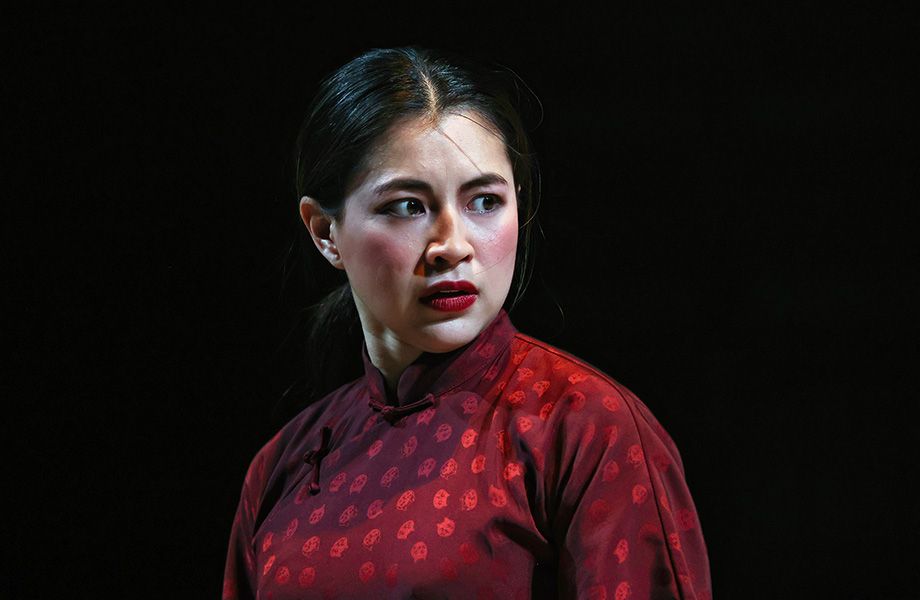
- Article Hero Image Caption: Kimie Tsukakoshi in The Poison of Polygamy (photograph by Prudence Upton).
- Alt Tag (Article Hero Image): Kimie Tsukakoshi in The Poison of Polygamy (photograph by Prudence Upton).
- Production Company: La Boite and Sydney Theatre Company
Wong (c.1875–1948) was a fervent Christian evangelist, and his work represents only one example of the hectoring and frequently bigoted reform fiction that proliferated in the late Qing. Chinese Christians, along with other intellectuals, sought to reshape the nation in the wake of repeated military humiliations, as well as the influx of science, technology, and ideology from abroad. All but ignored by its contemporaries, the text’s importance lies above all in its status as the earliest work of extended Sinophone fiction published in Australia. The credit for its present prominence belongs to Melbourne-based translator Ely Finch and the academics who provided the paratexts for a 2019 bilingual edition. For Australian purposes, the text has its limitations, being neither very forthcoming nor very reliable about Australian conditions, with half of it taking place in a Cantonese village. Unlike ‘coolie fiction’ such as Bitter Society (1905), written as a warning to Chinese not to embark for the United States, and explicit about the origins of mistreatment in Western contempt for Asians, Poison is, as a novel, neither very conscious of racism nor critical of imperialism. For Wong, if Chinese people have a terrible time overseas, it is because of Manchu perfidy or their own un-Christian ways.
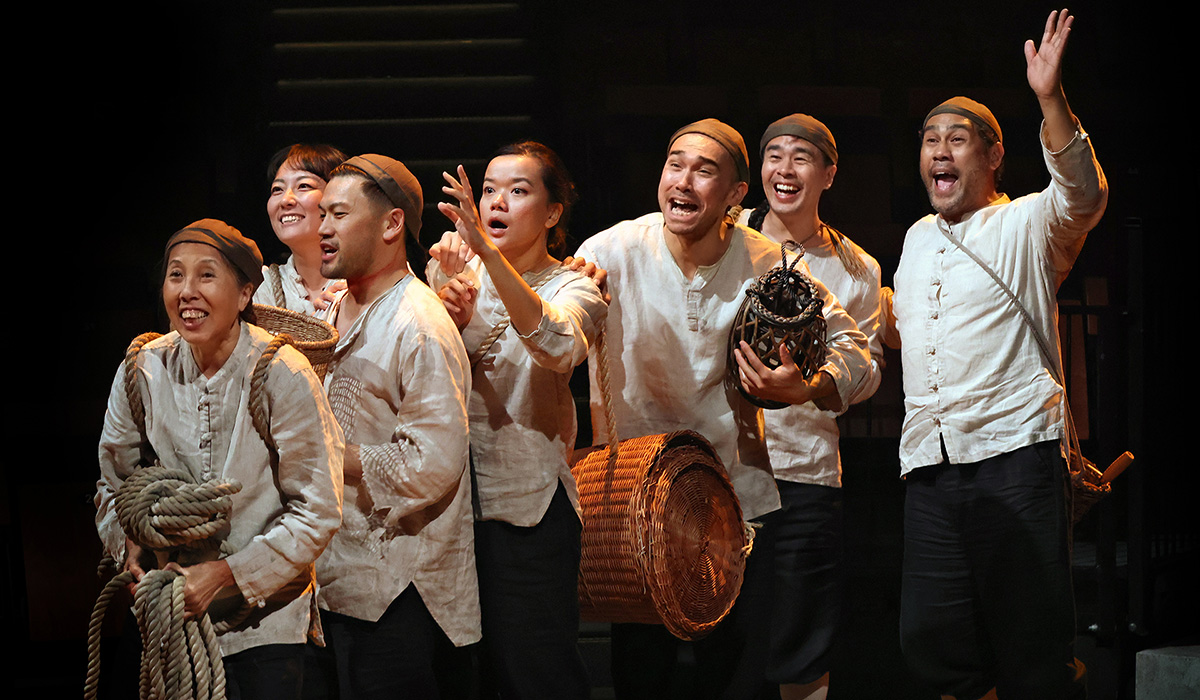 The Poison of Polygamy (photograph by Prudence Upton).
Not so, unsurprisingly, in the new dramatic adaptation by Felicia Anchuli King. King injects coherence, humour, and interest by splitting the meandering plot into short scenes, consolidating characters and episodes, and, most drastically, by providing a framing narrative: we are addressed from purgatory by the bible-bashing Preacher, who, as didactic narrator, stands in for Wong as author. Preacher buttonholes the audience, confronting us with our mores and juxtaposing the story with the complacent present. His braggadocio is unsteadied in the second half by the irruptions of the concubine’s ghost, who has her own story to tell. Historical context, a little shakily handled by Wong (who was writing half a century after the period he describes) is also fleshed out to help construct the desired image of colonial Australia, for instance by signposting the story with reference to the Lambing Flat riots and the Boxer Rebellion. (This rather sexes up the author biography, since Preacher is fleeing civil war instead of, like Wong, looking after family business affairs in Australia.) The supernatural milieu of the framing also allows for theatrical frissons of the eery, gory, and portentous varieties.
Changes are far more than cosmetic: thus, Wong’s bugbear of polygamy is transformed alchemically into a panoply of attackable present ills including ecological exploitation and cultural tunnel vision, while the ending’s Gordian bloodbath is reread and all but justified as feminist rage. Needless to say, Chinese dramatists have been recovering legendary or historical adulteresses and female assassins in this way for many decades, but the strategy’s success is undermined in Poison by the necessity of accepting the concubine as a victim, when on stage she has been, without exception, domineering. Whether by its confrontational addresses to the audience or through its profound commitment to anachronism – verbal, ideological, behavioural – the play becomes more a critique of the novel’s ethical agenda than an adaptation of it. The didactic thrust is the present progressivism, but the plot was structured to hammer home Christian morality in 1910. As in other areas of Australian thought, reconciliation is here an ambition rather than a reality.
The co-production by La Boite and Sydney Theatre Company furnishes a spirited realisation, a kind of energetic yarn that feels shorter than the show’s three hours, with credit due to director Courtney Stewart’s seamless pacing. As in traditional Chinese theatre, the stage is mostly bare; costumes are effectively allusive, and key props create colour and focal points. Actors roll red columns about, capably forming homes, boats, or mines, and rapid pace and slick physical sequences keep the story ticking along. Shan-Ree Tan, doubling the roles of the antiheroic Sleep-Sick and the bible-bashing Preacher, scowls and leers persuasively. Merlynn Tong is suitably piteous, if a little under-used, in the role of the virtuous, abandoned wife, while Kimie Tsukakoshi, as the concubine, has a rare old time melding pulp fiction vamp with vengeful proto-feminist. The admonition tale at the heart of the plot is softened by humour and topical nudges, but limited character development makes empathy hard.
The result is theatre about the need for multicultural theatre, about the demand for national narrative plurality. Script and production radiate with the consciousness of sex, gender, indigeneity, class, and colour of our own time and purposes, with little interest in conveying historical experience. As such, the production is a distinct improvement and a critical reimagination on the novella’s sermonising, and is rightly being celebrated on the grounds of representation and diversification of the Australian historical imaginary. If we are fortunate, the production’s success will inspire further challenging projects – whether by granting space to the great works of Chinese drama (is anyone reading The Peach Blossom Fan?) or in scouring Australia’s Chinese-language corpus for more buried treasure.
The Poison of Polygamy (La Boite and Sydney Theatre Company) continues at Wharf 1 Theatre, Walsh Bay until 15 July 2023. Performance attended: 10 June.