


- Free Article: No
- Contents Category: Theatre
- Custom Article Title: A Streetcar Named Desire
- Review Article: Yes
- Article Title: A Streetcar Named Desire
- Article Subtitle: Each ‘Ste-ll-a!’ in its rightful place
- Online Only: No
- Custom Highlight Text:
For fans of Tennessee Williams and this most famous of his plays, this production (directed by Alexander Berlage and produced by Redline Productions) is superb! Buy a ticket now, for the shoebox theatre of the ‘Old Fitz’ can seat only fifty-five people and, like the candles of a Tennessee Williams imaginary, this show will burn brightly, but only for a short time.
- Article Hero Image (920px wide):

- Article Hero Image Caption: Photograph by Phil Erbacher.
- Alt Tag (Article Hero Image): Photograph by Phil Erbacher.
- Production Company: Redline Productions
Blanche is delusional when she persists in playing the self-dramatising role of a coquettish Southern Belle, spurred on by a series of devastating emotional blows (we learn throughout) that have sent her spiralling into a state of psychological disintegration; running from a licentious past while clutching at things imaginary for stability. Yet while Stella slips into a dutiful role of support for her sister’s whims, her intensely physical husband, Stanley (O’Toole is impressively buffed for the role), shows only contempt for Blanche’s pretensions and anyone else unwilling to place their cards on the table. Add to the mix the recriminations of a lost inheritance, and this engrossing kitchen-sink drama plays on steadily towards its inimical and devastating end.
When I took my seat, I thought I could smell other people’s deodorant, but it was probably the scent of the fake smoke machine (used often for the ‘shower room’ off stage and to convey the humidity of the sweltering Deep South). But this is the joy of a compact theatre: you can smell the smoke machine and you can almost feel the heat radiating off the actors’ skin when they sit next to you on the stairs to deliver their lines. I enjoyed this Streetcar so much more than the Sydney Theatre Company’s Streetcar in 2009 (with Joel Edgerton and Cate Blanchett) because of this intimacy, which can’t be delivered on a bigger stage. We were right there in the cramped apartment, and the actors needed to walk behind us when they exited.
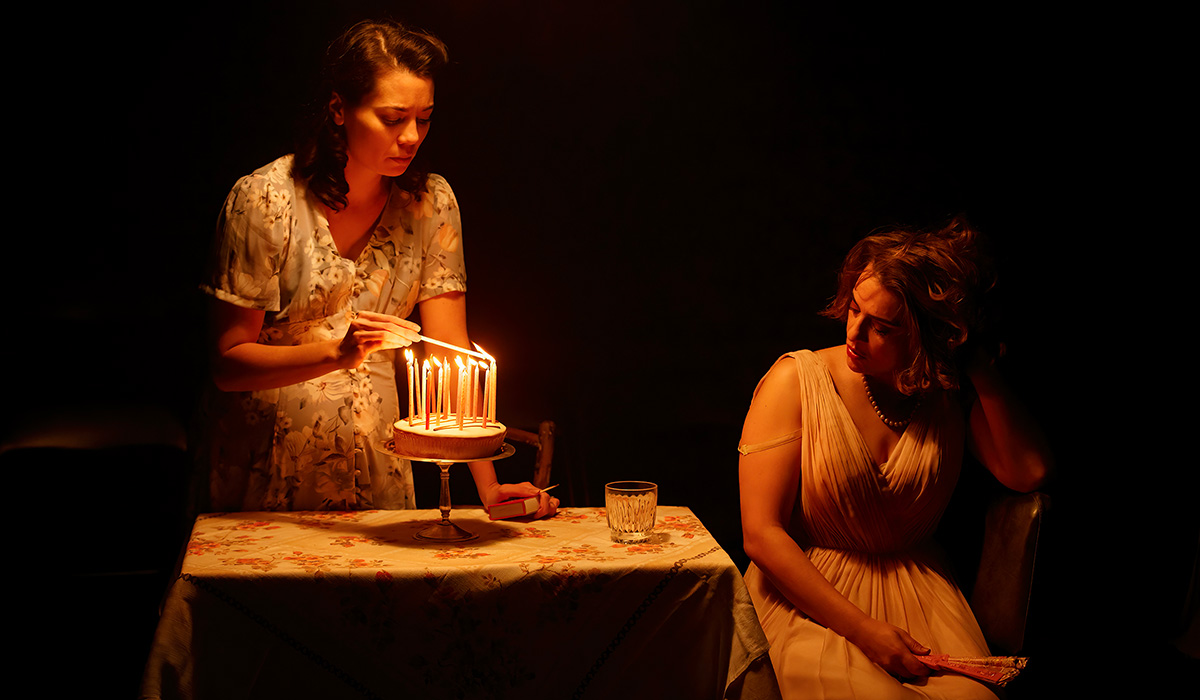 Blanche DuBois (Sheridan Harbridge) and Stella (Catherine Văn-Davies) in A Streetcar Named Desire (photograph by Phil Erbacher).
Alexander Berlage and his crew (set: Emma White; lighting: Phoebe Pilcher) have made the compact space work to their advantage. The set is made up of plain and rustic furniture with realistic detail and a peachy see-through curtain that can be drawn betwixt the sleeping quarters and kitchenette; an alluring trope of Williams’s sets, where the private is never quite private, making voyeurs of the audience as they watch exchanges both brutal and tender. The production is snazzy, with a range of dynamic effects, such as the music and sound – from the radio, the distant dance hall, and dramatic thematics on black-outs that shake the boards beneath us (sound designer and composer: Zac Saric). There are great lighting effects, including a range of onset glows and crackling white lights that match a character’s internal strain. At one point, an emptied stage snaps to black and pops back alight again in three seconds, revealing seven actors on set going about their business and four men seated around a table playing cards as if they were always there. This is a clever production that knows what it can do and does it well. Instead of feeling restricted by the theatre’s limitations, the show exploits an array of creative choices to deliver production values that belie the modestly priced tickets. Aleisa Jelbart’s costumes were equally well-chosen and restrained, though Stanley’s shoes seem a little too posh for his demeanour.
Because of the intimate staging, I appreciated the complex backstory of the characters (so crucial to the drama) so much more with this production. The three main pairings were orchestrated with the clarity of musical movements – the sisters Stella and Blanche were sweet, fraught, and compromised; the lovers Stella and Stanley were physical, sultry, and connected; and the hostile Blanche and Stanley were predatory, sassy, and abrasive. Sheridan Harbridge was desperately anxious and feeble as Blanche (that’s a compliment), yet so salty and worldly that she drew regular ironic laughs from the audience. Josh Price as Mitch played an excellent languid suitor to Blanche, their fondness creating a suspenseful haven of eleventh-hour comfort from the stalking mendacities of the plot (though the scripted darkness did make it difficult to see them at times). Angela Nica Sullen is exquisite in her warm and sassy role as Stella’s upstairs neighbour and protector, alongside the accomplished Albert Mwangi, who was terrific as one of Stanley’s mates, respectful and neighbourly, but ever fearful of Stanley’s drinking. Yet two moments really stood out.
Stanley’s evocative cries of ‘Stella!’ have become the litmus test or calling card for the role, following Brando’s iconic rendition in the 1951 film, so how can one make this seem fresh? Here, O’Toole absolutely nailed it. His seven iterative cries of ‘Stella!’ rang out coarsely through the intense silence stretched provocatively thin by an eruptive scene of domestic violence. Pregnant with remorse, these punctuating cries require all the actor’s skills: connection, nuance, vulnerability, timing. O’Toole paces the moment well to allow his palpable bellows to thunder through him as if the stage itself were trembling. His symphonic choices afforded each ‘Ste-ll-a!’ its rightful place, each hopeless bellow building wretchedly, rising and sinking in hopeless bouts of sorrow and confusion, raw timbres imbued with shrill emotion. We are surely meant to think (in Williams’s day as much as ours): do not go back, Stella, do not go back to him. But Stella appears in a doorway (her feet by my shoulder), drawn back to Stanley’s pain. Although Blanche’s desire impels this drama, the determination of Stanley and Stella to stay together becomes the play’s expression of love.
Another strong performance comes in the denouement, with Văn-Davies’ unscripted moment of Stella’s remorse. Looking beyond a moment of grief, she clutches at the shocking realisation that she no longer possesses a past that anyone can share with her. It is a tragic realisation, while in her arms she holds the symbolic hopes of new beginnings.
A Streetcar Named Desire (Redline Productions) is playing at the Old Fitz Theatre in Sydney until 1 July 2023. Performance attended: 7 June.