


- Free Article: No
- Contents Category: Music
- Custom Article Title: Australian Chamber Orchestra
- Review Article: Yes
- Article Title: Australian Chamber Orchestra
- Article Subtitle: Ukaria Festival
- Online Only: No
- Custom Highlight Text:
As much as it is a continual delight to hear the Australian Chamber Orchestra (ACO) giving unfailingly wonderful performances in its national touring programs, one is often left yearning to know more about this ensemble’s inner workings and how it creates its magic. For in its artistic director, Richard Tognetti, one might say there is indeed something of the magician, evident both in his own uniquely arresting violin playing and in the way he elicits quite startling results from his fellow musicians.
- Article Hero Image (920px wide):
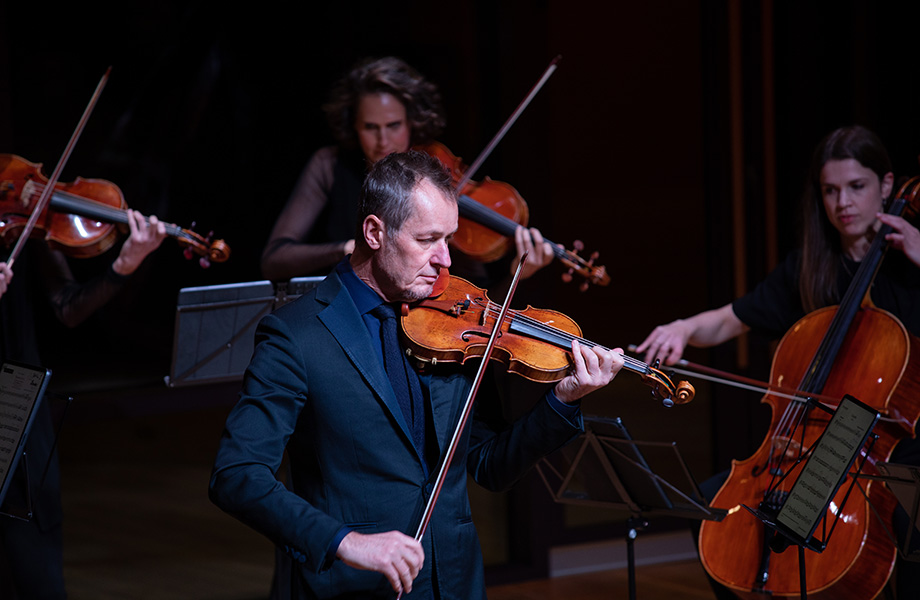
- Article Hero Image Caption: Richard Tognetti and the Australian Chamber Orchestra (photograph by Dylan Henderson).
- Alt Tag (Article Hero Image): Richard Tognetti and the Australian Chamber Orchestra (photograph by Dylan Henderson).
- Production Company: Australian Chamber Orchestra
On paper, it was a strangely disconnected assortment of pieces. Surely for the first time, John Williams and the seventeenth-century composer Tarquinio Merula were paired in a concert. Golijov followed Bach, Franz Waxman abutted Mozart, and Rameau glided into Debussy. Being the clever conjurer that he is, Tognetti seems to always find unexpected, illuminating connections that make sense only when you hear the results.
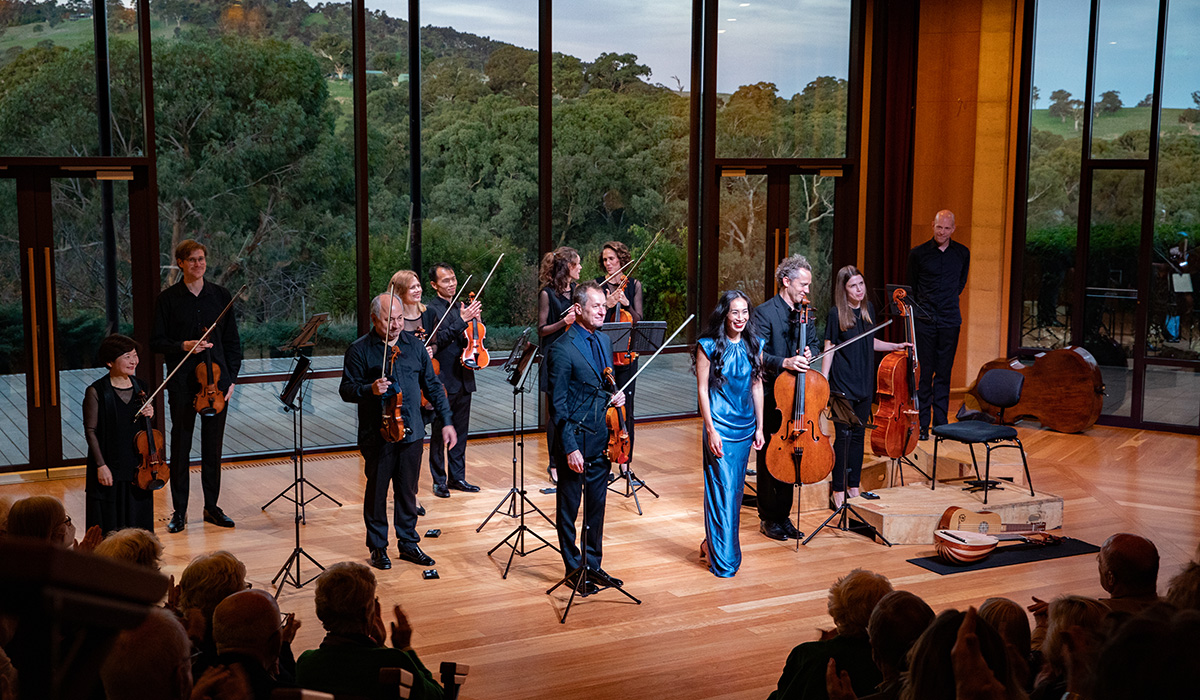 Richard Tognetti, Cathy-Di Zhang and the Australian Chamber Orchestra (photograph by Dylan Henderson).
The first of the three concerts, ‘Wanderers of the Night’, stretched matters to the hilt when the gothic melody of Williams’s ‘Blood Moon’, from his soundtrack to Robert Altmann’s psychological horror movie Images (1972), segued into Merula’s sacred canzonet, ‘Hor ch’è tempo di dormire’. How telling was this juxtaposition. The music’s icy tension only escalated in the latter’s pain-inflected lullaby melody, sung outstandingly by soprano Cathy-Di Zhang over a bass ostinato of two repeated notes a semitone apart. The words (unfortunately not supplied in the program) tell of the ultimate doom that will befall the baby Jesus; and it was as if Altmann’s nightmarish hallucinations were being magnified by this extraordinary piece from 1638.
The wonder was that cellist Julian Thompson could put down his usual instrument and instead play theorbo. Bravo to Thompson for his versatility and willingness to take on an additional challenge. Indeed, a feature of this festival was how various members of the ACO took to the spotlight – more about that anon.
A word also about Di Zhang, an Opera Australian artist. She is an intensely expressive, accomplished performer who is able to meet Tognetti and the ACO on their level. She was at home in this more contained early Baroque style of Merula and Juan Arañes’s infectiously rhythmic ‘Chacona: a la vida bona’, as she was in Golijov’s sumptuous ‘Lúa Descolorida’ and Richard Strauss’s even riper ‘Morgen’.
Ukaria’s 220-seat auditorium, designed by Anton Johnson and now nearing eight years old, looks out through large picture windows to a beautiful bushland setting with the gently rising Mount Barker Summit. During J.S. Bach’s Goldberg Variations (arranged by Bernard Labadie), the last golden rays of the sun combined as if by miracle with some of the tenderest, most highly crafted playing from Tognetti and his band. In many ways, they are comparable with Bach: tidy and stylish as the best period instrument orchestras, but unfettered and natural in expression as well.
Acoustically, the hall puts a lens right up to the performer, so that the listener is able to hear, warts and all, every whisker of bow on string. The marvel was how precisely these eleven musicians play together. Their thinking is so alike, their sound so well forged, that it really is like hearing a single instrument. On his imposing Gasparo da Salò double bass, Maxime Bibeau can be singled out for praise: the ACO violins set a phenomenal pace for speed and agility, but Bibeau keeps right up with them, in apparent defiance of all the laws of physics.
Offering greatest interest over the weekend, though, was Tognetti’s fastidiousness in directing the ensemble – often using minute eye contact to not only hold them together but also to harness their spirit.
At least as impressive was the wide expressive vocabulary of Tognetti’s own playing. As the soloist in Mozart’s Violin Concerto No.5 in A, he was characteristically mercurial and inventive, using a variety of techniques that felt spontaneous and well judged. Some notes were cleanly flat while others were rich imbued with vibrato. Hallmarks of his playing are his variety of bow speed (far exceeding that of most other violinists) plus an ability to tuck away rapid passages of notes with infinitesimally delicate precision. This concerto was a pure joy in his hands.
By way of total contrast, an early work by Pavel Haas – his String Quartet No. 2, ‘From the Monkey Mountains’ (in Tognetti’s arrangement) – offered an insight into the profoundly introspective mind of this Czech composer, who died in the gas chambers of Theresienstadt in 1944. Each of its four movements is founded on his response to scenic vistas in his homeland’s Vysočina region (from which the work gains its name). Lonely and forbidding, it received an intensely gritty performance.
A great delight was to witness other members of the group stepping forward to take solos. Violist Stefanie Farrands and violinists Ike See and Satu Vänskä were outstanding in arrangements of Georges Boulanger and César Franck, each bringing their own personalities to bear. One could see in these performances that the ACO is made up of musicians who are in their own right top-flight soloists.
There were a couple of mishaps. A sparrow fluttered in at one point, prompting one of the players to leave his spot and try to usher the poor, confused creature outside. The top string of Ilya Isakovich’s violin snapped during the third concert’s more vigorous playing, forcing him to exit the stage for repairs. A few comic theatrics made light of both incidents and reminded us that these remarkable players are only human after all.
This was only the second time the ACO have performed at Ukaria, but it was enough to deepen one’s respect for this élite ensemble.
The Australian Chamber Orchestra performed at the Ukaria Festival on 3-4 June 2023.