


- Free Article: No
- Contents Category: Film
- Custom Article Title: John Farnham: Finding the voice
- Review Article: Yes
- Article Title: John Farnham: Finding the voice
- Article Subtitle: Beyond ‘Sadie the Cleaning Lady’
- Online Only: No
- Custom Highlight Text:
John Farnham nearly missed the launch party for his most successful album, Whispering Jack (1986) – he was stuck on a couch in a foetal position. He was under immense pressure. His three-year stint as lead singer of Little River Band (LRB) had left him saddled with some of LRB existing debt. Whispering Jack was clearly his last chance to show the world the kind of artist he thought he could be.
- Article Hero Image (920px wide):
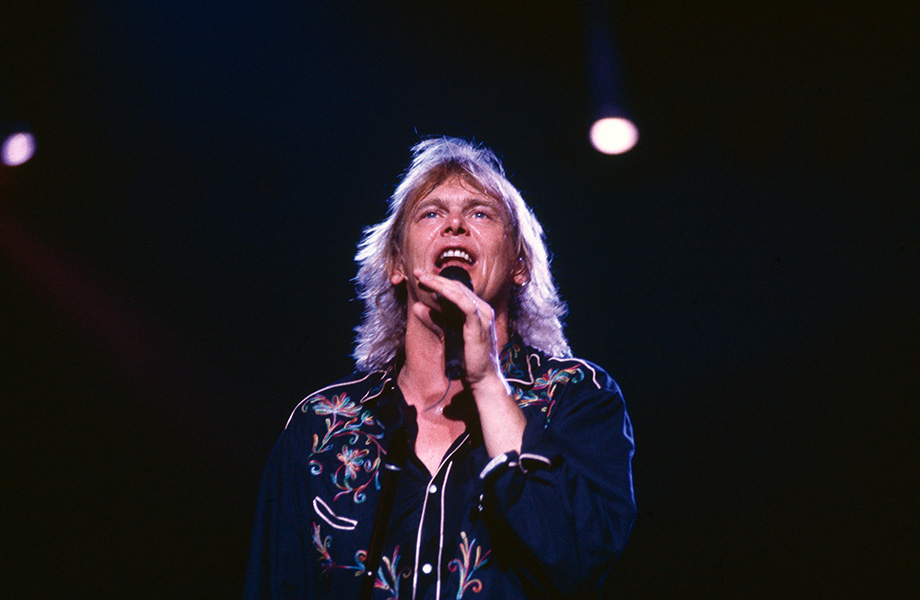
- Article Hero Image Caption: John Farnham at the Chain Reaction concert, 1990 (copyright Serge Thomann).
- Alt Tag (Article Hero Image): John Farnham at the Chain Reaction concert, 1990 (copyright Serge Thomann).
- Production Company: Beyond Oz
It all worked out for the best, of course. Whispering Jack, which featured the much-loved anthem ‘You’re the Voice’, remains the highest-selling Australian album to date. The choice this young English migrant had made back in the mid-1960s – to abandon a plumbing apprenticeship in favour of singing – now seemed vindicated.
This story, and that of Farnham’s life and work, is not new, but it is fashioned superbly in Poppy Stockell’s new documentary film, Finding the Voice. Told poorly, it could have been a neoliberal fantasy fest, where the heroic celebrity individual, a self-made man, overcomes adversity through initiative and hard work. The Farnham we see in this documentary is no such caricature; here was someone prepared to expend every bit of energy and to exhaust his reservoir of mental well-being, not with a view to restoring his erstwhile fame, but with the dream of producing an album that was true to himself. It is a story of resilience that has spoken to multiple generations of Australians, present company included.
As a documentary film, Finding the Voice has a lot going for it. The rich and extensive archival footage sustains the narrative. There are compelling new interviews, but given the age and health complications of many of the participants (Glenn Wheatley and Olivia Newton-John died before the film was completed), some of the testimonies are aural only. Celebrities local and global – Jimmy Barnes, Daryl Braithwaite, Celine Dion, and Robbie Williams, among others – appear for on-screen elegies, but these are used sparingly and tastefully. The result is that rare thing: a documentary not dominated by talking heads in darkened rooms. And of course, the soundtrack virtually selects itself.
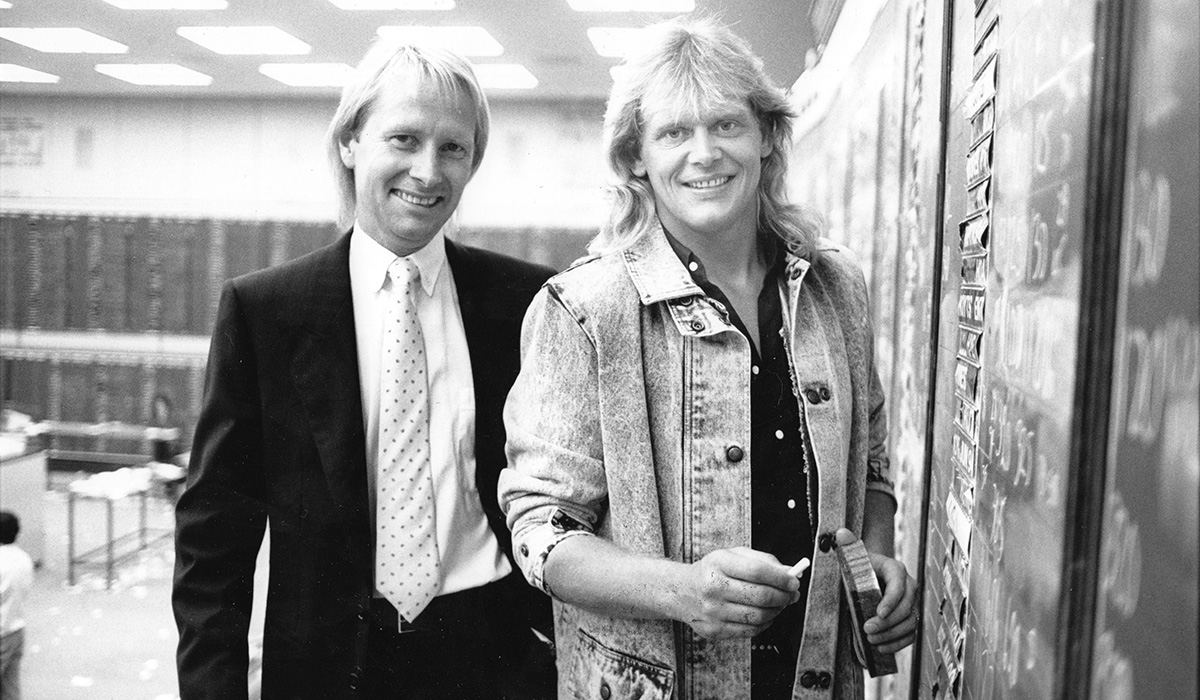 Glenn Wheatley and John Farnham at the Stock Exchange (copyright Gaynor Wheatley).
It is not, however, a biopic lacking in tension and emotion. No doubt drawing on music journalist Jane Gazzo’s book John Farnham: The Untold Story (2015), the film excavates the restrictive influence of the singer’s first manager, Daryl Sambell, and the cloying effect of the novelty tune ‘Sadie (The Cleaning Lady)’ (his first radio hit) on the next two decades of Farnham’s career. One supervisory tyranny is supplanted with another in the person of Graeham Goble, founding member of Little River Band and collaborator on Farnham’s 1980 album, Uncovered. The enduring image of Farnham’s years with LRB is that of a frustrated singer whose bandmates taped his microphone to its stand in an effort to contain his stage presence. Glenn Wheatley figures more as ‘brother’ to Farnham than as manager, but the story of Wheatley’s stint in jail for tax evasion is not elided here either.
When the film addresses the recently departed Wheatley and Newton-John, and traverses Farnham’s own battle with cancer, the audience is invited to participate in something like a wake rather than a triumphal celebration of several intersecting careers. Like any good biography, the life is anchored in the tenor of the times. For all his youthful successes (think ‘Sadie [The Cleaning Lady]’, ‘Raindrops Keep Falling on my Head’, and five King of Pop awards), we see in the 1970s a novelty performer left behind by the cutting-edge sounds of punk rock and protests generated by the Vietnam War.
In the era of Redgum, Midnight Oil, and Cold Chisel, Farnham’s music could sometimes seem politically non-committal (he wore his progressivism lightly). But this documentary locates his biggest hit, ‘You’re the Voice’, in an explicit Cold War context. The song was written by participants in the American anti-nuclear activism of the 1980s. There is brilliant archival of Farnham performing the song in West Berlin in 1987, the infamous wall still standing not too far away. ‘You’re the Voice’ became an anthem for democracy, so much so that the Australian Electoral Commission would eventually use it in television advertisements ahead of the 2001 federal election.
Depicting a life and career of this length in a ninety-minute feature required much excision, but there was more to be said about the final phase of Farnham’s career (assuming that it is, given his age and declining health, nearly over). At times, he has been fêted as a neutral or archetypal Australian. In 1988, Australia’s Bicentenary year, he was even awarded Australian of the Year after a hasty naturalisation ceremony.
All too often, Farnham and his music have been weaponised in the Australian public sphere for distinctly conservative ends. In 2005, the Australian government asked him to perform at the ninetieth anniversary of Anzac in a ceremony at Gallipoli, though Prime Ministers John Howard and Helen Clark ultimately vetoed the proposal. In 2017, as Australians voted in a postal survey on the legalisation of same-sex marriage, both Pauline Hanson and Tony Abbott suggested that Farnham ought to be asked to perform at the NRL Grand Final instead of American rapper Macklemore, whose ‘Same Love’ drew the ire of ‘No’ campaigners. Finding the Voice could have been an opportunity to recontextualise Farnham’s catalogue in the divisive politics of the twenty-first century.
Finding the Voice does, however, gesture to the generosity of this performer. Over the years, Farnham put his public appeal to civic use with fundraisers and appeals such as the ‘Concert for Rwanda’ (1994), a special performance for Australian service personnel in Dili (1999), several drought relief appeals, and Celeste Barber’s lucrative if ill-conceived ‘Firefight Australia’ concert in February 2020. Public disclosure of his struggle against depression in the mid-1980s was, in a sense, an act of generosity too. The footage of him performing ‘You’re the Voice’ with Gamilaraay man Mitch Tambo reflects some of Farnham’s progressive sensibilities. As Australians prepare to vote on the referendum for a Voice to Parliament later this year, perhaps those not already swayed by the generosity of the Uluru Statement itself might at least take heed of the generosity shown by an earlier Voice.
John Farnham: Finding the voice (Beyond Oz) was released in cinemas on 18 May 2023.