


- Free Article: No
- Contents Category: Music
- Custom Article Title: Melbourne Jazz Co-Operative
- Review Article: Yes
- Article Title: Melbourne Jazz Co-Operative
- Article Subtitle: A fortieth-birthday celebration
- Online Only: No
- Custom Highlight Text:
It is hard to believe that an organisation founded forty years ago could still be flourishing today under the helm of its original founder. When current creative director Martin Jackson, in 1982, conceived the idea of a co-operative aimed at fostering the development of jazz and improvised music in Melbourne, I doubt he could have foreseen where it might lead. But here we are, four decades on, part of a full house at the Melbourne Recital Centre, here to celebrate the numerous achievements of the Melbourne Jazz Co-operative (MJC).
- Article Hero Image (920px wide):
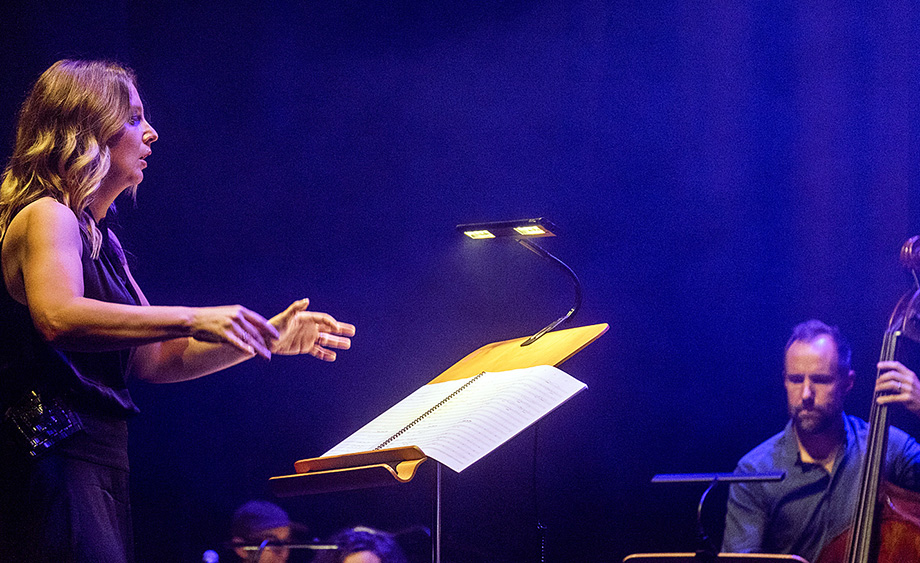
- Article Hero Image Caption: Vanessa Perica and Sam Anning, part of the Melbourne Jazz Co-Operative concert (photograph courtesy of Roger Mitchell).
- Alt Tag (Article Hero Image): Vanessa Perica and Sam Anning, part of the Melbourne Jazz Co-Operative concert (photograph courtesy of Roger Mitchell).
- Production Company: Melbourne Jazz Co-Operative
From the outset, the Co-op’s primary mission was to organise contemporary jazz concerts, ensuring that both established musicians and up-and-coming ones were given the opportunity to present new music to the public. In all that time, MJC has stayed true to this founding vision, hosting weekly and biweekly performances at a variety of venues, including the Limerick Arms, the long-running city venue Bennett’s Lane, Uptown Jazz Café in Fitzroy, and, more recently, at Michael Tortoni’s Jazzlab in Brunswick. Importantly, thanks to modest government grants, MJC was able to guarantee that performances were well advertised and that musicians were paid a professional fee.
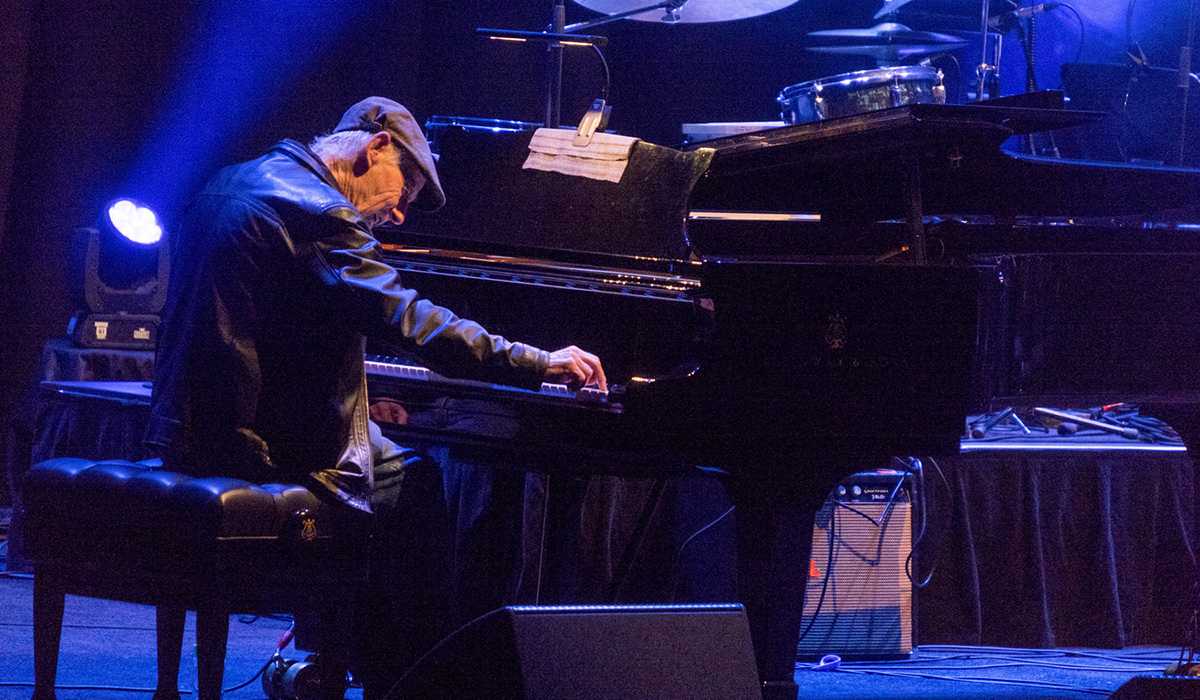 Mike Nock, part of the Melbourne Jazz Co-Operative concert (photograph courtesy of Roger Mitchell).
It is fitting that Paul Grabowsky, who performed the very first MJC concert in January 1983, was invited to perform as part of this fortieth-anniversary concert. His attendance, along with participants such as Mike Nock and Sandy Evans, both of whom have long associations with MJC, provided strong links to the Co-op’s history. The concert was structured in two distinct halves, the first presenting a series of duo and trio performances, each lasting around twenty minutes, highlighting the tight interplay and close listening characteristic of small group interactions.
Pianist Mike Nock, demonstrating his consummate artistry, performed with saxophonist Julien Wilson and guitarist Stephen Magnusson. From his opening notes, Nock unfurled a series of melodic figures – sparse, delicate, and lilting – that seemed to invite responses from his fellow players. His right hand roamed the upper register, striking each key in precise fashion, as if carefully assembling the building blocks of a narrative. Magnusson inserted himself into the intervals and spaces, his minimalist and pointillistic approach rich in colour and texture. Wilson edged in gradually, fashioning a swelling tide of sound, his saxophone recalling the sweet tones of Ben Webster one moment, the heated tenor of David Murray the next. Playing a single unbroken improvisation, the trio’s performance unfolded organically, brimming with nuance and small dramas.
Listening to saxophonist Sandy Evans and pianist Andrea Keller was like eavesdropping on an intimate conversation. Keller, an intensely lyrical player, has a ravishing tone, her music informed as much by the classical canon as jazz. Evans, meanwhile, demonstrated a facility for sustained flights, her lines twisting and turning, even as she adhered closely to Keller’s melodic lines. The result was mesmerising, near-telepathic, as the pair daringly improvised on a set of composed themes.
Barney McAll’s Non-Compliance Trio, featuring Sam Anning on bass and Felix Bloxsom on drums, stayed true to its name, refusing to be boxed into a singular style. Playing thick, chunky chords full of rumbling bass notes, McAll delivered a brief, energetic set, wilfully rough around the edges, steeped in funk, gospel, and blues.
The final small-group performance featured Torrio!, a trio comprising pianist Paul Grabowsky, saxophonist Mirko Guerrini, and drummer Niko Schäuble. Tapping into their shared European roots, invariably inspired by German folk melodies or the film scores of Nino Rota, these resolutely powerful players revelled in dramatic stridency and off-kilter melodies. The trio’s signature tune, ‘2nd Exit’, was a standout, mashing romantic flourishes, staccato beats, and bluesy wails, before escalating the mix into an uninhibited free-for-all.
The second half of the concert saw the première of an hour-long suite, ‘Jumping Yaks’, co-written by Niko Schäuble, Erkki Veltheim, Erik Griswold, and Eugene Ball. Taking its title from Sir Thomas Beecham’s famous quip – that Beethoven’s Seventh Symphony sounded like ‘a lot of yaks jumping around’ – the suite has endured a prolonged gestation, having originally been commissioned, but never performed, by Paul Grabowsky for the Australian Art Orchestra in 2013.
The eighteen-member ensemble brought together to perform ‘Jumping Yaks’ represents a who’s who of contemporary Australian jazz, surely an inestimable testament to the role MJC has played in so many careers. There being far too many to list individually, suffice to say it incorporated: James Macaulay, Ashley Ballat, Adrian Sherriff, Julien Wilson, Scott McConnachie, Fran Swinn, Sam Anning, Sandy Evans, Mirko Guerrini, Paul Grabowsky, and Vanessa Tomlinson. The considerable and exceedingly dense score (I can attest my front row seat was close enough to eyeball the mind-boggling scale of it) was conducted with verve and panache by Vanessa Perica, an accomplished composer whose 2020 début album won innumerable plaudits upon its release.
Niko Schäuble’s opening, ‘Movement 1’, demonstrated the way in which modern orchestral jazz – from George Russell to Mariah Schneider – emphasises tonal colouring over the traditional swing of composers like Duke Ellington or Count Basie. His piece swivelled between tightly-herded ensemble passages, pulse-driven underlays, clattering and jarring percussion, and blustering solos. Despite the instrumental arsenal at his disposal, Schäuble’s score routinely broke the ensemble down into smaller constituent units, generating the sort of agility associated with a small group sound. At the same time, when called for, he readily harnessed the ensemble’s full heft for dramatic effect. During these denser sections, Vanessa Tomlinson’s vibes and percussion proved a joy, furnishing a luxuriant backdrop, her resonant notes cavorting through repeated barrages of trumpets, saxophones, and tuba.
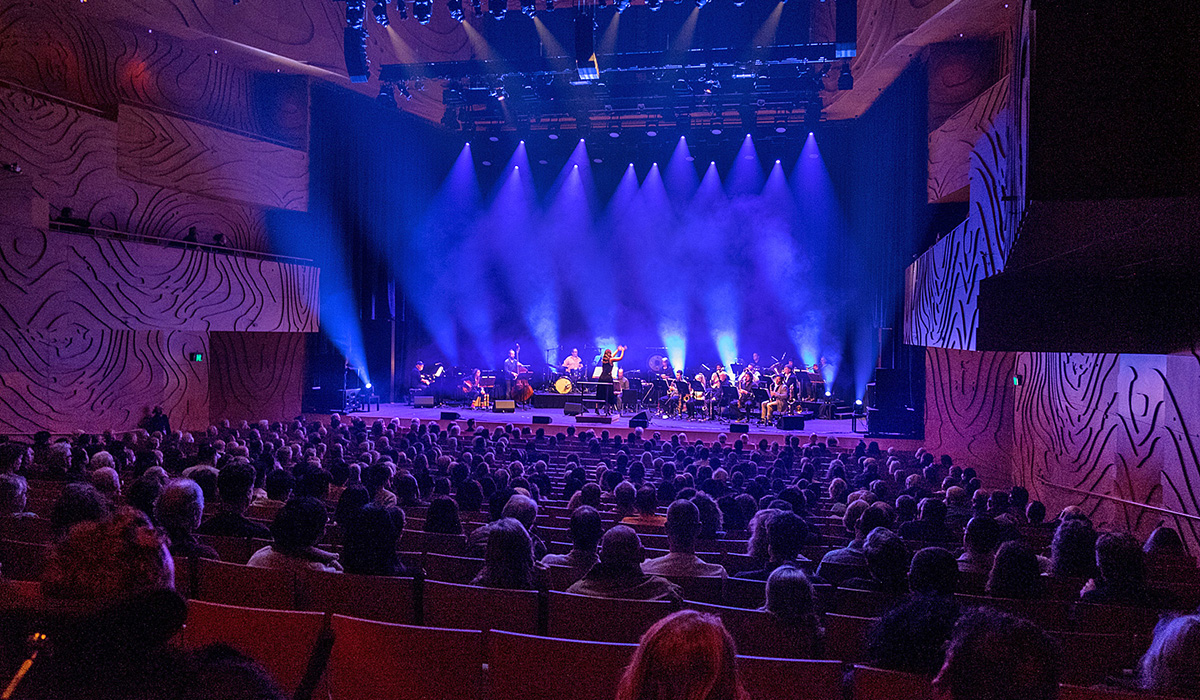 Melbourne Jazz Co-operative concert at the Melbourne Recital Centre (photograph courtesy of Roger Mitchell).
Erkki Veltheim’s ‘Flesheater’, the suite’s second movement, scored for eight musicians and performed sans conductor, appeared intent on testing – I suspect purposely – the listener’s patience. Perhaps this should come as no surprise, when considering the violinist’s stated objective, as printed in the program notes: ‘I thought about how some future culture might (mis)interpret Beethoven’s notation once our traditions become lost to time … I thought about musicians tearing bits off this musical skin until there was nothing left and they had to make their own way through collective improvisation.’ His piece was dense, frenetic, dissonant, dominated by Adrian Sherriff’s gruff bass trombone, Scott McConachie’s piecing saxophone, and the composer’s scratchy violin. It was awash with cacophony, the emphatic sounds of klaxons and horns mimicking urban street life, as if Mondrian’s Boogie Woogie Broadway had been transmuted into sound.
Erick Griswold’s piece ‘Yak Attack’ introduced more a playful element to proceedings. Replete with odd time signatures and galloping choruses, it even threw eccentric interludes of mariachi music into the mix, along with Balkan folk rhythms. Its centrepiece, however, was an extended solo by saxophonist Sandy Evans, which arrived as a radiant interlude, her tone lyrical and heartfelt, filled with emotive depth.
The suite’s final movement was Eugene Ball’s ‘Precipice’, a percussion-heavy piece that saw Niko Schäuble and Vanessa Tomlinson working in tandem to generate a strong rhythmic pulse, boisterous and forceful, that dominated throughout. Tomlinson’s busy and nimble intrusions, performed on an array of percussive instruments, served to bind this sprawling music together, providing a constant forward momentum. Ball acknowledges that he conceived his response to Beethoven’s final movement as a form of ‘plummeting earthward’, and his work was aptly characterised by an unconstrained, spiralling energy.
The evening provided a lot of music – arguably too much – to digest. But when it comes to marking forty years of a small, independent, not-for-profit arts co-operative, whose survival was never a given, then perhaps excess is called for. Certainly, MJC had much to celebrate, not least of which is the three-thousand-plus performances thus far programmed, and the establishment of the Melbourne Women’s Jazz Festival in 1997, an annual event that has played a pivotal role in countering gender inequity in Australian jazz. Across its four-decade-long commitment to live jazz in Melbourne, MJC has helped foster a seismic shift in jazz and improvised music in this country, which today ranks with the best anywhere.
While Creative Victoria provided support for this anniversary event, the harsh reality is that, in 2023, MJC, for the first time since its inception, finds itself entirely without Victorian or federal government support. If we compare the situation to the equivalent body in Sydney, the Sydney Improvised Music Association (SIMA) – founded several years after MJC and modelled on it – the disparity is pronounced, with SIMA sourcing some sixty per cent of its half-million-dollar funding revenue from government sources. One can only hope that Victorian and federal bodies see fit to rectify this anomaly in the next round of funding. If not, a coming generation of jazz and improvising musicians, particularly young female and gender-diverse performers, are the likely ones to brook the consequences.
Melbourne Jazz Co-Operative’s 40th Anniversary Celebration was performed at the Melbourne Recital Centre on 26 May 2023.