


- Free Article: No
- Contents Category: Art
- Custom Article Title: Pre-Raphaelites: Drawings & Watercolours
- Review Article: Yes
- Article Title: Pre-Raphaelites: Drawings & Watercolours
- Article Subtitle: A luminous exhibition from the Ashmolean
- Online Only: No
- Custom Highlight Text: ABR Arts headed to the Art Gallery of Ballarat for two related exhibitions: Pre-Raphaelites: Drawings & Watercolours, from the Ashmolean Museum, Oxford, and In the company of Morris, an exhibition drawn mostly from the Ballarat gallery’s own collection.
- Article Hero Image (920px wide):
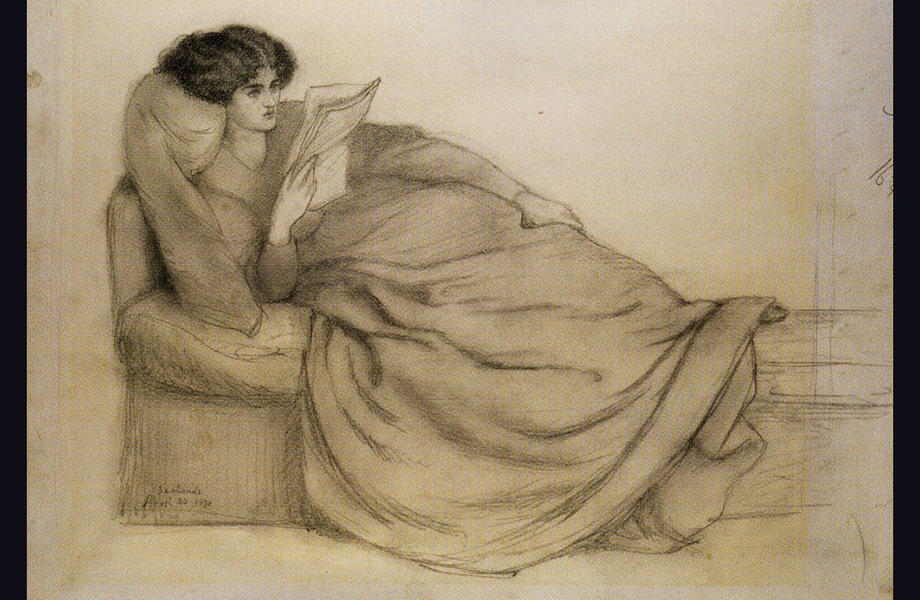
- Article Hero Image Caption: Dante Gabriel Rossetti, Jane Morris,1870 (courtesy of Ashmolean Museum).
- Alt Tag (Article Hero Image): Dante Gabriel Rossetti, Jane Morris,1870 (courtesy of Ashmolean Museum).
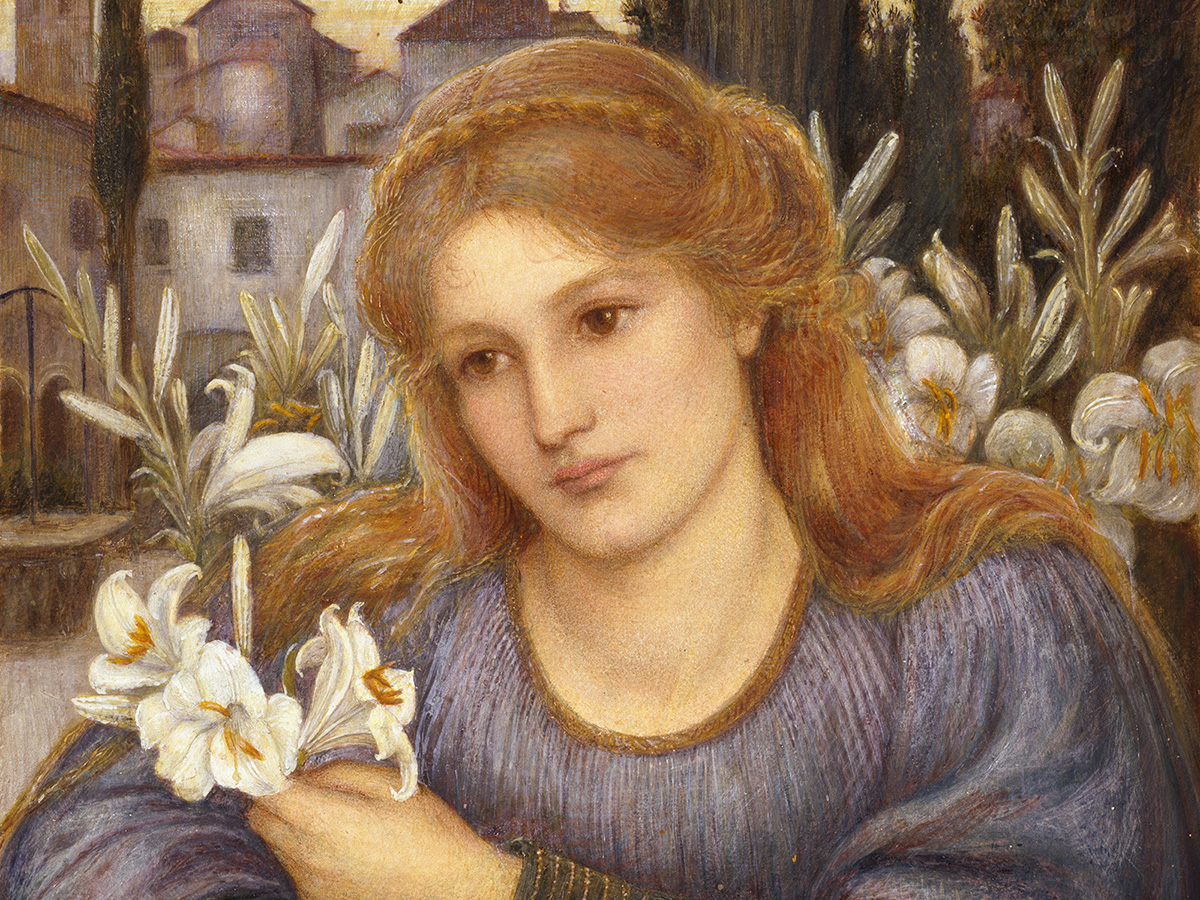 Marie Spartali Stillman, Cloister Lilies, 1891 (courtesy of Ashmolean Museum).
The Pre-Raphaelite Brotherhood was a phrase coined by a group of young artists in London in 1848. The founder members included William Holman Hunt, John Everett Millais, Dante Gabriel Rossetti, and Thomas Woolner. Like younger artists before and ever since, they craved a break from the art of their day, which they saw as artificial and stagey, not at all relevant to the current age. In their quest to find artistic meaning and pictorial truth, they looked to the art of the distant past, before the High Renaissance – that is, before the time of the supreme Renaissance artist, Raphael (hence the coinage pre-Raphaelite). It was one of several European art movements during the nineteenth century – Nazarenes by the German Romantics at the beginning of the century, Impression in France from the 1870s, Secessions in Austria and Germany at the end of the century – that aimed to find new and up-to-date modes of expression in order to make art relevant.
By going back to an imagined and imaginative mediaeval past, artists drew not only on the visual arts of the past but also on literature. Not surprisingly, with advances in printing technology during the nineteenth century, it is a period when book illustrations also flourished. There are several drawings for book illustrations, including a group by Millais for works by the poet laureate, Lord Tennyson, as well as by Arthur Hughes and Rossetti.
In a series of portraits of key artists and notable characters, we see them in delightful informal drawings and sketches, notably Millais, Ford Madox Brown, and John Ruskin. Appropriately, there is a group of Pre-Raphaelite beauties, or ‘stunners’ as Rossetti called them. The most striking of the era was Jane Morris, wife of William Morris. She also had a long-term relationship with Rossetti and is here shown in two of his studies. Both amplify Henry James’s famous description upon meeting Jane Morris:
A figure cut out of a missal – out of one of Rossetti’s … pictures … It’s hard to say whether she’s a grand synthesis of all the pre-Raphaelite pictures ever made – or they a ‘keen analysis’ of her – whether she’s an original or a copy … I didn’t fall in love with Mrs William Morris, the strange, pale, livid, gaunt, silent, and in a manner graceful and picturesque, wife of the poet and paper-maker … though doubtless she too has her merits. She has, for instance, wonderful aesthetic hair.
There are also two lovely portraits of Elizabeth Siddal, herself an artist, and another famed Pre-Raphaelite muse and model, who later married Rossetti.
With the numerous studies for what became finished oil paintings, many of them famous in their own day, including Charles Allston Collins’s Covent Thoughts (1851) and Millais’ The Black Brunswicker (c.1859–60), we can appreciate the artists’ first intentions. What is also thrilling about this exhibition is the large number of works from the very beginning of the movement, the early 1850s. One senses the excitement of artists exploring a new pictorial language. There are studies from 1851 for Holman Hunt’s most celebrated picture, The Light of the World, one version of which toured Australia in 1906 to a sensational response, with an estimated eighty per cent of the population turning out to see it. It caused a craze for Light of the World church windows around the country, including in Ballarat’s Anglican cathedral.
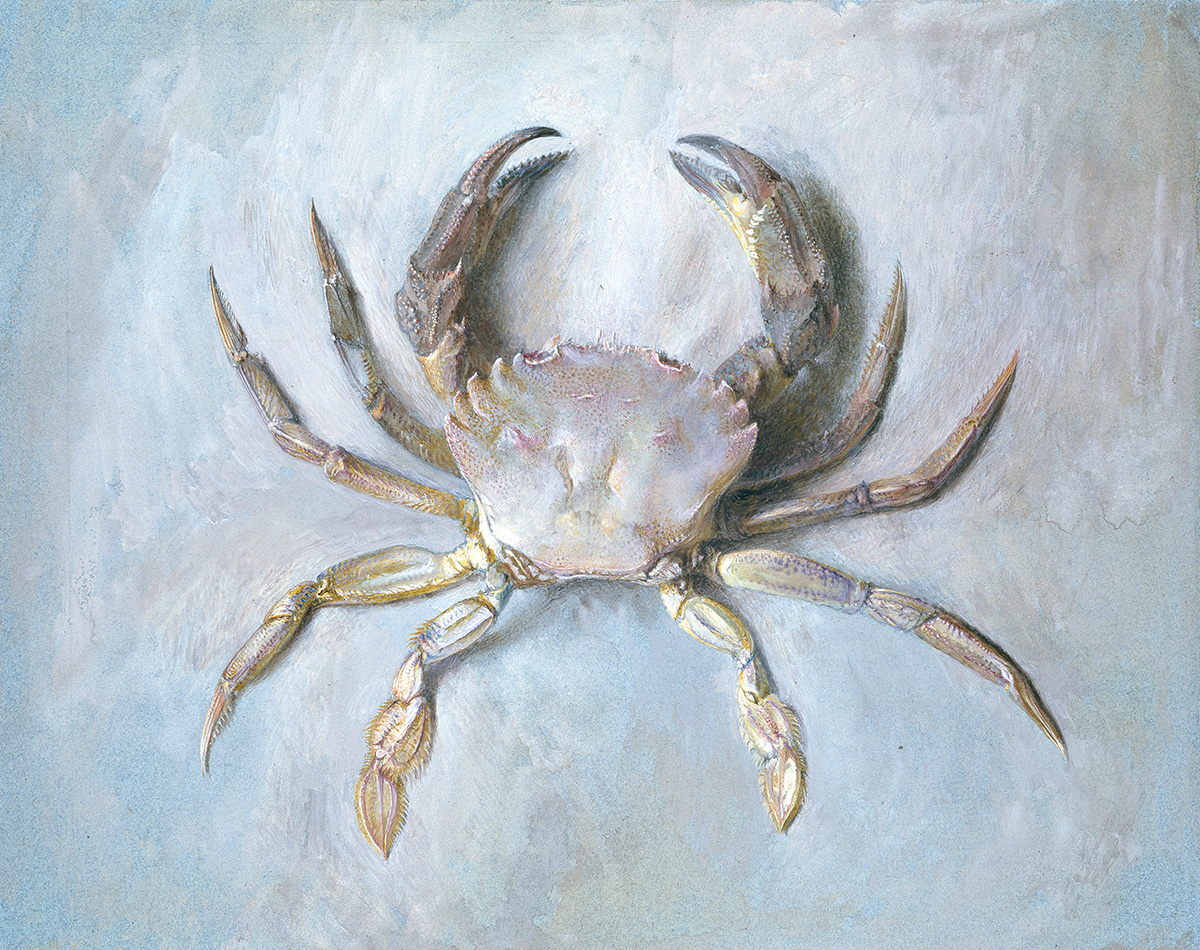 John Ruskin, Study of a Velvet Crab, 1870-71 (courtesy of Ashmolean Museum).
One of the key figures in the show is John Ruskin, represented by a fine group of watercolour nature studies and landscapes – true revelations in the show. Nowadays, Ruskin is better known as being his generation’s most influential writer on art and a champion of J.M.W. Turner, as well as the younger Pre-Raphaelites. The fascination with keen observation of nature by Pre-Raphaelite artists is seen in Ruskin’s work, and in several finely realised landscapes by other artists in both exhibitions.
Against this earnest and morally improving background, there is a delightful caricature sketch by Edward Burne-Jones, entitled May Gaskell and Burne-Jones sitting together, at a table laid with boiled eggs, a kettle and a loaf of bread between them. Burne-Jones is also represented through his stained-glass design work for Morris & Company, as is William Morris himself.
Two of the early members of the pre-Raphaelites Brotherhood, sculptor Thomas Woolner and painter–sculptor Bernhard Smith, came to Australia in 1852, lured by the gold rush. Their departure from England inspired a well-known painting by Ford Madox Brown, The Last of England, represented here by an engraving. Woolner stayed in Australia for nearly two years – enduring six months on the goldfields. Resuming his profession, he obtained commissions for sculptures of Australian notables, which kept him going for decades. Bernhard stayed in Australia and eventually became warden of Victorian goldfields. He visited Ballarat, a tangible Pre-Raphaelite connection.
A few of the Australian state galleries collected work by Pre-Raphaelite artists from the late nineteenth and early twentieth centuries, and have continued to do so. This in turn influenced the training and work of a generation of Australian artists. Morris & Company furnishings made their way to Australia in big quantities from the 1880s. The firm designed stained glass for Australian churches and buildings. A major Pre-Raphaelite art exhibition toured Australia in 1962.
The Ashmolean exhibition forms a perfect foil to In the company of Morris, a crisply curated exhibition of historical and contemporary works that owe a debt – directly or indirectly – to the Pre-Raphaelites and to William Morris. Notable Australian artists who were strongly influenced by the work of William Morris and the Arts and Crafts movement in the first half of the twentieth century – the aesthetics, ideas, and practices – include Christian and Napier Waller, and the Lindsays.
Moving to the contemporary sphere, In the company of Morris presents artists working today who continue the rich decorative traditions celebrated by Morris and the Pre-Raphaelites. The brief is expansive, with a diverse selection of artists, including Emily Floyd (works showing her fascination with utopias), eX de Medici (a richly ornamented etching), Elizabeth Pulie (a work inspired by Owen Jones’s Grammar of Ornament), Glenn Barkley (highly decorative ceramics), and Kate Rohde (elaborate sculptures installed against a wallpaper).
The work used to promote the exhibition, Deborah Klein’s Three women, shows them literally up to their necks in Pre-Raphaelitism. Klein presents rear views (neck and head) of anonymous women sporting fantastically braided examples of pre-Raphaelite hair and tattooed necks à la May Morris embroideries.
There is much to savour in both these fine exhibitions.
Pre-Raphaelites continues at the Art Gallery of Ballarat until 6 August 2023.
This is an expanded version of a talk Christopher Menz gave in opening Pre-Raphaelites on 19 May 2023.