


- Free Article: No
- Contents Category: Opera
- Custom Article Title: Tannhäuser
- Review Article: Yes
- Article Title: Tannhäuser
- Article Subtitle: Richard Wagner’s medieval mash-up
- Online Only: No
- Custom Highlight Text:
Let’s start with the complexities of the opera itself. The trouble with Tannhäuser is that Wagner, always his own worst enemy (but only just), could not leave it alone. Its performance history is more or less bookended by the two distinct versions of the opera: the original 1845 Dresden version; and the Paris one of 1861, commissioned by Emperor Napoleon III. I
- Article Hero Image (920px wide):
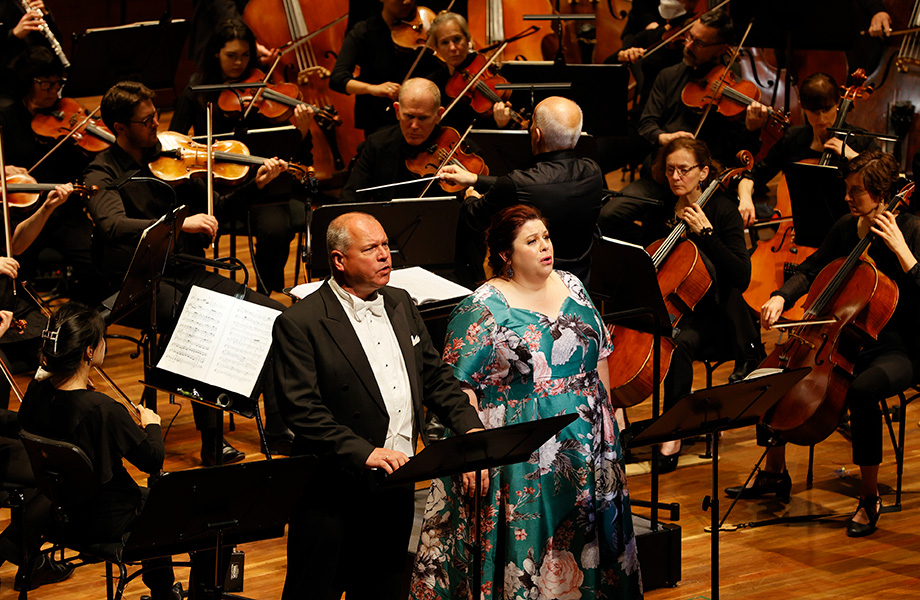
- Article Hero Image Caption: Stefan Vinke as Tannhäuser and Amber Wagner as Elisabeth (photograph by Jeff Busby).
- Alt Tag (Article Hero Image): Stefan Vinke as Tannhäuser and Amber Wagner as Elisabeth (photograph by Jeff Busby).
- Production Company: Opera Australia
The music, however, is a different matter. As we know, Tannhäuser’s Paris Opéra première (an object lesson never to combine ten on-stage hunting hounds with a baying, drunken aristocratic audience) was a notorious cause-célèbre, resulting in the withdrawal of the production after just three performances. Yet, there is no doubting this is by far the preferable version. It certainly received florid endorsement from Wagner’s most ardent Parisian fan, Baudelaire, who was so moved by the performance that he dashed off an eleven-thousand-word review. The poet also wrote to the composer, saying, ‘… I have said to myself constantly, especially at bad hours: If only I could hear a little Wagner tonight!’ (The italics are his).
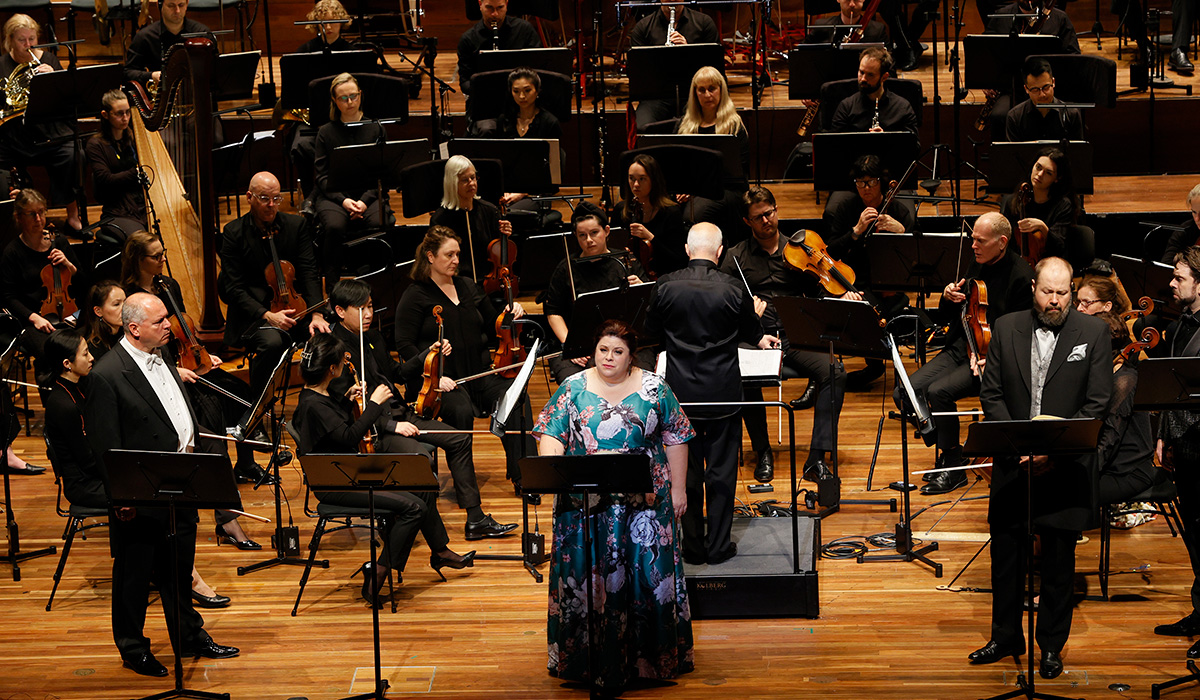 Stefan Vinke as Tannhäuser, Amber Wagner as Elisabeth and Timo Riihonen as Landgraf Hermann (photograph by Jeff Busby).
The ‘little Wagner’ we heard on Wednesday at Hamer Hall was, for the most part, extremely well executed. An augmented Orchestra Victoria, up out of the pit for a change and led by Sulki Yu (lovely violin solos), was indeed heroic at every point. The conductor, Johannes Fritzsch, a relatively late ring-in for an indisposed Asher Fisch, brought steadiness and majesty to the performance, ensured the singers were always discernible (no mean feat in this opera). From the overture, and an admirably restrained Venusberg bacchanal, through to the climactic apotheosis of Act III, Fritzsch’s hallmark was strength through clarity; it never let him down.
The title role is an obstacle course for any tenor, and the German Heldentenor Stefan Vinke, whom one remembers well from the Opera Australia Ring and Meistersinger, had the requisite power to get through the evening. Yet, it must be said, that in deploying unflinching vocal strength, Vinke sometimes bordered on coarseness of tone. He is a strong stage presence, and acted Tannhäuser to convincing ability; but one occasionally longed for some lyricism, some indication of vulnerability and yielding of temperament. Still, he remains a considerable artist, and reached noble heights in his Rome Narration in Act III.
The Venus of Anna-Louise Cole and Elisabeth of Amber Wagner (pron. Waggner, and no relation) were stand-out performances. Cole brought the same full-blooded and fearless attack to Venus as she did to her magnificent Chrysothemis in Victorian Opera’s concert performance of Elektra last year. This augurs well for Cole’s first Brünnhilde in one of the Opera Australia Rings in Brisbane later this year (she will also sing Sieglinde in the first two cycles). Amber Wagner’s splendid Dich, teure Halle! at the start of Act II was truly joyous, almost ecstatic, and would have stopped the show except for the composer’s canny concluding interrupted cadence. Likewise, her Prayer in Act III was all the more moving for its subtlety as well as its power of attack.
The other stand-out was Samuel Dundas, making his Wagner début as Wolfram von Eschenbach – one of the finest best friends in opera. Wolfram, of course, has the trump card of his great aria, O du mein holder Abendstern, and Dundas invested his star-stricken threnody with all the tonal beauty and inner meaning of a Schubert song. But it was often Dundas’s presence that effectively defined his character, sometimes by merely standing there, observing and waiting.
A word, too, for Timo Riihonen’s sonorous Landgraf Hermann, who had gravity in his voice as well as gravitas in his heart.
Smaller roles were well sung by Richard Anderson (Biterolf), Thomas Strong (Walther von der Vogelweider), Iain Henderson (Heinrich der Schreiber), and Alexander Sefton (Reinmar von Zweter). Jane Ede was a fine Shepherd. And let’s not forget the quartet of well-matched Pages: Leah Thomas, Louise Keast, Angela Hogan and Margaret Trubiano.
Choral forces (chorus master, Paul Fitzsimon), so integral to this opera, were placed to maximum antiphonal advantage, with males ranged behind the orchestra and scatterings of females in the choir stalls at either side. Glorious singing, most notably the fade-in, exultate, fade-out Pilgrims’ Chorus.
Although this was billed as a concert performance, a director, Shane Placentino, was credited. If anything, his touches were necessarily light ones, with various awkward entries and exits negotiated betwixt and between the crammed-in orchestra and the phalanx of black music stands for the singers. Any idea of a creative stage picture was restrictive, to say the least. Anyway, since Tannhäuser is basically a static piece and often resembles an oratorio, this concentrated attention on what was being played and sung.
Finally, while talking of stage pictures, I must mention one of the great continuing aesthetic problems with the venue. As Tannhäuser, by papal edict, cannot be properly absolved until his staff sprouts leaves (spoiler: it does, but too late), Hamer Hall cannot be redeemed until something is done about restoring an organ in what was once an organ loft and proper choir stalls. Since the hall’s successful renovations a decade ago, this large and unavoidably obvious space has been tacked over by a bleak assembly of dark-wood panels whose only positive purpose, as I observed on Wednesday, is as an impromptu screen for the subtitles. It’s time for a change. To paraphrase Ronald Reagan on his visit to divided Berlin in the late 1980s: Tear down this Great Wall of Masonite!
Tannhäuser (Opera Australia) will be repeated at Hamer Hall, Arts Centre Melbourne, on 20 May 2023. Performance attended: 17 May.