


- Free Article: No
- Contents Category: Film
- Custom Article Title: Saint Omer
- Review Article: Yes
- Article Title: Saint Omer
- Article Subtitle: Women watching women
- Online Only: No
- Custom Highlight Text: Women look at women in Saint Omer, and they look at each other looking. We look at them looking. In what is almost the opening scene of the film, a writer and academic named Rama (Kayije Kagame) lectures to a class of undergraduates, mostly young women. They are watching footage from the aftermath of World War II: women who slept with German soldiers are loaded onto carts, their heads shorn, and paraded through the streets as collaborators.
- Article Hero Image (920px wide):
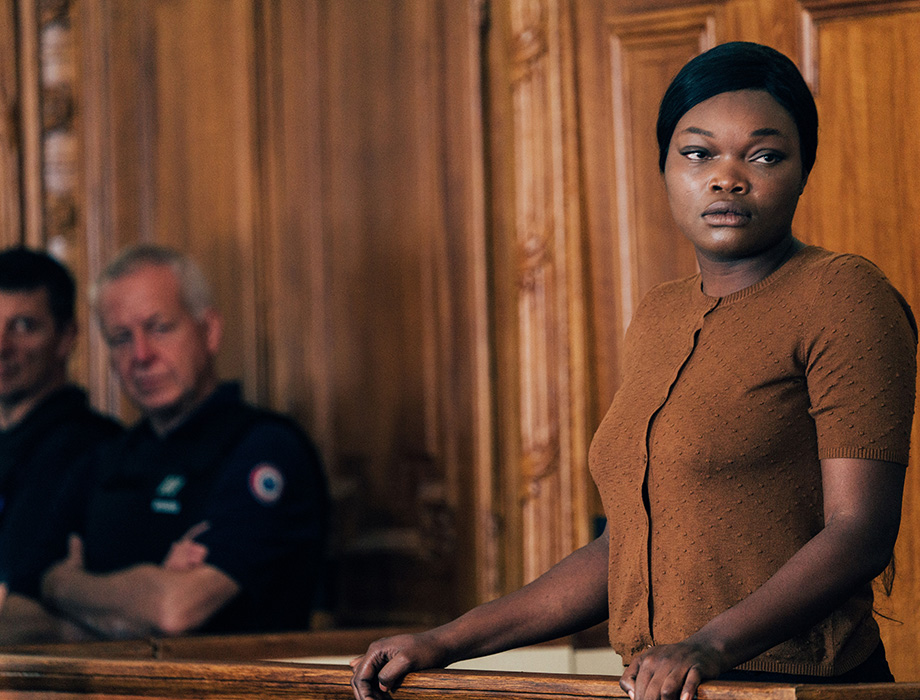
- Article Hero Image Caption: Guslagie Malanda as Laurence (courtesy of Palace Films).
- Alt Tag (Article Hero Image): Guslagie Malanda as Laurence (courtesy of Palace Films).
- Production Company: Palace Films
The courtroom, like the lecture hall, is a place where power relations are formalised in space: who sits where, who looks at who, whose vision and speech has authority. It should be Laurence who crumbles under the scrutiny of the unnamed presiding judge (Valérie Dréville), who sits opposite the public gallery, but instead it is Rama who begins to fall apart, even as no one apart from Laurence’s own mother (Salimata Kamate) appears to notice that she’s there. The judge is white and so is the jury; Laurence, like Rama, is of Senegalese background. Racialised difference, racist assumptions, and cultural misapprehension are currents that run through the courtroom – and outside of it – but these are not the sum of characters or events.
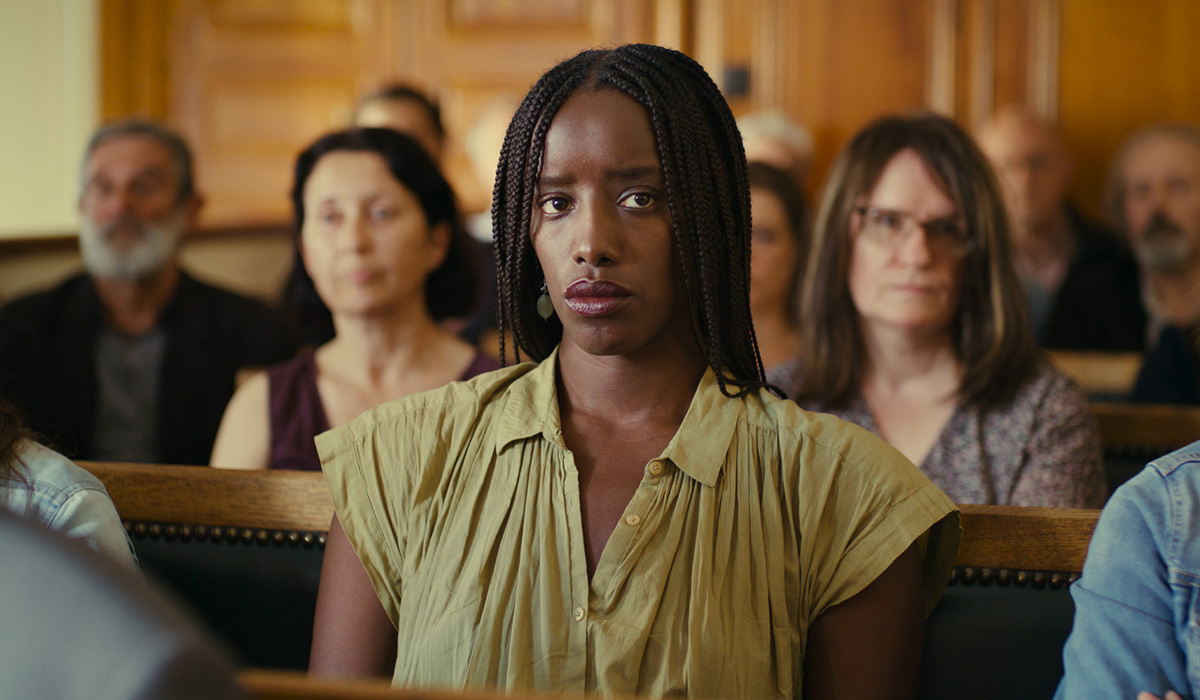 Kayije Kagame as Rama in Saint Omer (courtesy of Palace Films).
Saint Omer is Diop’s first feature drama, though she already has a distinguished career as documentarian. Diop was raised in the working-class suburbs of Paris (she is unrelated to the late, celebrated Senegalese filmmaker Djibril Diop Mambéty), and it is to these suburbs that she has returned over and again in her lyrical and intimate documentaries, including Nous (We), winner of Best Film at the 2021 Berlinale, which looks at communities living along a commuter train line, and Vers la tendresse (Towards Tenderness, 2016), in which she interviewed young working-class men about their attitudes to sex and relationships. Diop keeps her camera close to her subjects without intruding on their solitude, a balancing act that she pulls off, in part, by splitting sound and vision, often laying audio of her interviews onto contemplative shots of her subjects sitting in silence, in cafés, cars, or on the train. The gap between her subjects’ offscreen confessions and their onscreen quiet is one in which privateness, inwardness, and multiplicity thrive – no one in Diop’s films is ever reducible to stereotype. Diop is fascinated by faces (as was Duras, whom Diop has named more than once as an influence), and those faces, in repose, can be fascinating in turn, without necessarily giving much away about their bearer.
As Rama, Kagame allows emotion to show upon her face, and that face is as narrow and as grave as a Gothic carving. Rama (we are given to understand, without her ever quite saying so) feels that she is on trial as much as Laurence is; her agony is a complex mixture of recognition, sympathy, professional interest – she is planning to write a book about the trial – and visceral horror. She can’t take her eyes off Laurence, and neither can we, not only because Diop stages the courtroom proceedings in long, painterly close-ups – we have nowhere else to look – but because Malanda, with her wide, high cheekbones, makes Laurence into the picture of aristocratic mien and mask-like self-control. Unlike Rama, who, at times, practically broadcasts her inner thoughts, Laurence is a cipher, possibly even to herself. Right at the beginning, Laurence admits her guilt in the murder of her daughter, but tells the judge she doesn’t understand her own actions. ‘I hope this trial will give me the answer,’ she says.
Laurence, her lawyers and the presiding judge speak fluently and at length. Malanda’s performance, in particular, is brilliantly effective in its ambiguity: is Laurence a stony-hearted manipulator and disingenuous actor, or a woman who has done a truly terrible thing and yet can demonstrate grace in her unflinching admission of guilt? Here, Diop matches sound and vision, taking full advantage of the narrative structures built into the French legal system, where judges question witnesses and the defendant directly. And yet the accumulation of testimony carries us no closer to the truth, whatever that may be.
The legal proceedings are punctuated by Rama’s memories, and by home video footage, of her own childhood relationship with her mother, a cleaner, who struggled to raise Rama and her siblings in straitened circumstances. But the grainy video of Rama’s family – similar to the footage that Diop uses of her own family in Nous – is as unyielding, in the end, as the court testimony. There are no answers, only frameworks for viewing events – including France’s post-colonial history, class mobility and immobility, myth, witchcraft, the exhaustion of motherhood and more – none of which is definitive. Diop based Saint Omer on a real-life case, and Rama is a kind of stand-in for the director: Diop, too, was obsessed with the (real) trial, and went along to watch it, casting herself into the role of – what? – witness, spectator, voyeur, detective, judge? All or none of these? The unresolved anxieties of her looking she now gives to Rama, and by extension, to us. The inevitable glance between Laurence and Rama is alone worth witnessing: a hair-raising moment that, depending on how you view the woman in the defendant’s box, will either confirm your worst thoughts or startle you into new ones.
Diop’s conclusion of the courtroom drama – which is not quite the end of the film – is uncharacteristically schematic for a director so thoughtful. A long speech delivered by Laurence’s barrister (Aurélia Petit) directly to camera takes us back, by implication, to those shamed, shunned collaborators at the film’s outset – those monstrous and monstered women – in a way that lessens the vividness, urgency, and variousness of the film’s other currents. It is a plea for sympathy, for staying our judgement, that tips into sentimentality. This false note aside, Saint Omer is a complex, provocative, at times exhausting film – and you will see it in your mind long after it ends.
Saint Omer (Palace Films) will be on national release from 25 May 2023.