


- Free Article: No
- Contents Category: Film
- Custom Article Title: The Teachers' Lounge
- Review Article: Yes
- Article Title: The Teachers' Lounge
- Article Subtitle: Ilker Çatak’s arresting new film
- Online Only: No
- Custom Highlight Text:
Frau Carla Nowak (Leonie Benesch) stands in front of her class. A student volunteers a solution to the mathematical problem on the board. Carla responds, ‘Is that proof, or an assertion?’ This question will come to haunt Carla later, when it re-emerges in the school’s socio-political context, far messier than mathematics.
- Article Hero Image (920px wide):
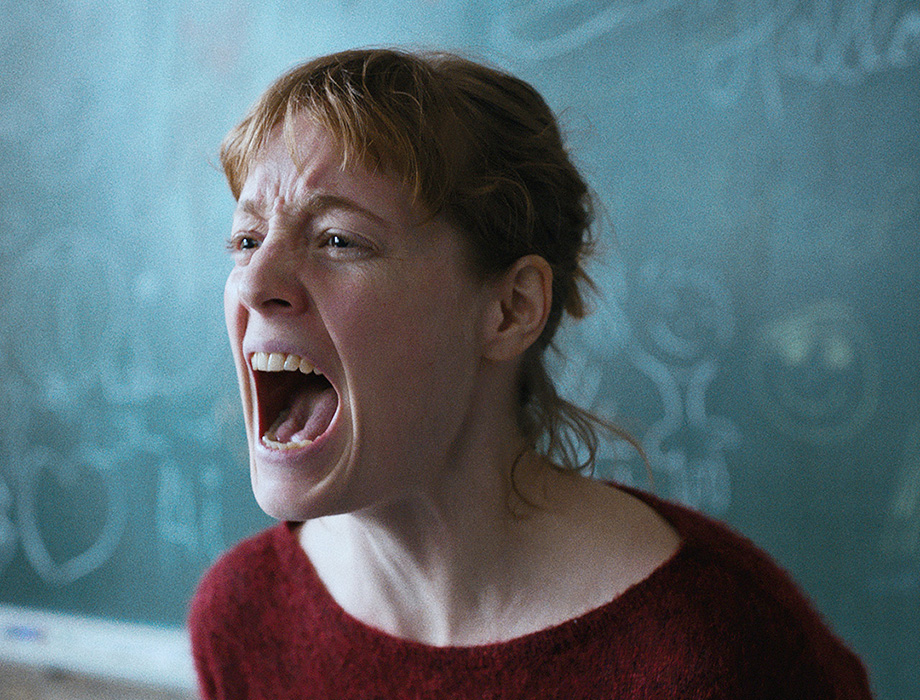
- Article Hero Image Caption: Leonie Benesch as Frau Carla Nowak in The Teachers' Lounge (courtesy of Palace Films).
- Alt Tag (Article Hero Image): Leonie Benesch as Frau Carla Nowak in The Teachers' Lounge (courtesy of Palace Films).
- Production Company: German Film Festival
We cringe, during a distinctly awkward moment, when the head teacher insists that the parents of the (falsely) accused Ali speak German. Later in the film, Carla asks a colleague, who shares her heritage, not to speak Polish with her, for the sake of the other teachers; ironically, Poles in Germany are often the butt of racist jokes, stereotyped as thieves. At this stage, it seems obvious that the school setting will function as a microcosm for the director’s critique of broader society. Çatak is playing with issues of race and class, which continue to cause disunity in contemporary Germany.
But the apparent racial tensions that open the film are something of a red herring. What follows is an uneasy depiction of living and acting morally, on a more fundamental level. The central intrigue extends beyond simple analogies, but the themes of denunciation, spying, reporting, suspicion, censorship, and surveillance are all loaded terms that resonate with Germany’s recent history.
The Teachers’ Lounge, however, is more preoccupied with contemporary concerns. The school represents the ‘average’, modern German Gymnasium – it is neither particularly privileged nor disadvantaged. Çatak uses the perceived neutrality of this setting to ask us what happens when we accidentally compromise our integrity.
Carla is introduced to us as a young, idealistic, skilled teacher. We are encouraged to identify with her through a series of dolly shots, her face purposeful as she strides along the corridors managing her responsibilities capably and swiftly. Her confident manner towards both students and parents indicates a maturity that belies her youthful looks. Her students aren’t all adoring; they test her boundaries, for example, by sneaking off for a smoke during her PE class. But she has their respect; they respond to her call-and-response clapping routine when she needs to regain order in the classroom – to begin with, at least.
Things begin to go wrong for Carla when, seeking to clear Ali’s name, she makes a snap decision. In setting a trap to catch the school’s thief, she has succumbed to the pervasive culture of surveillance and suspicion that stems from the school’s declared ‘zero tolerance policy’.
Çatak’s direct, penetrating critique is reminiscent of Ruben Östlund’s recent films The Square (2017) and Triangle of Sadness (2022). In a brilliant sequence, Carla finds her interview for the student-run magazine quickly spiralling out of control. A friendly puff-piece morphs into a sophisticated grilling. The precocious students’ sharp, witty repartee makes for a clever pastiche of the modern media’s role in endorsing particular ‘truths’. Getting laughs is not Çatak’s main aim. In contrast with Östlund’s work, The Teachers’ Lounge’s weapon of choice is not satire, but an atmosphere of suspenseful dread.
This sense is powerfully evoked during parent–teacher night when Carla’s presentation is interrupted by a parent arriving late and bearing accusations, like Banquo’s ghost. With this Shakespearian ‘hallucination’, her authority wavers and threatens to crumble; there is something decidedly theatrical about The Teachers’ Lounge. In part, this derives from the restrained setting, which calls for big performances from the cast. The film’s realist approach might have called for the absence of a soundtrack, but the repetitive, insistent strings of the orchestral score both reinforce the tension and underpin the theatrical quality of the drama.
Once Upon a Time … Indianerland (2017), Çatak’s first full-length offering was a coming-of-age romp, mashing up genres. With I Was, I Am, I Will Be (2019) and Stambul Garden (2021), he pursued a genuine and unflashy art of storytelling, seeking dramatic intensity by focusing on his characters. In conceptualising The Teachers’ Lounge, the director continues the trajectory that has been developing across his previous features, both refining and reducing the formal qualities of his cinema. Çatak refrains from flamboyant cinematography. Instead, the determinedly realistic mise en scène envelops our perception of the film’s characters. The world of the film is the familiar one of a school: corridors, desks, notebooks, and chalk. More pertinent for teachers are the staff-room politics, bullying, power struggles, and pushy parents. We are sent reeling through this everyday landscape, buffeted by a kind of centrifugal force that propels the drama, spinning Carla into panic and fragmenting her deeply held values.
Çatak’s directorial début was a bubble-gum riot of colour. In The Teachers’ Lounge, he has so intensely reduced the stylistic components that a simple shot of a glass of water, passed from teacher to student, manages to visually capture the scene’s full emotional power. There is a poetic beauty in those bubbles clinging to the glass, under pressure and longing to surface, reflecting the film’s suffocation and its moral precarity.
The Teachers’ Lounge, part of the German Film Festival, is screening nationally until 21 May 2023.